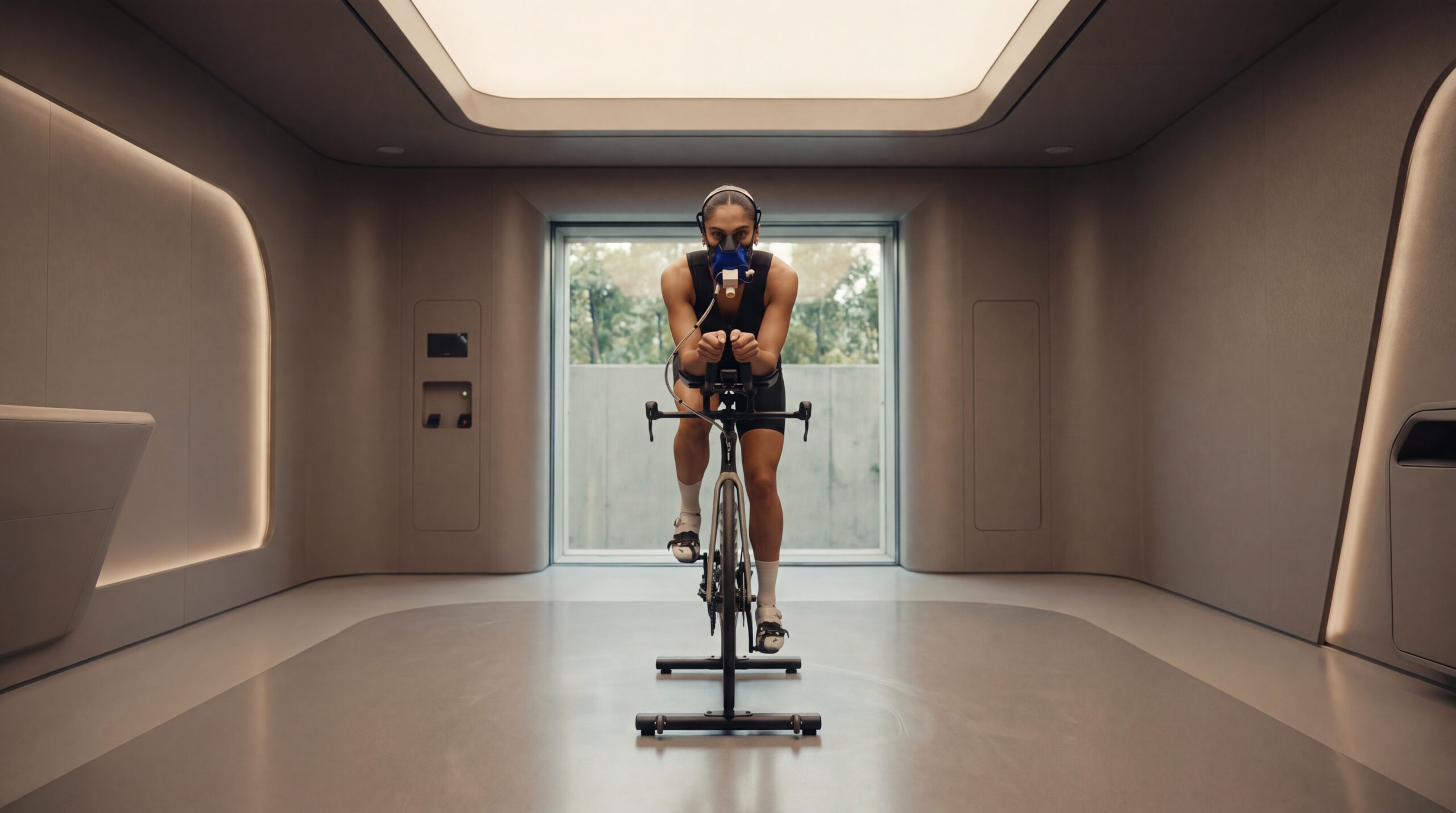
Your cycling VO2 max is one of the most important performance metrics you can measure as a rider. It determines the absolute ceiling of aerobic power you can produce on the bike — the upper limit of oxygen your body can deliver and use while pedaling. Every watt you generate at threshold, every hill you climb, and every breakaway you hold is ultimately constrained by this number.
But cycling VO2 max is not the whole picture. Power-to-weight ratio, functional threshold power (FTP), ventilatory thresholds, and pedaling economy all interact with your aerobic ceiling to determine real-world results. Understanding those relationships — and knowing which metric is currently your limiter — is what separates targeted training from random interval sessions.
This guide covers why cycling VO2 max matters across disciplines, how to test it properly on the bike, what scores to target at every level, and the workouts that raise it most effectively.
Why Your Cycling VO2 Max Matters at Every Level
Your cycling VO2 max determines the maximum rate of aerobic energy production available to you on the bike. It sets the upper limit of sustainable power before your body shifts to anaerobic pathways — producing lactate, accumulating fatigue, and forcing you to back off.
Power, Efficiency, and the Aerobic Ceiling
For cyclists, VO2 max is most useful when expressed alongside power output. Two key metrics bridge the gap between oxygen and watts:
Power at VO2 max (pVO2max) is the wattage you produce at your aerobic ceiling. Two cyclists with an identical cycling VO2 max may produce different power outputs if their efficiency differs — which is why testing both matters.
Functional Threshold Power (FTP) is the highest power you can sustain for roughly one hour, typically falling at 72–80% of pVO2max in trained riders. A higher cycling VO2 max raises the absolute wattage at every percentage of utilization, making your FTP higher even if the fraction stays the same.
Power-to-weight ratio (W/kg) is the defining metric for climbing. Since VO2 max is also expressed per kilogram, the relationship is direct: improving your cycling VO2 max — through increased aerobic capacity or reduced body fat — directly improves your W/kg.
How It Plays Out by Discipline
Road racing and criteriums: A high cycling VO2 max is critical for repeated surges — attacking, bridging, and responding to accelerations that spike oxygen demand to near-maximal levels.
Time trialing: Sustained output at 85–95% of VO2 max for 20–60 minutes. Your cycling VO2 max sets the ceiling; FTP and thresholds determine how close you can ride to it.
Climbing: Relative cycling VO2 max (mL/kg/min) is the dominant factor on long climbs. Elite professional climbers typically record 75–85+ mL/kg/min combined with very low body weight.
Gravel and ultra-endurance: Your cycling VO2 max sets the aerobic foundation, but metabolic flexibility — how efficiently you burn fat at moderate intensities — becomes relatively more important. Both are measured during a metabolic test.
What Is a Good Cycling VO2 Max?
Cycling VO2 max benchmarks vary by age, sex, and competitive level. Because cycling is weight-supported, absolute VO2 max (L/min) matters alongside relative VO2 max (mL/kg/min) — especially for flat racing and time trialing.
Male Benchmarks
| Level | VO2 Max (mL/kg/min) | Approximate FTP (W/kg) |
| Recreational | 35–45 | 2.0–3.0 |
| Fitness cyclist | 45–55 | 3.0–3.8 |
| Competitive amateur | 55–65 | 3.8–4.5 |
| Cat 1 / elite amateur | 65–72 | 4.5–5.2 |
| Professional | 72–85+ | 5.2–6.5+ |
Female Benchmarks
| Level | VO2 Max (mL/kg/min) | Approximate FTP (W/kg) |
| Recreational | 30–38 | 1.8–2.5 |
| Fitness cyclist | 38–48 | 2.5–3.2 |
| Competitive amateur | 48–58 | 3.2–4.0 |
| Cat 1 / elite amateur | 58–65 | 4.0–4.8 |
| Professional | 65–77+ | 4.8–5.8+ |
FTP estimates assume reasonable cycling efficiency. Individual values vary with economy, body composition, and training history.
Professional male road cyclists typically record a cycling VO2 max of 75–85 mL/kg/min, with grand tour climbers at the upper end. Professional women typically range from 60–72 mL/kg/min. The highest recorded values approach 90+ mL/kg/min in exceptional cases.
Worth noting: some world-class cyclists succeed with “merely” excellent scores by compensating with superior economy and threshold capacity. Your cycling VO2 max is the ceiling — but efficiency and sustainability determine how much of it you can actually use in a race.

How to Test Your Cycling VO2 Max
The most useful test is performed on a cycle ergometer or smart trainer with breath-by-breath gas analysis. Treadmill testing is not interchangeable — your cycling VO2 max will typically be 5–12% lower than a treadmill score because of the different muscle groups and biomechanics involved. Training zones from a running test will overestimate your capacity on the bike.
What a Bike-Based Test Provides
A cycling-specific metabolic test gives you data that no FTP test, ramp test, or wearable can match:
- Your true cycling VO2 max measured under the conditions you actually train and race in
- Power at VO2 max (pVO2max) — the exact wattage that defines your aerobic ceiling on the bike
- Ventilatory thresholds (VT1 and VT2) — translating directly into accurate cycling training zones
- Fat-burning profile — the power output where you burn the most fat, critical for endurance pacing
- Cycling economy — oxygen consumed per watt, revealing your pedaling efficiency
- Resting metabolic rate (RMR) — for nutrition planning and weight management
PNOĒ for Testing Cycling VO2 Max
PNOĒ’s portable metabolic analyzer tests your cycling VO2 max on any stationary bike or smart trainer, measuring breath-by-breath gas exchange with clinical precision (validated at r = 0.98 against gold-standard lab systems). A single 10-minute test generates 23 biomarkers and an AI-driven training and nutrition plan personalized to your physiology on the bike.
For riders using power meters, PNOĒ calibrates power-based training zones to your actual ventilatory thresholds — not the estimated zones from an FTP test, which cannot identify your cycling VO2 max or metabolic thresholds with the same precision.
The Best Workouts to Improve Your Cycling VO2 Max
Improving your cycling VO2 max requires accumulated time at or near your aerobic ceiling on the bike. These four protocols are the most effective and well-researched options.
4×4-Minute Intervals
4 minutes at 90–95% of max heart rate (approximately 90–100% of pVO2max), followed by 3 minutes of easy spinning. Repeat 4 times. This accumulates 16 minutes near VO2 max intensity and produces 7–15% improvement over 8–12 weeks when performed twice weekly alongside base volume.
5×3-Minute Intervals
3 minutes at 95–100% of pVO2max, followed by 3 minutes easy. Repeat 5 times. Shorter work intervals allow higher average power — useful when your cycling VO2 max is limited by peripheral (muscular) rather than central (cardiac) factors.
30/15 Microintervals
30 seconds at 120–130% of FTP, 15 seconds easy spinning. Repeat for 10–15 minutes, rest 5 minutes, then repeat. These keep oxygen consumption elevated near VO2 max throughout the block because the brief recovery prevents significant heart rate drop-off. Psychologically manageable and highly effective for building cycling VO2 max.
Hill Repeat Intervals
Find a 3–6 minute climb at 5–10% gradient. Ride at 90–100% of pVO2max, recover on the descent. Repeat 4–6 times. Climbing naturally elevates power demand and oxygen consumption, making hill repeats one of the most sport-specific ways to build cycling VO2 max.
How Often?
Two sessions per week targeting your cycling VO2 max is the evidence-supported frequency. The remaining volume should be Zone 2 endurance rides — 75–80% of weekly hours. This polarized model consistently outperforms a “sweetspot all the time” approach for raising the aerobic ceiling, though sweetspot training has its place for FTP development.
Training Your Cycling VO2 Max by Race Goal
Road racing: Prioritize 2 VO2 max sessions per week (4×4 and 30/15 microintervals), add 1 threshold session, and fill the rest with endurance rides. Simulate race demands through group rides with irregular surges.
Time trialing: A higher cycling VO2 max raises the ceiling from which FTP is derived. Include 1 VO2 max session and 1–2 threshold sessions per week during the build phase.
Climbing: Where cycling VO2 max relative to body weight matters most. Hill repeat intervals are the most specific stimulus. Pair with body composition management guided by measured RMR — losing non-functional mass while preserving muscle and metabolic rate.
Masters cyclists (40+): The same training principles apply with increased emphasis on recovery, strength work to counteract sarcopenia, and periodic metabolic testing to track how your cycling VO2 max responds to age-related changes.
Nutrition That Supports Your Cycling VO2 Max
Fuel the hard sessions. VO2 max intervals deplete glycogen fast. A carb-rich meal 2–3 hours before and intra-workout carbohydrate (30–60g/hour) for sessions over 60 minutes ensures you can sustain the intensity that drives adaptation.
Optimize fat burning for endurance. A PNOĒ test identifies your crossover point — the power output where your body shifts from fat to carbohydrate as the primary fuel. Training at and below this power improves fat oxidation, delaying glycogen depletion on long rides.
Eat enough. Chronic underfueling is endemic in cycling culture. Metabolic testing measures your actual RMR, ensuring caloric intake supports training adaptation and cycling VO2 max improvement rather than driving metabolic suppression.
Monitor iron. Iron deficiency reduces oxygen-carrying capacity and can suppress your cycling VO2 max by 5–10%, even without clinical anemia. Check ferritin levels regularly.
Common Mistakes That Stall Cycling VO2 Max Improvement
Using FTP as a proxy for VO2 max zones. FTP tests estimate threshold power but do not measure your cycling VO2 max, ventilatory thresholds, or metabolic data. Zones derived from FTP are approximations — metabolic testing provides the actual numbers.
Too much sweetspot, not enough VO2 max work. Sweetspot (88–93% FTP) develops threshold but is a suboptimal stimulus for raising the aerobic ceiling. If your cycling VO2 max is the limiter, you need time at 90–100% intensity — not slightly below threshold.
Easy rides that aren’t easy. Many cyclists turn every ride into a moderate effort that compromises recovery and reduces the quality of hard sessions. Accurate Zone 2 boundaries from a metabolic test ensure your easy rides are genuinely easy — protecting the adaptation from your VO2 max work.
Aggressive dieting. Excess body fat lowers relative VO2 max and W/kg. But rapid weight loss sacrifices muscle, reduces training capacity, and triggers metabolic slowdown. Metabolic testing guides the balance — helping you lose fat without losing your cycling VO2 max in the process.
Never testing. Training by feel, FTP estimates, or wearable scores leaves significant performance on the table. A cycling-specific metabolic test provides the data that separates good training from optimal training.
Start Riding Faster With Metabolic Testing
Your cycling VO2 max is the most trainable performance metric available to you as a rider. Testing it on the bike — with breath-by-breath gas analysis — gives you the data to train with precision, fuel with accuracy, and measure real physiological improvement rather than guessing from power estimates.
A 10-minute PNOĒ test delivers your cycling VO2 max, pVO2max, ventilatory thresholds, fat-burning profile, RMR, and a personalized plan — all from a single breath test on any bike or smart trainer.
→ Back to the complete VO2 max guide
References
- Lucía A, Hoyos J, Chicharro JL. “Physiology of Professional Road Cycling.” Sports Medicine. 2001;31(5):325–337. https://pubmed.ncbi.nlm.nih.gov/11347684/
- Helgerud J, Høydal K, Wang E, et al. “Aerobic High-Intensity Intervals Improve VO2max More Than Moderate Training.” Medicine & Science in Sports & Exercise. 2007;39(4):665–671. https://pubmed.ncbi.nlm.nih.gov/17414804/
- Rønnestad BR, Hansen J, Ellefsen S. “Block Periodization of High-Intensity Aerobic Intervals Provides Superior Training Effects in Trained Cyclists.” Scandinavian Journal of Medicine & Science in Sports. 2014;24(1):34–42. https://pubmed.ncbi.nlm.nih.gov/22646668/
- Seiler S. “What Is Best Practice for Training Intensity and Duration Distribution in Endurance Athletes?” International Journal of Sports Physiology and Performance. 2010;5(3):276–291. https://pubmed.ncbi.nlm.nih.gov/20861519/
- Tsekouras YE, Tambalis KD, Sarras SE, et al. “Validity and Reliability of the New Portable Metabolic Analyzer PNOE.” Frontiers in Sports and Active Living. 2019;1:24. https://www.frontiersin.org/journals/sports-and-active-living/articles/10.3389/fspor.2019.00024/full
- Mandsager K, Harb S, Cremer P, et al. “Association of Cardiorespiratory Fitness With Long-term Mortality Among Adults Undergoing Exercise Treadmill Testing.” JAMA Network Open. 2018;1(6):e183605. https://jamanetwork.com/journals/jamanetworkopen/fullarticle/2707428
- Bassett DR, Howley ET. “Limiting Factors for Maximum Oxygen Uptake and Determinants of Endurance Performance.” Medicine & Science in Sports & Exercise. 2000;32(1):70–84. https://pubmed.ncbi.nlm.nih.gov/10647532/
Related Posts

Repeated Sprint Ability: Why Soccer Is Really an Aerobic Sport
Soccer Player VO2 Max: How World Cup Athletes Compare to You
Brain Fog and Metabolism: What Your Breath Reveals About Focus