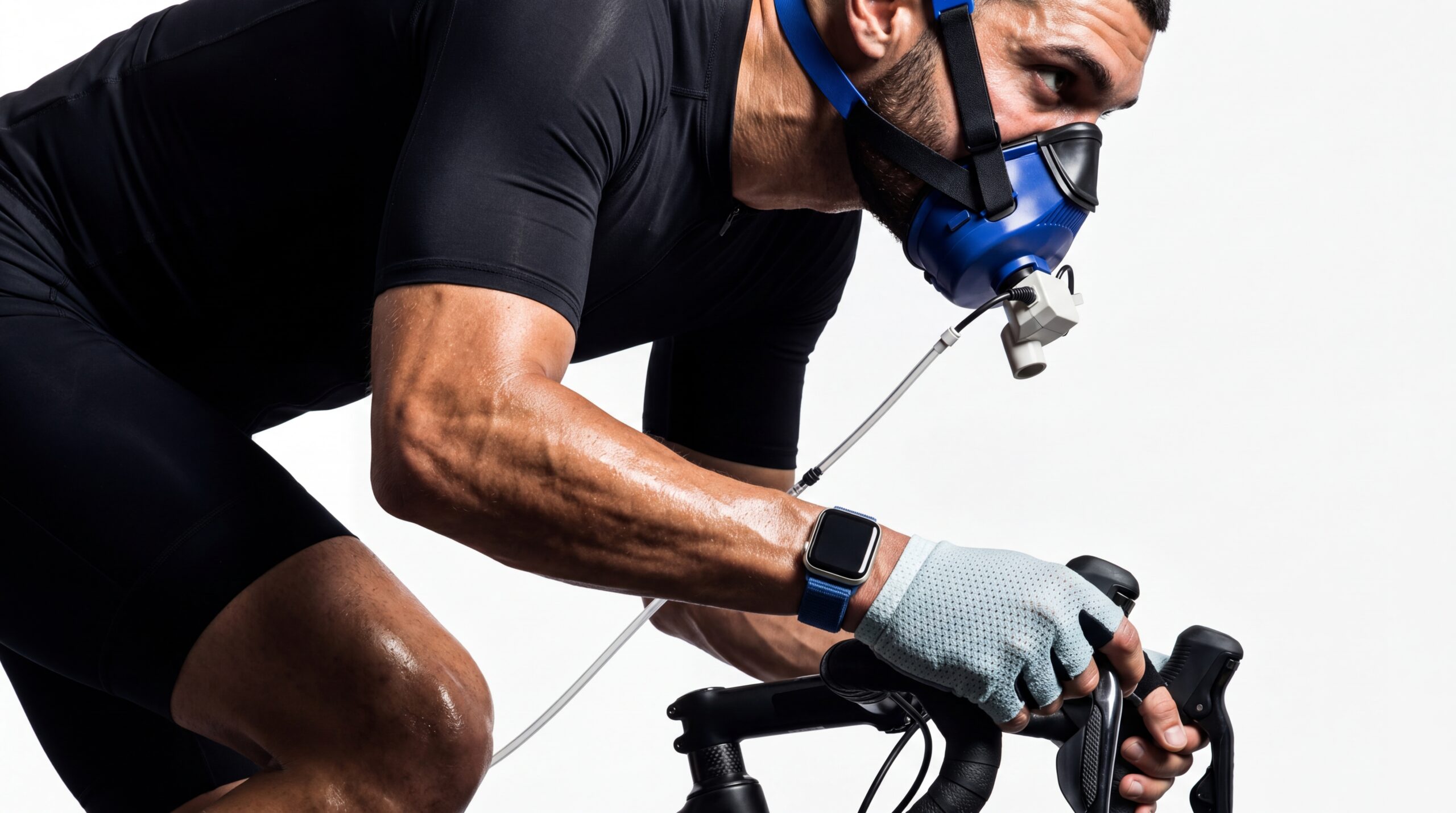
If you own a smartwatch, you probably have a VO2 Max number on your wrist right now. Apple Watch, Garmin, Fitbit, WHOOP, Polar, and COROS all display a VO2 Max score — and for millions of users, this is the only VO2 Max data they’ve ever seen. But how good is wearable VO2 Max accuracy, really? Can you use that number to set training zones, track real fitness progress, or make health decisions?
This guide compares wearable VO2 Max accuracy across every major platform, explains the science behind how smartwatches estimate VO2 Max, identifies the specific situations where scores are unreliable, and shows what clinical-grade breath testing provides that no wearable can.
How Do Smartwatches Estimate VO2 Max?
No consumer wearable actually measures VO2 Max. The term “measures” implies direct assessment of oxygen consumption — and no smartwatch contains a gas analyzer. Instead, wearables estimate VO2 Max using algorithms that correlate heart rate data with movement data during physical activity.
The Algorithm Behind Wearable VO2 Max
The fundamental relationship that wearable VO2 Max algorithms exploit is the well-established linear correlation between heart rate and oxygen consumption during submaximal exercise. A person who maintains a lower heart rate at a given running pace likely has a higher VO2 Max than someone with a higher heart rate at the same pace.
Wearables capture your heart rate (via optical sensor) and your movement speed (via GPS for outdoor activities, or accelerometer for indoor movement). Proprietary algorithms combine these inputs with your user profile data (age, sex, height, weight) to generate an estimated VO2 Max score using regression models derived from population-level datasets.
Each manufacturer uses a different algorithm:
Garmin uses Firstbeat Analytics (now part of Garmin), which analyzes the heart rate–pace relationship during outdoor runs and walks. Garmin’s VO2 Max estimate updates after GPS-tracked outdoor activities that meet minimum duration and intensity requirements.
Apple Watch estimates VO2 Max (displayed as “Cardio Fitness” in the Health app) using heart rate data during outdoor walks, runs, and hikes. Apple’s algorithm reportedly incorporates multiple data points including walking heart rate, walking speed, and heart rate recovery.
WHOOP estimates VO2 Max using a combination of resting heart rate, heart rate variability (HRV), physiological data, and activity metrics. WHOOP’s approach differs from Garmin and Apple in that it does not require a specific outdoor exercise session.
Fitbit estimates VO2 Max (displayed as “Cardio Fitness Score”) using heart rate data during runs, calibrated to demographic data.
Polar estimates VO2 Max through its “Fitness Test” feature (a resting assessment using HRV) and through exercise-based analysis during tracked activities.
How Accurate Is Wearable VO2 Max? What the Research Shows
A systematic review and meta-analysis by the INTERLIVE consortium — the largest study of its kind — evaluated wearable VO2 Max accuracy against gold-standard laboratory measurements. The findings paint a complex picture of how much you can actually trust that number on your wrist.
Overall Wearable VO2 Max Accuracy
Wearables using exercise-based algorithms (requiring an outdoor activity) show a near-negligible average systematic error — approximately 0.09 mL/kg/min — which sounds impressive. However, the random error is substantial: limits of agreement of approximately ±9.83 mL/kg/min. This means that for any individual, the wearable VO2 Max estimate could be 5–10 mL/kg/min above or below the actual laboratory-measured value.
Wearables using resting-based algorithms show even wider variation, with an average overestimation of 2.17 mL/kg/min and limits of agreement of approximately ±15.24 mL/kg/min.
In practical terms: if your actual lab-measured VO2 Max is 45 mL/kg/min, your wearable might display anything from 35 to 55 on any given day. The average across many measurements may be close to correct, but individual readings carry significant uncertainty — which is why wearable VO2 Max accuracy should be understood as directional, not clinical.
Apple Watch VO2 Max Accuracy
Apple Watch VO2 Max estimates (Cardio Fitness) use walking and running heart rate data. Research shows reasonable correlation with lab values at the population level, but individual Apple Watch VO2 Max accuracy varies. It tends to be less accurate for:
- Very fit individuals (VO2 Max underestimated)
- Sedentary individuals (VO2 Max overestimated)
- Users taking heart rate–affecting medications (beta-blockers, calcium channel blockers)
- Indoor activities (no GPS data available for pace calculation)
Apple Watch VO2 Max accuracy improves over time as the algorithm accumulates more data from your activities, but individual readings should be treated as estimates, not measurements.
Garmin VO2 Max Accuracy
Garmin’s Firstbeat-based VO2 Max estimate is among the most studied in the wearable space. Research shows typical agreement within 5–10% of lab values for moderately trained individuals performing outdoor runs. Garmin VO2 Max accuracy is generally stronger during running than cycling (where Garmin requires a power meter for estimation).
Garmin VO2 Max accuracy weaknesses include beginners and very unfit individuals (algorithms calibrated on moderately active populations), elite athletes (Garmin frequently underestimates very high VO2 Max values), heat, altitude, and illness (environmental factors affect heart rate independent of fitness), and atypical heart rate responders (naturally high or low max HR individuals).
WHOOP VO2 Max Accuracy
WHOOP estimates VO2 Max using physiological data, activity metrics, and demographic information rather than requiring a specific outdoor exercise test. This approach offers convenience but comes with a trade-off: WHOOP’s VO2 Max accuracy relies more heavily on resting physiological indicators and proprietary modeling, which research suggests produces wider confidence intervals than exercise-based estimates.
WHOOP excels at tracking recovery, strain, and HRV — but its VO2 Max score should be interpreted as a general fitness indicator rather than a clinical measurement.
Fitbit and Polar VO2 Max Accuracy
Fitbit and Polar both provide reasonable VO2 Max estimates for their target markets (general fitness tracking), but face similar limitations to other wearable algorithms: reliance on heart rate–pace relationships, population-level calibration, and inability to capture the physiological variables that drive VO2 Max at the individual level. Their wearable VO2 Max accuracy falls within the same ±5–10 mL/kg/min range seen across the category.
What Wearable VO2 Max Estimates Cannot Tell You
Regardless of how accurate the number itself is, every wearable VO2 Max estimate shares the same fundamental limitation: it provides a single number without any physiological context. Understanding the gap between wearable VO2 Max accuracy and clinical VO2 Max testing is about more than the number — it’s about the depth of actionable information.
Wearable VO2 Max: What You Get
- An estimated VO2 Max number (mL/kg/min)
- Trend tracking over time (is the number going up or down?)
Clinical VO2 Max Test (PNOĒ): What You Get
- Directly measured VO2 Max — not estimated, not algorithmically derived, but measured from the oxygen and CO2 in your breath
- Resting metabolic rate (RMR) — your exact caloric burn at rest, impossible for any wearable to measure
- Ventilatory thresholds (VT1 and VT2) — precise training zone boundaries based on gas exchange, not heart rate formulas
- Fat oxidation rate and crossover point — the exercise intensity at which you burn the most fat
- Respiratory exchange ratio (RER) — your metabolic flexibility, indicating how efficiently your body switches between fat and carbohydrate fuel sources
- O2 pulse — cardiovascular efficiency per heartbeat, a direct indicator of cardiac function
- VE/VCO2 — ventilatory (lung) efficiency, which may reveal respiratory limitations invisible to any wearable
- Biological age — calculated from your measured VO2 Max relative to population norms
- Oxygen chain analysis — identifies whether your lungs, heart, or cells are the specific system limiting your VO2 Max
- AI-generated training and nutrition plans — personalized to your measured metabolic data

When Wearable VO2 Max Is Useful (and When It’s Not)
Wearable VO2 Max Is Useful For:
Long-term trend tracking. If your wearable VO2 Max score increases consistently over several months, your aerobic fitness is almost certainly improving. The absolute number may be wrong, but the direction of change is meaningful.
Daily motivation and accountability. Seeing a fitness score on your wrist encourages consistent activity. For people who are not athletes and simply want to stay active, wearable VO2 Max provides a helpful reference point.
Detecting significant fitness changes. A sustained and unexplained drop in wearable VO2 Max may signal overtraining, illness, or deconditioning — prompting you to investigate further.
Wearable VO2 Max Is Not Reliable For:
Setting training zones. Training zones derived from estimated VO2 Max and age-predicted max heart rate can be off by 10–20 bpm. Months of training at incorrect intensities is the most common hidden cause of plateaus — and it’s a limitation of wearable VO2 Max accuracy that most users don’t realize.
Making health or clinical decisions. A wearable VO2 Max score should not be used to assess cardiovascular disease risk, guide cardiac rehabilitation, or make medical decisions. These applications require directly measured VO2 Max from a clinical-grade test.
Comparing your score to normative charts. VO2 Max norms are derived from laboratory measurements. Comparing a wearable estimate to lab-derived norms introduces an inherent accuracy mismatch.
Identifying your VO2 Max limiter. No wearable can tell you whether your lungs, heart, or mitochondria are the bottleneck. Without this information, training to improve VO2 Max is guesswork.
Measuring metabolic rate, fat burning, or ventilatory efficiency. These biomarkers require gas exchange measurement — which no consumer wearable performs.
The Best Approach: Wearable + Clinical VO2 Max Testing
Wearables and clinical VO2 Max testing are not competitors — they are complementary tools. The question isn’t whether wearable VO2 Max accuracy is good enough to replace clinical testing. It’s how to use both together.
Use clinical VO2 Max testing (with PNOĒ) to establish your accurate baseline, identify your physiological limiters, set precise training zones, and generate personalized training and nutrition plans. Re-test every 8–12 weeks to measure real physiological adaptation.
Use your wearable for daily tracking between clinical tests — monitoring activity levels, tracking heart rate during workouts, and observing VO2 Max trends over time.
PNOĒ integrates with Apple Watch, Garmin, WHOOP, and Fitbit through its health dashboard. Clinical VO2 Max test data calibrates your wearable tracking, making daily metrics more meaningful by anchoring them to measured physiological baselines. This combined approach gives you the precision of clinical metabolic testing with the convenience of continuous wearable monitoring.
How PNOĒ Compares to Wearable VO2 Max
| Feature | Apple Watch / Garmin / WHOOP | PNOĒ Lab-grade Test |
|---|---|---|
| VO2 Max measurement | Estimated from HR algorithms | Directly measured (breath-by-breath) |
| Accuracy vs. lab | ±5–15% individual variation | r = 0.98 correlation with gold standard |
| Resting metabolic rate | Not measured | Measured directly |
| Training zones | Estimated from age formulas | Measured from ventilatory thresholds |
| Fat oxidation data | Not measured | Measured at every intensity |
| Lung efficiency (VE/VCO₂) | Not measured | Measured directly |
| Cardiac efficiency (O₂ pulse) | Not measured | Measured directly |
| Metabolic flexibility (RER) | Not measured | Measured directly |
| Biological age | Not provided | Calculated from measured VO2 Max |
| Personalized plans | Generic recommendations | AI-generated from 23 biomarkers |
| VO2 Max limiter identification | Not possible | Identifies lungs, heart, or cells |
| Daily tracking | Continuous | Periodic (re-test every 8–12 weeks) |
Frequently Asked Questions About Wearable VO2 Max
Is Apple Watch VO2 Max accurate?
Apple Watch provides a reasonable estimate for general fitness tracking, but individual readings can vary by ±5–10 mL/kg/min from lab values. It tends to underestimate fit individuals and overestimate sedentary ones. For training zone accuracy, clinical decisions, or identifying your VO2 Max limiter, a clinical breath test is necessary.
How accurate is Garmin VO2 Max?
Garmin’s Firstbeat-based estimate is among the most studied and generally falls within 5–10% of lab values during outdoor running. However, accuracy decreases for beginners, elite athletes, and non-running activities. Garmin VO2 Max accuracy is best used for trend tracking, not absolute measurement.
Can a smartwatch replace a VO2 Max lab test?
No. Wearable VO2 Max accuracy is sufficient for general trend tracking but cannot replace the clinical-grade data a breath test provides: directly measured VO2 Max, resting metabolic rate, fat oxidation rate, ventilatory thresholds, metabolic flexibility, and limiter identification. These require gas exchange analysis that no consumer wearable performs.
Your Wearable Number Is a Starting Point, Not the Full Picture
If your Apple Watch says your VO2 Max is 42, or your Garmin says 48, or WHOOP gives you 45 — those numbers tell you something. They tell you roughly where your aerobic fitness falls and whether it’s trending up or down.
But they don’t tell you why your VO2 Max is what it is. They don’t tell you which organ system is holding you back. They can’t tell you how many calories you actually burn at rest, how efficiently you burn fat, or what your precise training zones are. And they can’t generate a personalized plan to improve your VO2 Max based on your unique physiology. These are the limits of wearable VO2 Max accuracy — and the reason clinical testing exists.
A 10-minute PNOĒ VO2 Max test provides all of this — and then your wearable becomes more useful than ever, because you have the clinical baseline to interpret what it’s telling you every day.
References
- Díaz-Martínez AE, et al. “Validity of CRF Estimated by Consumer Wearables Against Gold-Standard Methods: A Systematic Review and Meta-Analysis (INTERLIVE Consortium).” Progress in Cardiovascular Diseases. 2024. https://www.sciencedirect.com/science/article/abs/pii/S0033062024000306
- Tsekouras YE, Tambalis KD, Sarras SE, et al. “Validity and Reliability of the New Portable Metabolic Analyzer PNOE.” Frontiers in Sports and Active Living. 2019;1:24. https://www.frontiersin.org/articles/10.3389/fspor.2019.00024/full
- Alcantara JMA, et al. “Validity and Between-Days Reliability of Two Different Metabolic Systems for Measuring Gas Exchange During Walking.” Medical Engineering & Physics. 2025;136:104281. https://www.sciencedirect.com/science/article/abs/pii/S1350453324001814
- Ross R, Blair SN, Arena R, et al. “Importance of Assessing Cardiorespiratory Fitness in Clinical Practice: A Case for Fitness as a Clinical Vital Sign.” Circulation. 2016;134(24):e653–e699. https://www.ahajournals.org/doi/full/10.1161/CIR.0000000000000461
- Fuller D, Colwell E, Low J, et al. “Reliability and Validity of Commercially Available Wearable Devices for Measuring Steps, Energy Expenditure, and Heart Rate: Systematic Review.” JMIR mHealth and uHealth. 2020;8(9):e18694. https://mhealth.jmir.org/2020/9/e18694/
- Mandsager K, Harb S, Cremer P, et al. “Association of Cardiorespiratory Fitness With Long-term Mortality Among Adults Undergoing Exercise Treadmill Testing.” JAMA Network Open. 2018;1(6):e183605. https://jamanetwork.com/journals/jamanetworkopen/fullarticle/2707428
Related Posts

Repeated Sprint Ability: Why Soccer Is Really an Aerobic Sport

Soccer Player VO2 Max: How World Cup Athletes Compare to You

Brain Fog and Metabolism: What Your Breath Reveals About Focus