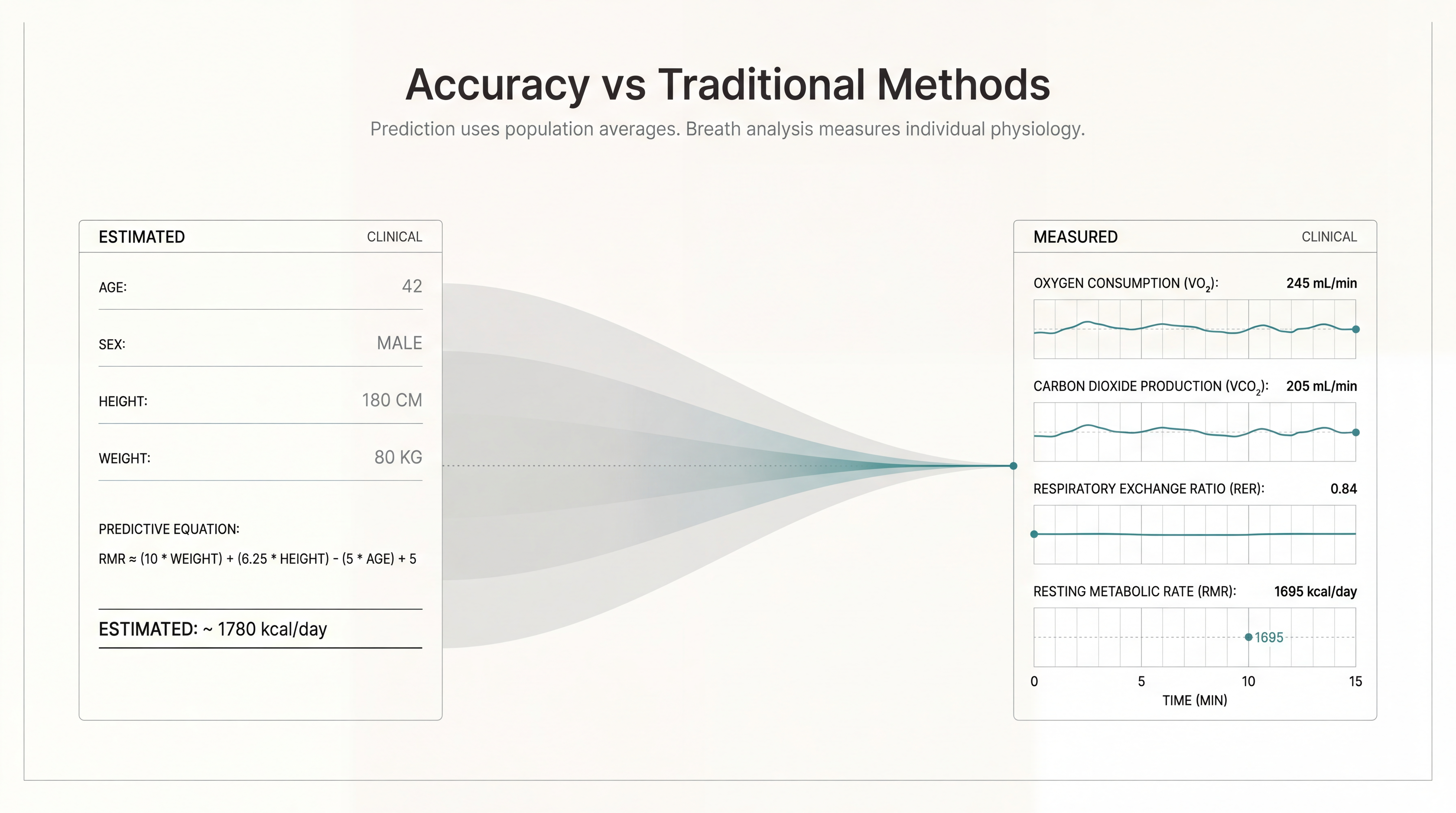
When evaluating metabolic testing accuracy, one of the most important distinctions is whether a method is measuring physiology or estimating it.
Calorie calculators, predictive equations, smartwatches, and fitness formulas can all provide useful information. But they generally use population data, demographic variables, heart rate, movement, or algorithms to estimate what is happening in an individual.
Indirect calorimetry takes a different approach. It measures oxygen consumption and carbon dioxide production and uses respiratory gas exchange to calculate energy expenditure.
Neither approach is automatically useful in every situation. The question is what level of individual physiological information you actually need.
Metabolic Testing Accuracy vs Predictive Equations
Resting-calorie calculators commonly use variables such as age, sex, body weight, and height.
For example, the widely used Mifflin-St Jeor equation was developed by measuring resting energy expenditure with indirect calorimetry in 498 individuals and then building a predictive equation from those population data.
That makes equations convenient and useful for estimating typical energy needs. But an equation still predicts where an individual is likely to fall based on the population used to create or validate it.
Studies comparing predictive equations with measured indirect calorimetry have found that prediction accuracy varies between individuals and populations. One validation study in adults with overweight or obesity found meaningful differences between measured resting energy expenditure and several commonly used predictive equations.
A resting metabolic test instead measures the individual’s respiratory gas exchange.
Put simply:
A predictive equation asks, “What would we expect for someone like you?”
Indirect calorimetry asks, “What are we measuring from you right now?”
Metabolic Testing vs Wearables
Wearables provide something metabolic testing cannot: continuous information collected during everyday life.
Smartwatches can be useful for monitoring heart rate, activity, sleep-related metrics, training patterns, and longitudinal behavior.
Energy expenditure is different.
Most consumer wearables estimate calorie expenditure using combinations of movement, heart rate, demographic information, and proprietary algorithms rather than directly measuring respiratory gas exchange.
A validation study comparing the Apple Watch 6, Polar Vantage V, and Fitbit Sense against criterion measurements found that accuracy differed by metric and activity, including variability in estimates of energy expenditure.
This does not make wearables unhelpful. When comparing wearable estimates with metabolic testing accuracy, it is important to recognize that the two methods serve different purposes and collect different types of information.
Used together, metabolic testing can establish measured physiological benchmarks while wearable data provides continuous context between assessments.
What About Estimated VO2 Max?
Many watches and fitness platforms now provide an estimated VO2 Max.
These estimates can be useful for monitoring trends, particularly when conditions remain similar over time.
During a metabolic exercise assessment, however, oxygen consumption is measured directly from respiratory gases while exercise workload increases. Carbon dioxide production and ventilation are collected at the same time, providing information about the integrated cardiorespiratory and metabolic response to exercise.
Professional cardiopulmonary exercise-testing guidance emphasizes standardized gas-exchange measurement, appropriate protocols, monitoring, quality assurance, and interpretation rather than relying on a single estimated fitness metric.
This becomes especially relevant when the goal extends beyond VO2 Max to individualized training zones, ventilatory thresholds, fuel use, or broader exercise response.

Can Portable Metabolic Testing Be Accurate?
Portable does not automatically mean less accurate, just as laboratory size alone does not establish validity.
When evaluating metabolic testing accuracy, a metabolic analyzer should be compared with an appropriate reference system and assessed for both validity and reliability.
PNOĒ has undergone peer-reviewed comparison with established metabolic-analysis systems.
In one study involving 22 participants, PNOĒ was compared with the stationary COSMED Quark CPET. Researchers reported high test-retest reliability for VO2, VCO2, ventilation, and respiratory quotient and concluded that PNOĒ accurately determined respiratory gases across the exercise intensities studied in healthy individuals under controlled laboratory conditions.
A second study published in 2025 compared PNOĒ with the portable COSMED K5 during a four-stage treadmill walking protocol. The authors concluded that PNOĒ was a valid and reliable measure of the cardiometabolic outcomes examined and was comparable with the K5 under those study conditions.
These findings support the measurement technology while also illustrating an important principle: validation claims should remain tied to the populations, protocols, and conditions actually studied.
Accuracy Also Depends on the Testing Protocol
Even a validated device cannot compensate for inconsistent testing conditions.
For resting assessments, recent exercise, food intake, stimulants, movement, stress, and whether the client reaches an appropriate resting state may influence the result.
Indirect-calorimetry research also emphasizes the importance of reaching a stable measurement period before interpreting resting energy expenditure.
For exercise testing, appropriate equipment preparation, mask fit, workload progression, client effort, monitoring, and data-quality review all matter.
This is why metabolic testing accuracy depends on both the analyzer and the testing protocol.
Measurement and Estimation Both Have a Role
There is no need to treat every estimate as useless.
Predictive equations are fast and accessible. Wearables provide valuable longitudinal information. Fitness algorithms make basic tracking available to millions of people.
But when the goal is to understand an individual’s actual resting energy expenditure, respiratory response, oxygen consumption, or fuel-utilization pattern, direct respiratory measurement provides information that generalized estimates cannot reproduce in exactly the same way.
The most useful approach is often to combine them.
A metabolic assessment can establish a measured baseline. Wearables and other data can help monitor what happens between tests. Retesting can then determine whether physiology itself has changed.
That distinction – measurement versus estimation – is ultimately the most useful way to think about metabolic testing accuracy.
Frequently Asked Questions
Is metabolic testing more accurate than a calorie calculator?
They use different methods. A calorie calculator estimates resting energy expenditure using a population-derived equation. Indirect calorimetry measures respiratory gases and calculates energy expenditure from the individual’s measured VO2 and VCO2.
Are smartwatch calorie estimates accurate?
Accuracy varies by device, activity, and individual. Consumer devices generally estimate energy expenditure rather than directly measuring respiratory gas exchange.
Why might two metabolic tests give different results?
Metabolism itself can change, and differences in preparation, recent exercise, food intake, equipment setup, exercise protocol, effort, and measurement stability can also affect results. Consistent testing conditions are particularly important when comparing results over time.
Move From Estimates to Measured Physiology
Estimates are useful when convenience is the priority. Measurement becomes more valuable when personalization requires a clearer picture of individual physiology.
Learn more about PNOĒ metabolic testing and how validated breath analysis can support more individualized nutrition, training, performance, and health decisions.
See How PNOĒ Fits Into Your Facility
Sources
- Weir JB de V. New Methods for Calculating Metabolic Rate With Special Reference to Protein Metabolism. Journal of Physiology. 1949.
PubMed – PMID 15394301
DOI: https://doi.org/10.1113/jphysiol.1949.sp004363 - Mifflin MD, St Jeor ST, Hill LA, Scott BJ, Daugherty SA, Koh YO. A New Predictive Equation for Resting Energy Expenditure in Healthy Individuals. American Journal of Clinical Nutrition. 1990.
PubMed – PMID 2305711
DOI: https://doi.org/10.1093/ajcn/51.2.241 - Al-Domi H, et al. Validation of Predictive Equations for Resting Energy Expenditure Compared With Indirect Calorimetry. 2020.
PubMed – PMID 31971355
DOI: https://doi.org/10.15586/jptcp.v27i1.653 - Hajj-Boutros G, Landry-Duval MA, Comtois AS, Gouspillou G, Karelis AD. Wrist-Worn Devices for the Measurement of Heart Rate and Energy Expenditure: A Validation Study. European Journal of Sport Science.
PubMed – PMID 34957939
DOI: https://doi.org/10.1080/17461391.2021.2023656 - Pritchard A, et al. ARTP Statement on Cardiopulmonary Exercise Testing 2021. BMJ Open Respiratory Research.
PubMed – PMID 34782330 - Tsekouras YE, et al. Validity and Reliability of the New Portable Metabolic Analyzer PNOE.
PubMed – PMID 33344948
Full text – PMC - Kwok MMY, Ng SSM, Myers J, So BCL. Assessing the Validity and Reliability of the PNOE for Measuring Cardiometabolic Outcomes During Walking Exercise. 2025.
PubMed – PMID 40407443
Full text – PMC
DOI: https://doi.org/10.3390/jfmk10020159 - Fullmer S, et al. Approximate Time to Steady-State Resting Energy Expenditure Using Indirect Calorimetry in Young, Healthy Adults. Frontiers in Nutrition. 2016.
PubMed – PMID 27857943
Full text – PMC
Related Posts

CGM vs Metabolic Testing: What’s the Difference?

Insulin Resistance Testing & Breath Analysis

Mitochondrial Health: The Foundation of Energy and Longevity