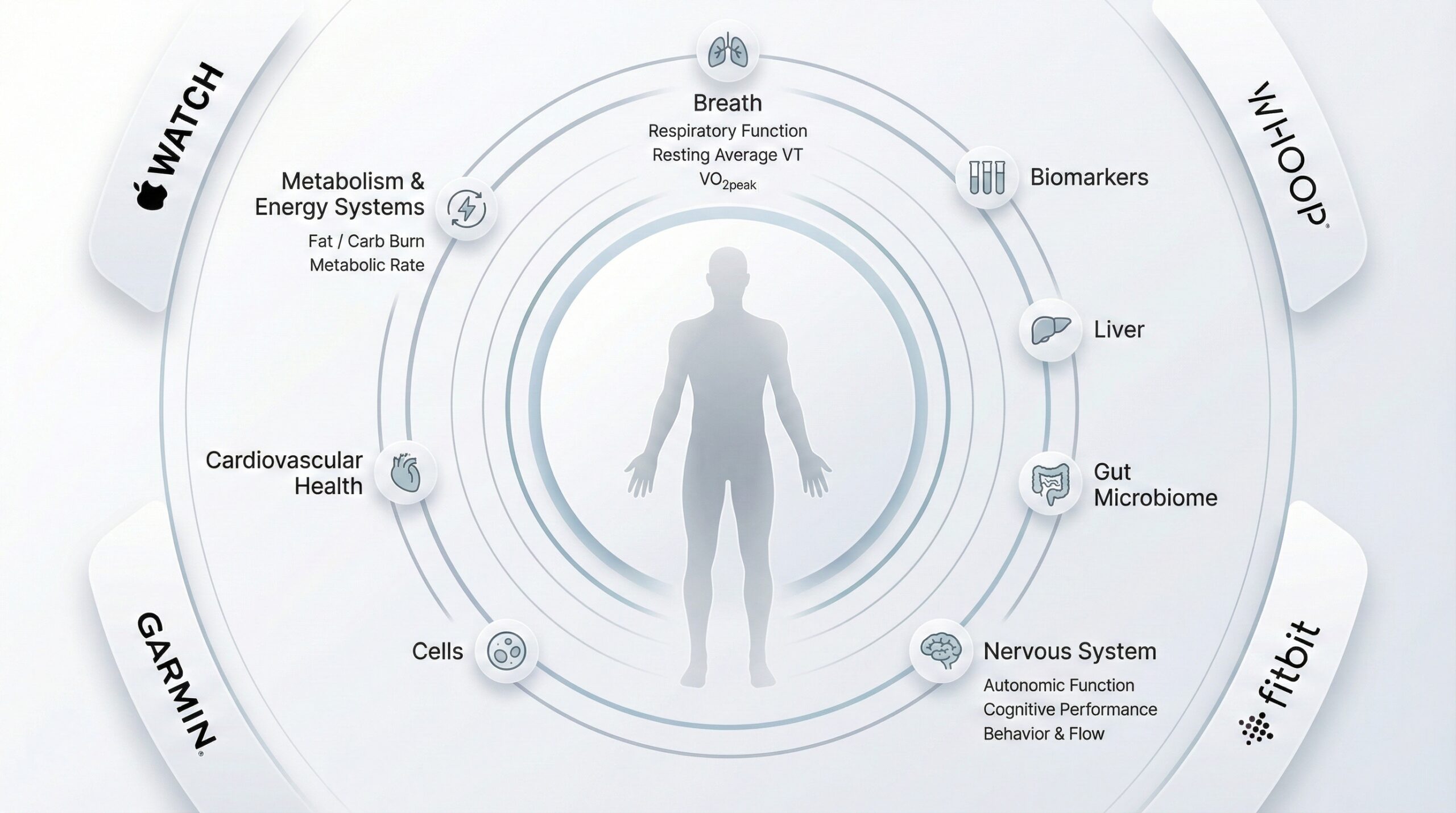
PNOĒ integrations are the key to bridging elite-grade metabolic testing with the everyday metrics captured by your favorite fitness wearables. By uniting data from devices like Apple Watch, Garmin, WHOOP, Fitbit, and Oura Ring, PNOĒ creates a comprehensive view of your health and performance. This means metabolic testing results – such as VO2 max, resting metabolic rate, and fuel usage – appear alongside daily activity, heart rate, sleep, and recovery stats in one place. These PNOĒ integrations make it easy to see how your metabolic status and everyday habits intersect at a glance.
How does it work? In other words, PNOĒ integrations leverage Apple Health (on iOS) and Google Fit (on Android) to seamlessly pull in your Apple Watch workouts, Garmin runs, WHOOP recovery scores, Fitbit steps, and Oura sleep cycles. Even though the PNOĒ device itself doesn’t pair directly with a watch or ring, its Precision App uses these PNOĒ integrations to provide a unified dashboard where PNOĒ test results and wearable insights combine. The result is a single source of truth that guides personalized training, nutrition, and longevity plans.
PNOĒ Integrations with Apple Watch (via Apple Health)
For iPhone users, PNOĒ integrations (via Apple Health) make connecting your Apple Watch effortless. All your Apple Watch data – from heart rate and VO2 max tracking estimates to exercise minutes and calorie burn – flows into Apple Health, and from there into the PNOĒ app. This PNOĒ integration means you can review your metabolism analysis results next to your daily fitness rings and workout stats.
Performance enthusiasts benefit from seeing how each intense run or HIIT session recorded by the watch corresponds to improvements in measured VO2 max and fat-burning efficiency from their PNOĒ test. At the same time, clinicians and coaches get a fuller picture – combining Apple’s broad activity tracking with PNOĒ’s precise metabolic insights – to personalize guidance for both longevity and athletic training. In short, PNOĒ integrations essentially transform your Apple Watch from a basic activity tracker into a vital part of a metabolic health monitoring system.
Garmin Devices: PNOĒ Integrations via Google Fit
Garmin wearables are a staple for runners, cyclists, and triathletes – and yes, PNOĒ integrations fully support Garmin devices. By syncing your Garmin Connect data through Google Fit (or Apple Health on iOS), all your routes, pace, heart rate zones, and even Garmin’s own VO2 max estimates feed into the PNOĒ platform. These PNOĒ integrations ensure endurance athletes see the full picture: how the miles logged on a Garmin watch translate into improvements in aerobic capacity, fat utilization, and recovery as measured by PNOĒ.
For example, while Garmin’s built-in VO2 max tracking might estimate your score as, say, 50, a PNOĒ test can precisely measure your actual VO2 max and reveal nuances behind that number. By combining Garmin’s day-to-day training feedback with PNOĒ’s lab-quality data, coaches and wellness professionals can fine-tune programs for peak performance and cardiometabolic health. In short, PNOĒ integrations help ensure your daily runs and rides aren’t just numbers on a screen. Instead, they become part of a science-backed plan for improvement.
WHOOP: PNOĒ Integrations for Deeper Recovery Insights
The WHOOP strap is all about 24/7 data – continuous heart rate, heart rate variability (HRV), sleep performance, and strain scores. With PNOĒ integrations, WHOOP users gain an extra layer of context for those recovery metrics.
Your WHOOP data syncs through Apple Health (on iOS), allowing the PNOĒ app to display, for instance, your recovery score or daily strain alongside your latest metabolic test results. This means you can correlate a high-strain day with your PNOĒ analysis – did that tough workout push you into an anaerobic zone identified in your PNOĒ report? Or see how improvements in your VO2 max (from a PNOĒ test) correspond to better recovery scores on WHOOP. By integrating WHOOP’s round-the-clock monitoring with PNOĒ’s metabolic testing insights, athletes and biohackers get a truly holistic view. They can optimize training load, refine recovery strategies, and even work toward longevity. Put simply, PNOĒ integrations give WHOOP users the missing piece – precise metabolism data to complement their strain and recovery metrics.
Fitbit: PNOĒ Integrations for Daily Wellness Data
Fitbit devices are known for simplicity and lifestyle tracking – steps, daily calories burned, sleep duration, and resting heart rate. PNOĒ integrations bring this data into the realm of clinical precision. By connecting your Fitbit through Google Fit or a third-party sync app, the PNOĒ platform can display your step count, active minutes, and sleep alongside your PNOĒ test results.
For someone on a weight management journey, this is a game-changer: you might see that although Fitbit estimated 2,200 calories burned today, your PNOĒ-measured resting metabolic rate and exercise data suggest a different number for true energy expenditure. Armed with that knowledge, a nutritionist or health coach can adjust your diet plan far more accurately.
Similarly, if your Fitbit logs 8 hours of sleep, PNOĒ’s metabolism analysis can show how quality rest is impacting your fat burn and recovery ability. Ultimately, these PNOĒ integrations give your Fitbit data new meaning and accuracy. They bridge the gap between general wellness tracking and personalized metabolic guidance.
Oura Ring: PNOĒ Integrations for Sleep & Readiness Data
Even the popular Oura Ring falls under the umbrella of PNOĒ integrations, linking Oura’s advanced sleep and readiness metrics directly with PNOĒ.
The Oura Ring has made a name for itself by tracking sleep quality, recovery scores, and daily readiness trends in a sleek package. PNOĒ’s software platform can integrate Oura’s data (via Apple Health or Google Fit) to augment your metabolic insights.
Imagine reviewing your PNOĒ report showing a dip in your fat-burning efficiency or aerobic capacity, and right alongside it, noticing that Oura flagged several nights of poor sleep that same week. Such correlations become clear when Oura’s sleep and recovery stats live next to PNOĒ’s metabolic testing data. For health practitioners, this combined view is invaluable: they can demonstrate how improving sleep (tracked by Oura) might boost VO2 max or RMR (revealed by PNOĒ), reinforcing the importance of lifestyle factors in achieving longevity and wellness goals.
Overall, PNOĒ integrations ensure that even subtle lifestyle factors captured by Oura are factored into your metabolic health plan. In other words, aspects like sleep quality and recovery patterns are no longer overlooked when personalizing your approach.
Conclusion: Unlocking Holistic Health with PNOĒ Integrations
In summary, PNOĒ integrations with Apple Watch, Garmin, WHOOP, Fitbit, and Oura Ring transform what could be isolated data points into a connected, actionable health picture. By syncing metabolic test data with wearable outputs, PNOĒ integrations bridge the gap between lab-grade insights and everyday life. The payoff is powerful. Athletes get more personalized training and recovery plans. Clinicians gain a 360° view of each client’s cardiorespiratory fitness and daily habits. Meanwhile, individuals aiming for longevity or weight management receive tailored guidance based on their unique metabolism and lifestyle patterns.
All of this comes with the confidence that your VO2 max, calorie burn, and other critical metrics are measured accurately by PNOĒ and enriched by the context your wearables provide. In a world where health tracking can be overwhelming, PNOĒ integrations offer a comprehensive, user-friendly approach to understanding and improving your well-being.
Related Posts