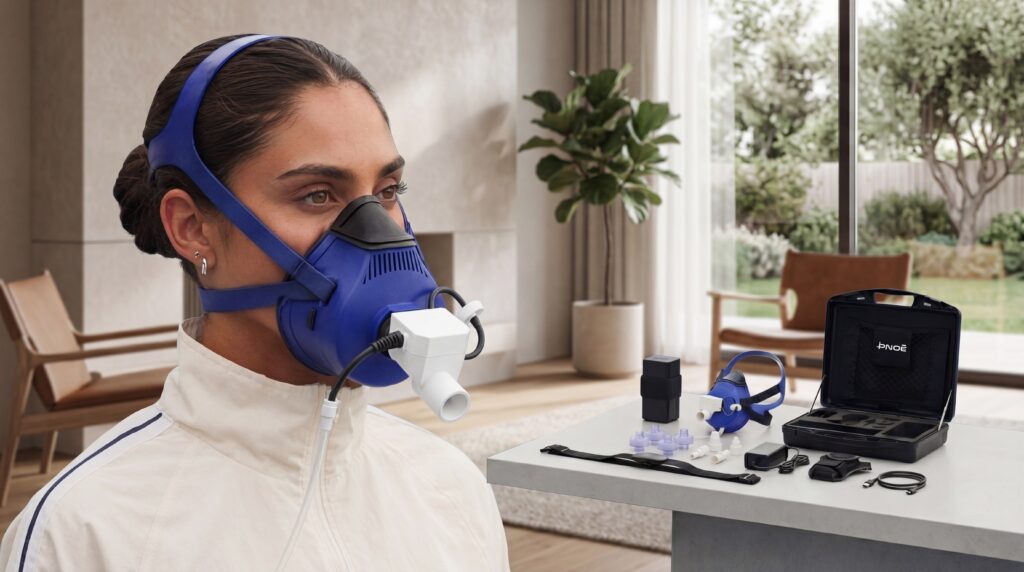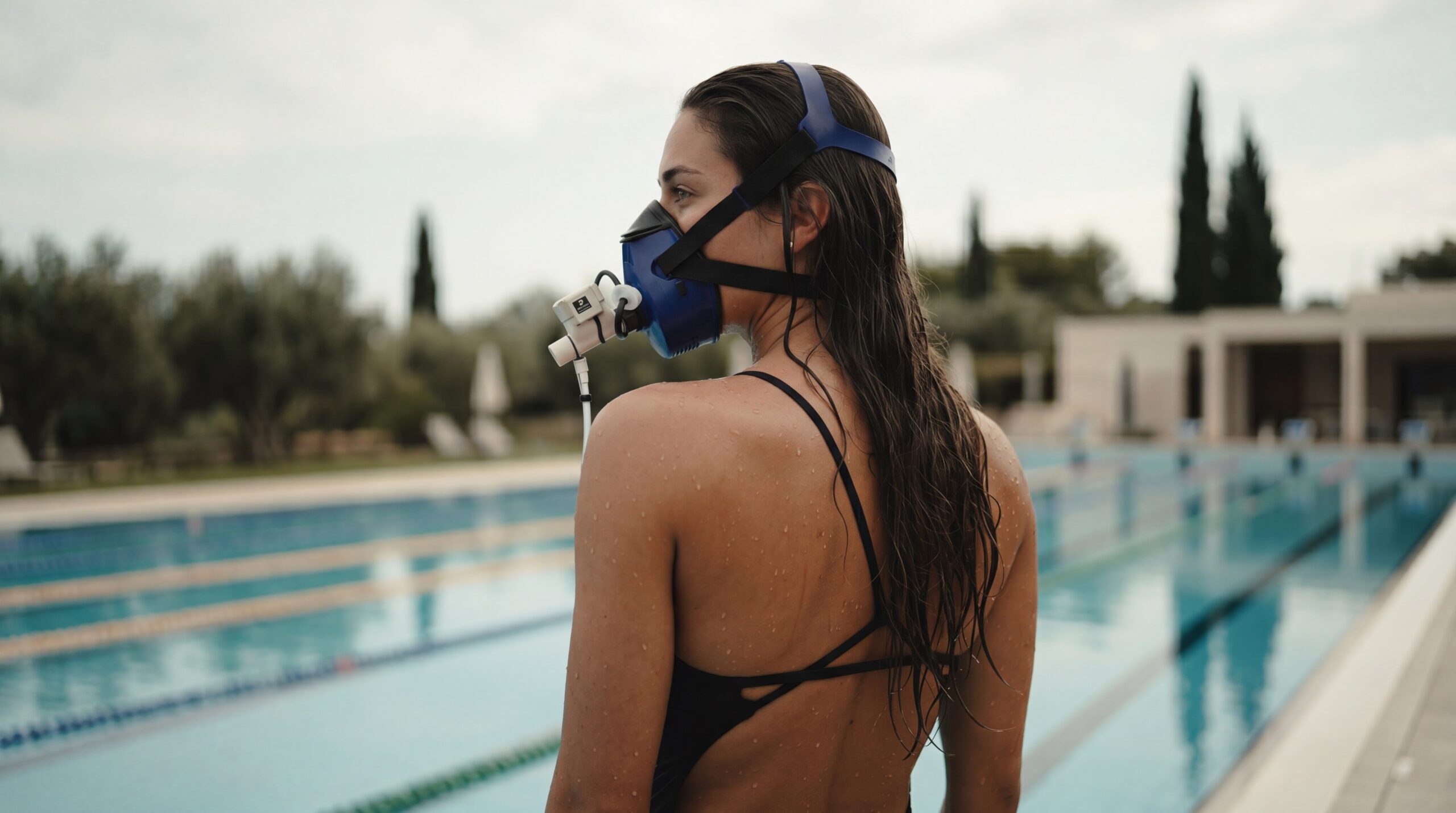
Swimming places unique demands on the aerobic system that make VO2 Max for swimmers fundamentally different from land-based sports. Restricted breathing patterns, horizontal body position, upper-body–dominant propulsion, and the thermoregulatory effects of water all influence how oxygen is consumed and delivered during swimming. Understanding these differences is essential for swimmers who want to test, interpret, and improve their VO2 Max effectively.
Why VO2 Max for Swimmers Is Different
Restricted Breathing Limits VO2 Max Expression
Unlike running or cycling, swimmers cannot breathe freely. Breathing is dictated by stroke mechanics — typically every 2–4 strokes in freestyle, with even more restricted patterns in butterfly and breaststroke. This forced ventilatory restriction means swimmers often reach ventilatory limitations before their cardiovascular or muscular systems are fully taxed.
This makes ventilatory efficiency (VE/VCO₂) and breathing mechanics (tidal volume peak, breathing frequency) especially important VO2 Max metrics for swimmers. A metabolic test that measures these variables — like PNOĒ — reveals whether a swimmer’s VO2 Max is limited by breathing mechanics rather than cardiac fitness or mitochondrial capacity.
Upper-Body Muscle Recruitment
Swimming recruits the upper body far more than running or cycling. Since upper-body muscles have smaller capillary beds and lower oxidative capacity than legs, VO2 Max measured during swimming is typically 10–15% lower than the same person’s VO2 Max measured during running. This mode-specificity means swimmers need testing protocols and benchmarks calibrated to their sport.
Horizontal Position and Cardiac Effects
The horizontal body position in water redistributes blood volume toward the heart, increasing stroke volume at rest and during submaximal exercise. This alters the heart rate–VO2 relationship compared to upright land exercise, making heart rate–based VO2 Max estimation (from wearables or formulas) particularly unreliable for swimmers.
VO2 Max for Swimmers: Benchmarks by Level
| Level | Male VO2 Max (mL/kg/min) | Female VO2 Max (mL/kg/min) |
| Recreational swimmer | 35–42 | 30–36 |
| Competitive age-group | 48–58 | 42–50 |
| National-level | 58–68 | 50–60 |
| Elite / Olympic-level | 65–80+ | 56–70+ |
Values represent treadmill/ergometer-measured VO2 Max. Swimming-specific VO2 Max (measured in pool or with swim-specific protocols) will be 10–15% lower.
How to Test VO2 Max for Swimmers
The most practical approach to testing VO2 max for swimmers combines a land-based metabolic test with swim-specific performance analysis:
Land-based VO2 Max test (treadmill or cycle ergometer): Provides your maximal aerobic capacity, ventilatory thresholds, RMR, and complete oxygen chain analysis. A PNOĒ test generates 23 biomarkers that apply directly to swim training — including ventilatory efficiency metrics that are uniquely relevant for swimmers’ restricted breathing patterns.
Pool-based threshold testing: Critical swim speed (CSS) testing in the pool, calibrated with heart rate zones from your metabolic test, provides swimming-specific training paces. The combination of metabolic test data and pool performance data gives swimmers the most complete training prescription.
PNOĒ’s metabolic test is particularly valuable for measuring VO2 max for swimmers because it captures the ventilatory variables (VT Peak, VE/VCO₂, breathing frequency patterns) that determine whether breathing mechanics are limiting swimming VO2 Max — information no pool test or wearable can provide.
How to Improve VO2 Max for Swimmers
Swim-Specific VO2 Max Intervals
8×100m at 90–95% effort with 20–30 seconds rest between repeats. This is the swimming equivalent of the 4×4 running protocol — accumulating time at or near VO2 Max intensity in a swim-specific context.
4×200m at 85–90% effort with 30–45 seconds rest. Longer intervals sustain elevated oxygen consumption and train the specific pacing discipline required for 200m and 400m race events.
Broken 400s/800s: Swim 400m or 800m at race pace, but break it into 50m or 100m segments with 5–10 seconds rest. This allows sustained near-VO2 Max effort across a longer total distance than continuous swimming would permit.
Land-Based Training to Improve Swimming VO2 Max
Supplementary land-based aerobic training (running, cycling, rowing) builds the central cardiovascular capacity that swimming-specific training alone may not fully develop — especially for swimmers limited by cardiac output rather than peripheral factors. Two to three land-based Zone 2 sessions per week (30–45 minutes) complement pool training and improve the aerobic base that supports swimming VO2 Max.
Breathing Mechanics and Respiratory Training for Swimming VO2 Max
If your PNOĒ test reveals ventilatory limitations (low VT Peak, elevated VE/VCO₂), targeted respiratory muscle training can directly improve swimming VO2 Max. Inspiratory muscle trainers, controlled breathing drills, and bilateral breathing practice enhance the ventilatory capacity that swimmers need to maximize oxygen uptake under restricted breathing conditions.
Strength and Dryland Training for Swimming VO2 Max
Upper-body and core strength training improves stroke power and efficiency, allowing swimmers to produce more propulsion per unit of oxygen consumed. This improves swimming economy — the swimming equivalent of running economy — which amplifies the performance benefit of any given VO2 Max score.
Mistakes That Hold Back VO2 Max for Swimmers
Using running or cycling VO2 Max data without adjustment. Swimming VO2 Max is 10–15% lower than treadmill VO2 Max. Training zones must be recalibrated for pool use.
Ignoring ventilatory limitations. Many swimmers assume their VO2 Max is heart-limited when breathing mechanics are the actual bottleneck. Metabolic testing differentiates these causes.
Neglecting land-based aerobic work. Pool training alone may not fully develop central cardiovascular capacity. Supplementary Zone 2 work on land supports swimming VO2 Max improvement.
Relying on wearable VO2 Max during swimming. Most wearable VO2 Max algorithms require GPS-based outdoor running. Swimming VO2 Max estimates from wearables are unreliable at best and unavailable on most platforms.
Build a Faster Aerobic Engine in the Water
Your VO2 Max for swimming sets the aerobic ceiling for every race and every training set. Knowing your actual VO2 Max, understanding whether breathing mechanics or cardiac fitness is your limiter, and training with precision based on metabolic data is the difference between grinding laps and getting faster.
References
1. Fernandes RJ, Billat VL, Cruz AC, et al. “Does Net Energy Cost of Swimming Affect Time to Exhaustion at the Individual’s Maximal Oxygen Consumption Velocity?” Journal of Sports Medicine and Physical Fitness. 2006;46(3):373–380. https://pubmed.ncbi.nlm.nih.gov/16998440/
2. Lavoie JM, Montpetit RR. “Applied Physiology of Swimming.” Sports Medicine. 1986;3(3):165–189. https://pubmed.ncbi.nlm.nih.gov/3520747/
3. Roels B, Schmitt L, Libicz S, et al. “Specificity of VO2max and the Ventilatory Threshold in Free Swimming and Cycle Ergometry: Comparison Between Triathletes and Swimmers.” British Journal of Sports Medicine. 2005;39(12):965–968. https://pubmed.ncbi.nlm.nih.gov/16306508/
4. Lemaitre F, Coquart JB, Chavallard F, et al. “Effect of Additional Respiratory Muscle Endurance Training in Young Well-Trained Swimmers.” Journal of Sports Science and Medicine. 2013;12(4):630–638. https://pubmed.ncbi.nlm.nih.gov/24421721/
5. Sousa A, Figueiredo P, Oliveira N, et al. “Ventilatory and Physiological Responses in Swimmers Below and Above Their Maximal Lactate Steady State.” Journal of Strength and Conditioning Research. 2015;29(10):2836–2843. https://pubmed.ncbi.nlm.nih.gov/25148466/
6. Tsekouras YE, Tambalis KD, Sarras SE, et al. “Validity and Reliability of the New Portable Metabolic Analyzer PNOE.” Frontiers in Sports and Active Living. 2019;1:24. https://www.frontiersin.org/journals/sports-and-active-living/articles/10.3389/fspor.2019.00024/full
Related Posts
Brain Fog and Metabolism: What Your Breath Reveals About Focus
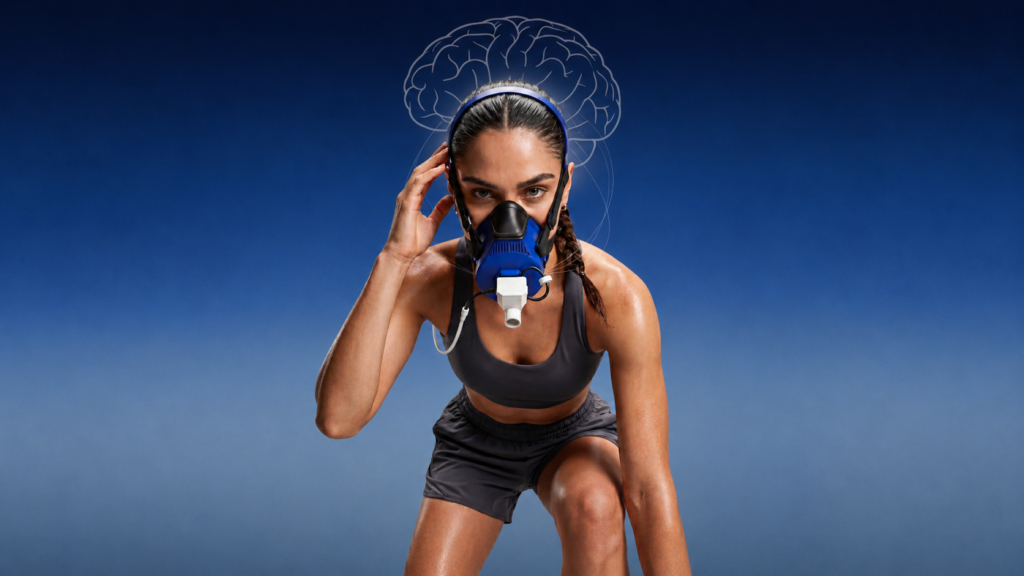
VO2 Max and Brain Health: How Fitness Protects Your Cognition