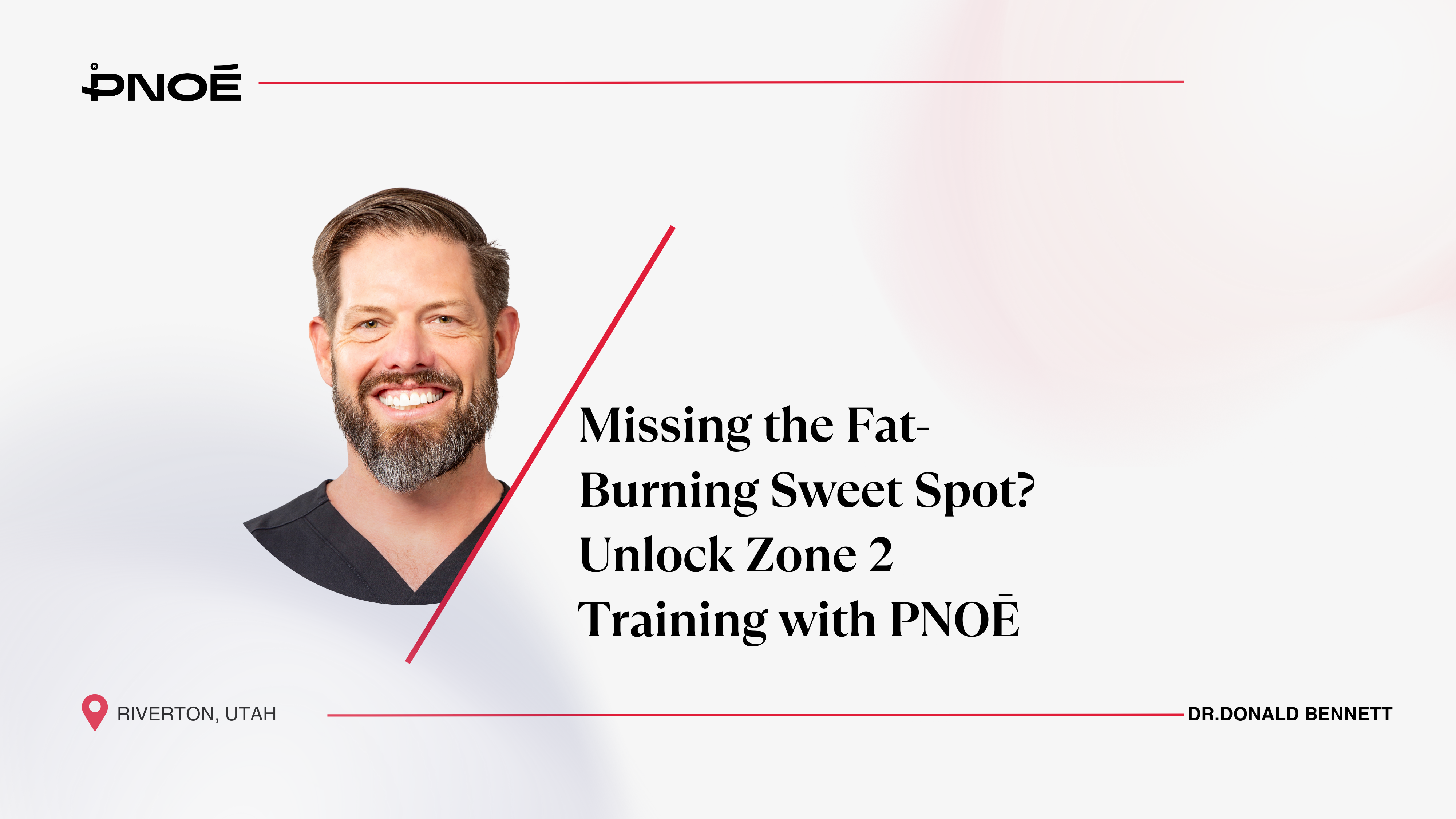
Welcome to this session of the PNOĒ Webinar Series, where clinicians and health leaders explore how advanced breath analysis and cardio-metabolic testing can transform training, nutrition, and long-term health outcomes.
In this webinar, we focus on one of the most misunderstood yet most powerful concepts in metabolic health: zone 2 training. Many individuals believe they are training efficiently for fat loss and longevity, yet consistently miss the true fat-burning sweet spot.
Joined by Dr. Donald Bennett, we examine how personalized VO2 Max testing, fat oxidation analysis, and individualized training zones enable practitioners to guide clients toward sustainable metabolic improvements, reduced inflammation, better hormone balance, and long-term adherence.
This conversation bridges clinical science, real-world implementation, and patient education, showing how PNOĒ breath analysis becomes a central tool for metabolic optimization, behavior change, and durable health outcomes.
Discover how identifying true zone 2 training unlocks fat metabolism, mitochondrial efficiency, and measurable progress without overtraining or burnout.
Follow PNOĒ on Instagram: @pnoe_analytics
Panos Papadiamantis:
Hello everyone, and welcome. I’m Panos Papadiamantis, Co-Founder of PNOĒ. Today, I’m joined by Dr. Donald Bennett, a long-time PNOĒ user who has built his practice around innovative health technologies, including metabolic testing and breath analysis.
In today’s discussion, we’ll explore how Dr. Bennett integrates PNOĒ, VO2 Max testing, and zone-based training with other clinical modalities to deliver more personalized and effective nutrition and training strategies for his clients.
Dr. Donald Bennett:
Thank you, Panos. It’s great to be here. Integrating PNOĒ and VO2 Max testing into our patient experience has been incredibly impactful.
I’m a physician and Medical Director at Move Health, a consumer-focused organization centered on metabolic health. Every client who comes through our clinic undergoes PNOĒ VO2 Max testing, and in many cases, resting metabolic rate testing as well.
Our clients are typically metabolically unhealthy or seeking metabolic optimization. For them, this means fat loss, reduced inflammation, muscle preservation and growth, improved hormonal balance, lower oxidative stress, and long-term anti-aging benefits.
Dr. Donald Bennett:
Before implementing zone 2 training based on breath analysis, we relied on calculated training zones. That approach led to overtraining, elevated cortisol, and narrowing testosterone-to-cortisol ratios. Once we shifted to personalized zone 2 training using PNOĒ, especially for our most metabolically impaired clients, the results changed dramatically.
Individuals who could barely tolerate exercise began improving rapidly. Within three to six months, their metabolic profiles were completely different.
Panos Papadiamantis:
That’s a powerful outcome. Could you share more about your practice, your motivation, the population you serve, and how you see it evolving?
Dr. Donald Bennett:
Certainly. I’m traditionally trained in emergency medicine and completed fellowship training in metabolic health, anti-aging, longevity, and hormone optimization. I also served in the U.S. Navy with the Marine Corps, where I saw firsthand how exercise, nutrition, and metabolic readiness directly affect performance and resilience.
When building this practice, we asked a simple question: what provides the greatest measurable benefit for patients? The American Heart Association published a landmark paper in 2016 stating that VO2 Max should be treated as a vital sign. That framework guided our approach.
By establishing true training zones through VO2 Max testing, we can reduce all-cause mortality risk and train individuals at the correct intensity.
Dr. Donald Bennett:
The difference between calculated and measured zones is enormous. I’ve seen patients whose estimated zone 2 heart rate was 134 beats per minute, while their true zone 2 was closer to 103. That discrepancy leads to chronic overtraining and poor results.
Our intake process includes labs, bioimpedance analysis, VO2 Max testing, and consultation. We start with zone 2 to build a metabolic base before progressing to higher-intensity work.
In six months of consistent zone 2 training alone, we routinely see 20% or greater improvements in VO2 Max among metabolically unhealthy individuals.
Panos Papadiamantis:
That’s an important clarification. There’s a common misconception that active metabolic testing is only for athletes, or that metabolically impaired individuals can’t perform it. Your experience shows that this isn’t just scientifically inaccurate, it’s practically incorrect.
Dr. Donald Bennett:
Exactly. Implementation was the initial challenge. Physician time is expensive, so we trained intake professionals, medical assistants and trainers to safely administer the tests.
Clients may use a treadmill or a bike, depending on orthopedic limitations. The test doesn’t require running. Walking with an incline is often sufficient. The goal is metabolic insight, not maximal suffering.
Once testing is complete, clients return for a physician consult where we integrate labs, PNOĒ data, and body composition to build a personalized plan.
Dr. Donald Bennett:
The support from PNOĒ has been critical. When unusual results appear such as an extremely early ventilatory threshold we receive immediate guidance on interpretation and programming.
Without that clinical and educational support, integrating this technology would have been significantly more difficult.
Panos Papadiamantis:
Support is central to what we do at PNOĒ. The device is only the first step. The real value lies in interpreting cardio-metabolic data and translating it into actionable nutrition, training, and recovery strategies.
It’s also important to highlight that a VO2 Max test does not need to be a true maximal test. Most actionable insights come from the submaximal portion of the test, where fuel utilization, breathing efficiency, and metabolic limitations become clear.
Dr. Donald Bennett:
Absolutely. We work with perimenopausal women, older men, younger adults, the insights are universally valuable.
Let me share an example. Since July, our bioimpedance data shows over 100 pounds of weight loss, more than 100 pounds of fat loss, and significant muscle gain across our client base. This is the result of precision, not punishment.
When a client stalls, we revisit their zone 2 adherence. Often, small adjustments restore progress quickly.
Panos Papadiamantis:
This highlights why PNOĒ is not just a prescription tool, but an engagement and education platform. The consult effectively becomes a “Biology 101” session, helping clients understand why specific behaviors matter.
When people understand mitochondrial health, fat oxidation, and energy systems, adherence improves dramatically.
Dr. Donald Bennett:
Exactly. Many clients believe they’re doing everything right exercising hard, eating better yet remain stuck. When we show them their fat-carbohydrate crossover, it becomes clear why intensity, not effort, was the problem.
Reducing effort often leads to better results. That realization is transformative.
Panos Papadiamantis:
At a physiological level, breath analysis measures airflow, oxygen, and carbon dioxide. From these signals, we derive 23 biomarkers that reflect cardiovascular, pulmonary, cellular, and metabolic function.
This allows us to calculate biological age, metabolic rate, macronutrient needs, and optimal training distribution all without blood draws.
Panos Papadiamantis:
One of the most powerful concepts is the fat-carbohydrate crossover point. In metabolically impaired individuals, fat oxidation may never dominate. In metabolically flexible individuals, fat utilization persists even at high intensities.
This single marker often explains why traditional training fails and how to fix it.
Dr. Donald Bennett:
And it’s critical to define terms correctly. Many studies label high-intensity work as “endurance training,” when it’s actually threshold or zone 4 training. True endurance training is zone 2 and confusing the two leads to cortisol dysregulation and burnout.
Panos Papadiamantis:
Exactly. Zone 3 often becomes a metabolic dead zone too intense for fat oxidation, not intense enough for adaptation. Zone 2 and zone 4 drive adaptation; zone 3 is best reserved for race rehearsal.
Dr. Donald Bennett:
We also see how even short time spent in zone 4 can suppress fat oxidation for a prolonged period. After one high-intensity bout, it can take eight minutes or more to return to fat metabolism.
This is why discipline and monitoring matter, especially for individuals with cortisol dysregulation.
Panos Papadiamantis:
Exercise timing is also critical. Evening high-intensity sessions can spike cortisol at the wrong time, impairing sleep and recovery. Without understanding this physiology, people unknowingly sabotage their progress.
Dr. Donald Bennett:
When clients correct this focusing on zone 2, proper timing, and consistency sleep improves, stress resilience improves, and metabolic markers normalize.
Panos Papadiamantis:
Dr. Bennett, thank you for sharing these insights. For those interested in learning more whether clinically or from a business perspective our team has shared a link to schedule a conversation.
This webinar will also be published on YouTube for continued education and sharing.
Dr. Donald Bennett:
Thank you, Panos. It was a pleasure. The outcomes we’re seeing with PNOĒ have been truly remarkable.
Panos Papadiamantis:
Thank you again, and thank you to everyone who joined us today.
Watch the full episode HERE.
Related Posts
Turning Breath Analysis into a Business Enabler for Chiropractic Clinics

PNOĒ & PEMF: A Powerful Combo for Physical Therapy Facilities