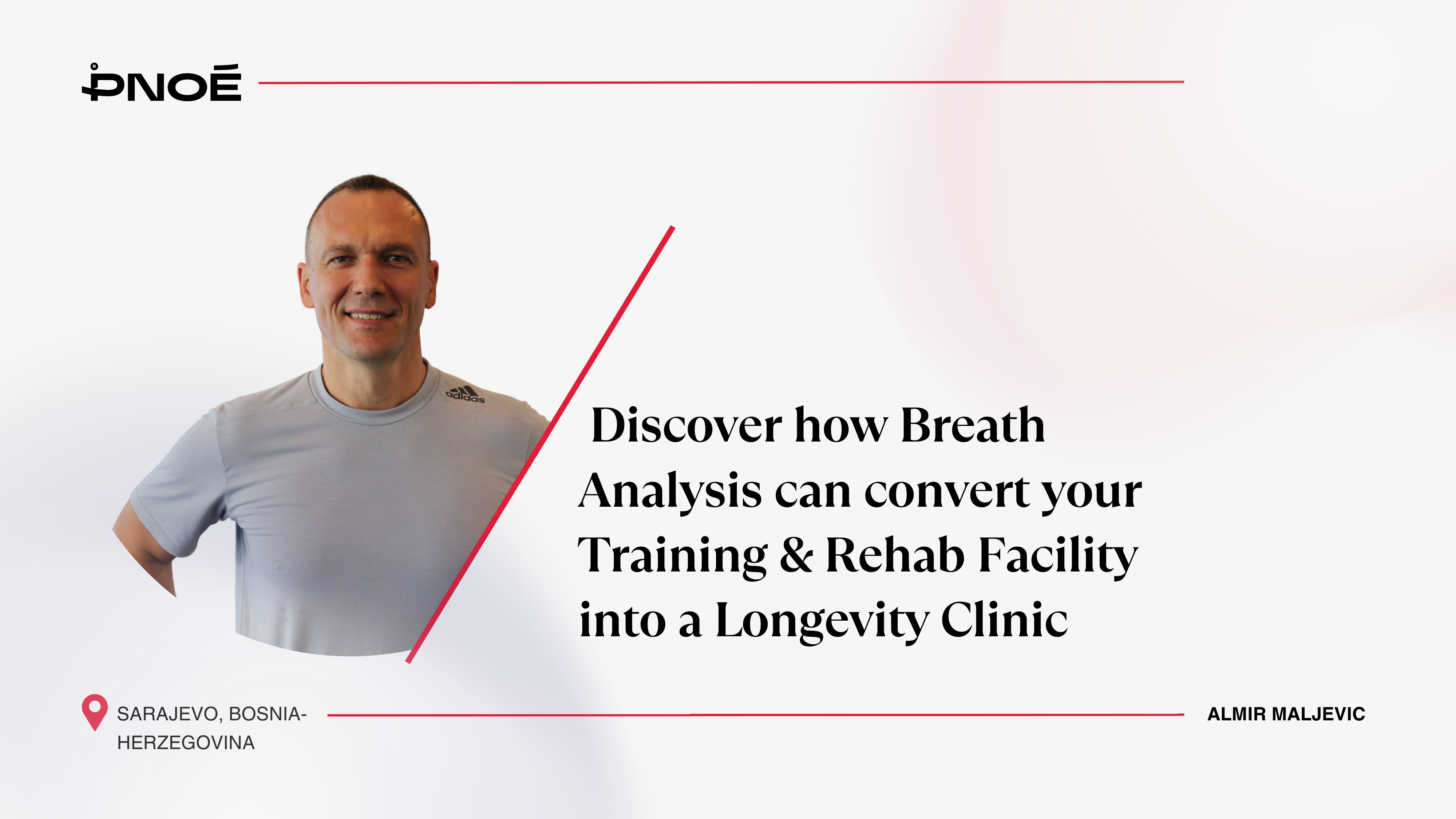
Welcome to this session of the PNOĒ Webinar Series, where forward-thinking practitioners explore how advanced breath analysis and cardio-metabolic testing are redefining training, rehabilitation, and longevity care.
In this webinar, we examine how a traditional training and rehabilitation facility can evolve into a longevity-focused clinic by understanding the deeper physiological systems that drive pain, performance, recovery, and long-term health.
Joined by Almir Maljevic, a leading PNOĒ affiliate and pioneer in applied physiology, we discuss how integrating metabolic testing, VO2 Max, fat oxidation analysis, and respiratory assessment allows practitioners to move beyond musculoskeletal treatment and address the true root causes of dysfunction.
This conversation highlights how education, objective data, and system-level thinking transform client outcomes, retention, and business growth turning training into a measurable, transformative process rather than guesswork.
Discover how PNOĒ breath analysis enables facilities to deliver holistic care, improve compliance, and position themselves at the forefront of longevity, metabolic health, and human performance.
Follow PNOĒ on Instagram: @pnoe_analytics
Panos Papadiamantis:
Hello everyone, and welcome. I’m Panos Papadiamantis, Co-Founder of PNOĒ. Today, I’m joined by Almir Maljevic, one of our most experienced affiliates and a true pioneer in applying breath analysis and metabolic testing across multiple clinical and performance settings.
Almir has done remarkable work using PNOĒ to transform his practice not only in terms of services offered, but also the type of clients he attracts and the depth of care he delivers. Today’s discussion is designed to help practitioners understand how a facility can evolve from a traditional training or rehab model into a holistic longevity clinic.
Almir, thank you for joining us.
Almir Maljevic:
Thank you, Panos. I’m very happy to be here.
I’m speaking from Sarajevo, Bosnia and Herzegovina. Together with my brother and our team, we run a training and rehabilitation facility called Pro-Fit Health. Strength and Conditioning. We intentionally chose a name that reflects everything we do health first, then strength and conditioning even if we weren’t marketing experts at the time.
Since 2017, we’ve operated with a structured system. Initially, our focus was almost exclusively on musculoskeletal issues low back pain, post-surgical rehabilitation, injury prevention, and youth athletic development, grounded in functional movement principles.
Over time, however, it became very clear that training a human being is far more complex than addressing the musculoskeletal system alone.
Almir Maljevic:
We began exploring how other physiological systems influence movement, pain, and performance in the respiratory system, cardiovascular system, and metabolic system.
The challenge was that traditional technologies were expensive, complex, and produced data that wasn’t actionable. PNOĒ changed that completely. It provided gold-standard metabolic testing that was practical, accurate, and easy to interpret.
Over the last two years, our work has expanded dramatically. We moved from treating isolated musculoskeletal problems to addressing metabolic dysfunction, respiratory limitations, and cardio-metabolic health.
While we’re not officially called a clinic, the level of care we now provide is absolutely clinical in nature.
Panos Papadiamantis:
What you’re describing highlights something fundamental. Many cases that appear musculoskeletal on the surface are actually driven by deeper physiological limitations particularly in breathing, metabolism, and cardiovascular efficiency.
Without objective diagnostics, these individuals are treated narrowly. With breath analysis, the picture becomes much broader, and care naturally becomes more holistic.
Almir Maljevic:
Exactly. Once we can present clients with objective, medically validated data, the conversation changes.
We use visual education extensively explaining airflow, oxygen delivery, VO2 Max, and why cardiovascular fitness matters. Most clients have never been exposed to these concepts.
When you show them that improvement is not just possible but predictable if they follow specific principles they commit for the long term.
This has been transformative not only for outcomes, but also for retention and business sustainability.
Almir Maljevic:
Let me share a real example. Recently, we retested a client, a physician nearing retirement who runs a large pharmaceutical company. His PNOĒ breath analysis revealed significant respiratory limitations.
He mentioned shoulder pain, thoracic discomfort, a prior motorcycle injury, and waking every night at 3 a.m. due to pain. Individually, these seemed unrelated. But when we analyzed breathing mechanics, posture, and respiratory muscle function, everything connected.
We identified impaired respiratory mechanics contributing to musculoskeletal pain and sleep disruption.
Almir Maljevic:
We referred him to our respiratory physical therapy department, focusing on diaphragmatic and intercostal muscle function. After just two treatments, his sleep improved and nighttime pain disappeared.
He told me, repeatedly, “Holistic approach is everything.”
This case illustrates how respiratory dysfunction can cascade into pain, poor sleep, and reduced longevity, one of the three pillars alongside nutrition and training.
Panos Papadiamantis:
This story is incredibly powerful. It also highlights how traditional medicine often misses these connections, not due to resistance, but due to siloed thinking.
A single respiratory limitation can impair sleep, increase pain, reduce recovery, and accelerate biological aging.
Almir Maljevic:
Exactly. At rest, this individual’s breathing appeared normal. But under movement, oxygen demand increased and his system failed to adapt.
The heart compensated by working harder, yet oxygen delivery didn’t improve. This was clearly visible in PNOĒ metrics, such as O2 pulse.
Once he understood that the respiratory system was the root cause, everything made sense.
Panos Papadiamantis:
You also mentioned a case where metabolic testing uncovered a far more serious condition.
Almir Maljevic:
Yes. A very fit individual came in training six days per week, no pain, no obvious issues. However, his resting metabolic rate test showed abnormally low fat oxidation and a suppressed metabolism.
This pattern didn’t match his lifestyle. We recommended blood work, which revealed liver abnormalities. Further imaging identified a small liver tumor.
Thankfully, it was caught early. This is the power of metabolic insight not diagnosis, but early detection and direction.
Panos Papadiamantis:
While rare, this underscores how perturbed metabolism often signals deeper issues, hormonal imbalances, metabolic syndrome, or other underlying pathology.
PNOĒ doesn’t diagnose disease, but it provides an objective starting point for investigation.
Almir Maljevic:
Absolutely. This is where prevention truly begins long before medication is required.
What I believe most strongly is that education is the greatest value PNOĒ provides. People don’t lack willpower; they lack understanding.
When clients see their biology quantified VO2 Max, metabolic flexibility, fat oxidation, respiratory efficiency and understand how systems interact, compliance skyrockets.
Panos Papadiamantis:
We view every PNOĒ consultation as a foundational “Biology 101” session explaining how oxygen, energy, and movement interact.
Once people understand why they’re being asked to do something, adherence becomes natural.
Almir Maljevic:
We emphasize this heavily. Our consultations last anywhere from 45 minutes to two hours. Clients leave with clarity, sometimes frustration about past mistakes but always empowered.
I experienced this personally. As a former elite athlete, I trained too hard and ate too little. PNOĒ testing showed me exactly why. I trained less, ate more, shifted energy systems and lost six kilograms in three weeks.
That personal experience reinforced everything.
Panos Papadiamantis:
This illustrates perfectly how training is a transformation process. The body adapts but the direction of adaptation depends entirely on whether stress is applied intelligently.
Almir Maljevic:
Exactly. I refuse to rely on hope. We test, we monitor, and we individualize daily.
Using PNOĒ training zones and real-time heart-rate monitoring, clients learn how stress, sleep, nutrition, and recovery affect performance day by day.
This protects the immune system, prevents overtraining, and supports long-term health.
Panos Papadiamantis:
You’re also expanding this philosophy through education and media.
Almir Maljevic:
Yes. I’m launching a podcast focused on the unknowns of human physiology, starting with experts in exercise physiology. The goal is education for practitioners and the public alike.
Panos Papadiamantis:
This work is truly at the forefront of holistic health and longevity care. There is enormous opportunity for practitioners willing to adopt this approach.
Almir, thank you for sharing your experience, insights, and real-world outcomes.
Almir Maljevic:
Thank you, Panos. I truly appreciate the support from PNOĒ especially the metabolic experts who help us interpret data and deliver better care.
Panos Papadiamantis:
Support is foundational to our mission. Without it, none of this would scale.
Thank you to everyone who joined us today. A link has been shared to connect with our team for more information.
Watch the full episode HERE.
Related Posts
Turning Breath Analysis into a Business Enabler for Chiropractic Clinics

PNOĒ & PEMF: A Powerful Combo for Physical Therapy Facilities