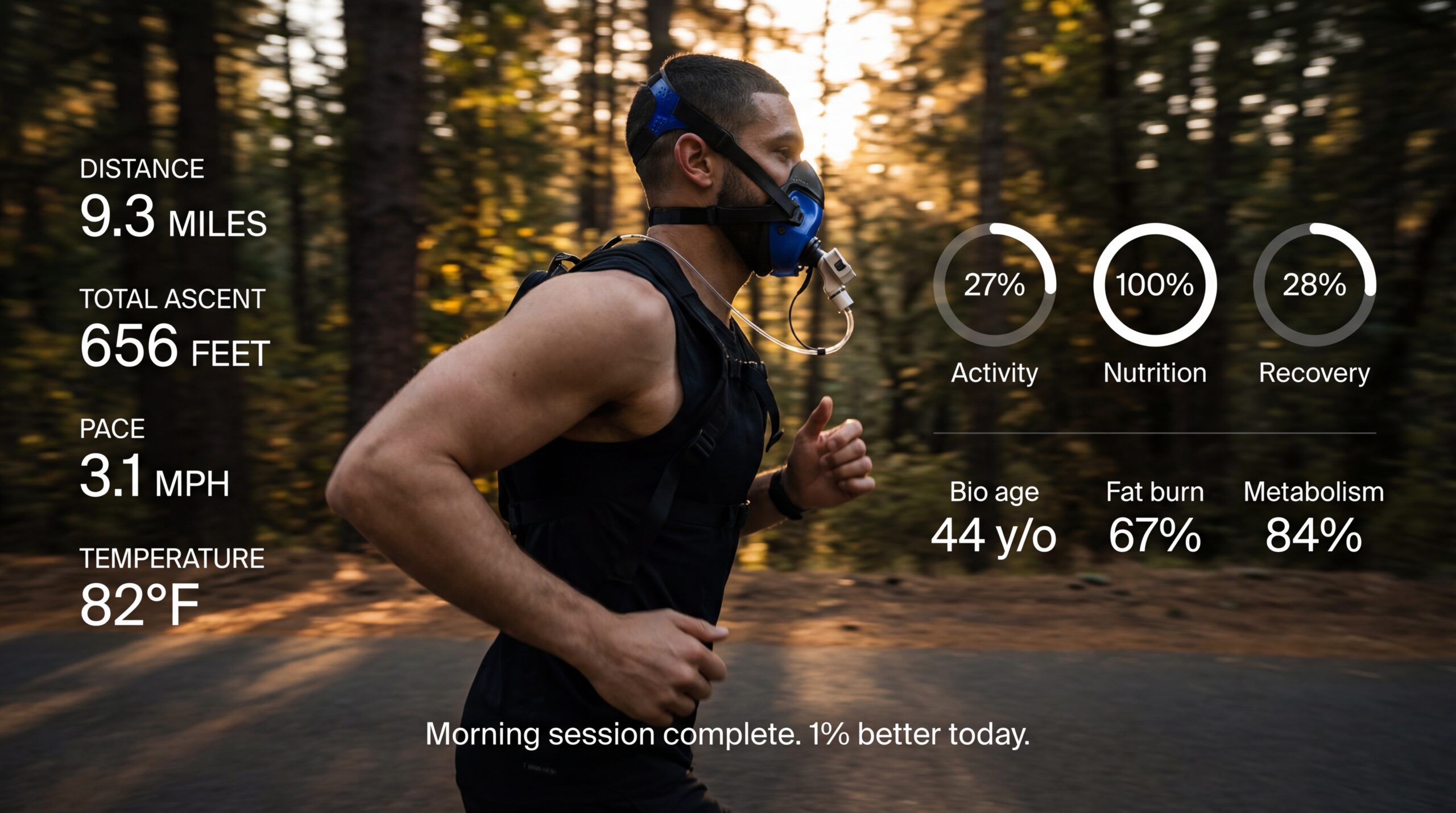
Elite athlete VO2 max values represent the outer limits of human aerobic capacity — numbers that show what is physiologically possible when genetics, decades of training, and optimized physiology converge. Understanding where the best in the world actually land gives useful context for your own score, reveals what separates world-class aerobic capacity from merely excellent, and explains why VO2 max alone does not determine athletic greatness.
This guide breaks down elite athlete VO2 max benchmarks by sport, covers the highest values ever recorded, and explains the factors that turn a high number into actual performance.
What VO2 Max Do Elite Athletes Have?
Elite athlete VO2 max values vary significantly by sport, driven mainly by how much total muscle mass each discipline recruits and how that muscle is loaded. The broad ranges below reflect published exercise physiology data and laboratory testing of professional and Olympic-level competitors.
As a reference point, the average untrained adult man scores 35–40 mL/kg/min and the average woman 27–31 mL/kg/min. Elite endurance athletes routinely double those figures — which is exactly why elite athlete VO2 max numbers are so striking.
Elite Athlete VO2 Max by Sport
Cross-Country Skiing: The Highest Values in Sport
Cross-country skiing produces the highest elite athlete VO2 max values of any discipline, because it recruits both the upper and lower body at high intensity simultaneously — maximizing total oxygen demand. Elite male cross-country skiers typically record 80–90 mL/kg/min, with the very best exceeding 90.
Two Norwegian skiers, Bjørn Dæhlie and Espen Harald Bjerke, have reported values around 96 mL/kg/min, among the highest ever attributed to skiers. Elite female cross-country skiers typically range from 70–78 mL/kg/min.
Distance Running: Elite Runner VO2 Max
Elite male distance runners typically record an elite athlete VO2 max of 70–85 mL/kg/min. Marathon great Eliud Kipchoge has been estimated at around 85 mL/kg/min. Elite female distance runners generally fall between 62 and 75 mL/kg/min, with American marathoner Joan Benoit Samuelson recording 78.6 mL/kg/min in 1984 — one of the highest values ever measured in a woman.
What is notable is that many world-class marathoners do not have the highest VO2 max in their sport. Several compete and win with values of 70–78 mL/kg/min, compensating with exceptional running economy and lactate threshold. This is a recurring theme in elite athlete VO2 max data: the number is necessary, but not sufficient.
Cycling: Elite Cyclist VO2 Max
Professional male road cyclists typically record an elite athlete VO2 max of 75–85 mL/kg/min, with grand tour climbers often at the upper end. Professional female cyclists generally range from 60–72 mL/kg/min.
Cycling also holds the record for the highest elite athlete VO2 max ever verified in a laboratory — more on that below. In competition, though, cyclists express their aerobic capacity as power output (watts per kilogram), and the ability to convert oxygen into watts varies between riders even at the elite level.
Rowing: High Absolute VO2 Max
Elite rowers produce some of the highest absolute VO2 max values (measured in liters per minute rather than mL/kg/min) thanks to their large body mass and powerful cardiovascular systems. Absolute values of 6.0–7.0+ L/min are common in Olympic-level male rowers. Their relative elite athlete VO2 max sits around 60–72 mL/kg/min for men and 52–62 for women — lower than runners in relative terms because of their greater body mass.
Swimming: Elite Swimmer VO2 Max
Elite male swimmers typically record 65–80 mL/kg/min when tested on land, with swimming-specific values 10–15% lower. Elite female swimmers range from 56–70 mL/kg/min. Because swimming restricts breathing, ventilatory efficiency plays a particularly large role in how an elite swimmer’s VO2 max translates to performance in the pool.
Team Sports: Soccer, Basketball, and Football
Elite athlete VO2 max values in team sports are lower than in pure endurance disciplines, but still well above average. Elite soccer players typically range from 55–70 mL/kg/min, with midfielders and wing-backs at the higher end. Professional basketball players fall around 40–55 mL/kg/min, and NFL skill-position players (running backs, wide receivers) often test at 50–60 mL/kg/min.

The Highest Elite Athlete VO2 Max Ever Recorded
The highest elite athlete VO2 max ever verified under rigorous laboratory conditions belongs to Oskar Svendsen, an 18-year-old Norwegian cyclist who recorded 96.7 mL/kg/min in Lillehammer in August 2012 — a value so high the testing equipment was sent back to the manufacturer to verify its calibration. Weeks later, Svendsen won the junior world time trial championship.
Remarkably, Svendsen’s untrained baseline just three years earlier had already been around 74 mL/kg/min — on par with a domestic professional cyclist — before climbing roughly 30% to his record. His story is also a cautionary one: he left elite cycling in his early twenties, a reminder that the highest elite athlete VO2 max in history does not guarantee a lasting career.
On the women’s side, Joan Benoit Samuelson’s 78.6 mL/kg/min from 1984 remains among the highest verified female values, followed closely by Norwegian skier Bente Skari at 76.6 and Brazilian cyclist Flavia Oliveira at 76.
Notably, of the top recorded elite athlete VO2 max values of all time, the overwhelming majority belong to Scandinavian athletes — and Norwegians in particular — fueling ongoing debate about the relative roles of genetics, altitude, climate, and training culture.
Why Elite Athlete VO2 Max Alone Does Not Win Races
One of the most important lessons in elite athlete VO2 max data is that the competitor with the highest number does not always win. Several factors determine how much of that aerobic ceiling translates into results:
Exercise economy. The oxygen cost of movement at a given speed or power varies between athletes. A runner with a VO2 max of 75 and exceptional economy can beat a rival with a VO2 max of 80 but poorer economy — because the first athlete spends less oxygen to hold the same pace.
Fractional utilization. The percentage of VO2 max an athlete can sustain at race pace differs. Some elite competitors hold 85–90% of their VO2 max for an hour; others fade earlier. This threshold capacity, built through years of tempo and base training, amplifies or undercuts the value of any given elite athlete VO2 max.
Body composition and power-to-weight. In weight-bearing sports like running and climbing, relative VO2 max (per kilogram) is what matters. Optimizing lean mass while minimizing non-functional body fat extracts more performance from the same score.
Metabolic flexibility. The ability to efficiently switch between fat and carbohydrate fuel affects pacing, endurance, and resistance to glycogen depletion — none of which a raw elite athlete VO2 max number captures.
This is why comprehensive metabolic testing — measuring VO2 max alongside economy, thresholds, fuel utilization, and metabolic flexibility — provides a far more complete performance picture than VO2 max alone. A PNOĒ test captures all of these variables in a single 10-minute breath assessment.
What Elite Athlete VO2 Max Data Means for You
You do not need an elite athlete VO2 max to be healthy, fit, or competitive in your age group. The health benefits of improving your score are actually greatest at the lower end of the spectrum — moving from “Poor” to “Average” on the norms chart delivers the single largest reduction in mortality risk of any fitness change you can make.
Still, elite benchmarks provide useful context and prove just how trainable the human aerobic system is. Whether your current score is 35 or 65, the same principles that build an elite athlete VO2 max apply at every level: targeted interval training, a deep aerobic base, smart nutrition, and data-driven programming based on metabolic testing rather than guesswork.
Sources
- Bassett DR, Howley ET. “Limiting Factors for Maximum Oxygen Uptake and Determinants of Endurance Performance.” Medicine & Science in Sports & Exercise. 2000;32(1):70–84. https://pubmed.ncbi.nlm.nih.gov/10647532/
- Lundby C, Montero D, Joyner M. “Biology of VO2 max: Looking Under the Physiology Lamp.” Acta Physiologica. 2017;220(2):218–228. https://pubmed.ncbi.nlm.nih.gov/27888643/
- Sandbakk Ø, Holmberg HC. “Physiological Capacity and Training Routines of Elite Cross-Country Skiers: Approaching the Upper Limits of Human Endurance.” International Journal of Sports Physiology and Performance. 2017;12(8):1003–1011. https://pubmed.ncbi.nlm.nih.gov/28095083/
- Lucía A, Hoyos J, Chicharro JL. “Physiology of Professional Road Cycling.” Sports Medicine. 2001;31(5):325–337. https://pubmed.ncbi.nlm.nih.gov/11347684/
- Joyner MJ, Coyle EF. “Endurance Exercise Performance: The Physiology of Champions.” Journal of Physiology. 2008;586(1):35–44. https://pubmed.ncbi.nlm.nih.gov/17901124/
- Mandsager K, Harb S, Cremer P, et al. “Association of Cardiorespiratory Fitness With Long-term Mortality Among Adults Undergoing Exercise Treadmill Testing.” JAMA Network Open. 2018;1(6):e183605. https://jamanetwork.com/journals/jamanetworkopen/fullarticle/2707428
- Tsekouras YE, Tambalis KD, Sarras SE, et al. “Validity and Reliability of the New Portable Metabolic Analyzer PNOE.” Frontiers in Sports and Active Living. 2019;1:24. https://www.frontiersin.org/journals/sports-and-active-living/articles/10.3389/fspor.2019.00024/full
Related Posts
Repeated Sprint Ability: Why Soccer Is Really an Aerobic Sport
Soccer Player VO2 Max: How World Cup Athletes Compare to You
Brain Fog and Metabolism: What Your Breath Reveals About Focus