Metabolic testing has moved from elite labs into everyday fitness, longevity, and wellness practices. By analyzing a client’s breath, you can measure VO2 Max, resting metabolic rate, fuel utilization, ventilatory thresholds, and dozens of other markers that translate directly into personalized training and nutrition. The technology is powerful — but the analyzer you choose will shape the depth of your results, the experience your clients receive, and the economics of your business.
If you’ve been researching options, two names likely keep coming up: PNOĒ and VO2 Master. Both are respected in the breath-analysis space, but they’re built for different audiences. This in-depth PNOĒ vs VO2 Master comparison walks you through how each performs across the dimensions that matter most: measurement depth, software and reporting, total cost of ownership, business support, and long-term ROI.
The goal is to give you the facts, drawn from each company’s own published materials and from peer-reviewed validation studies, so you can make a confident decision for your practice.
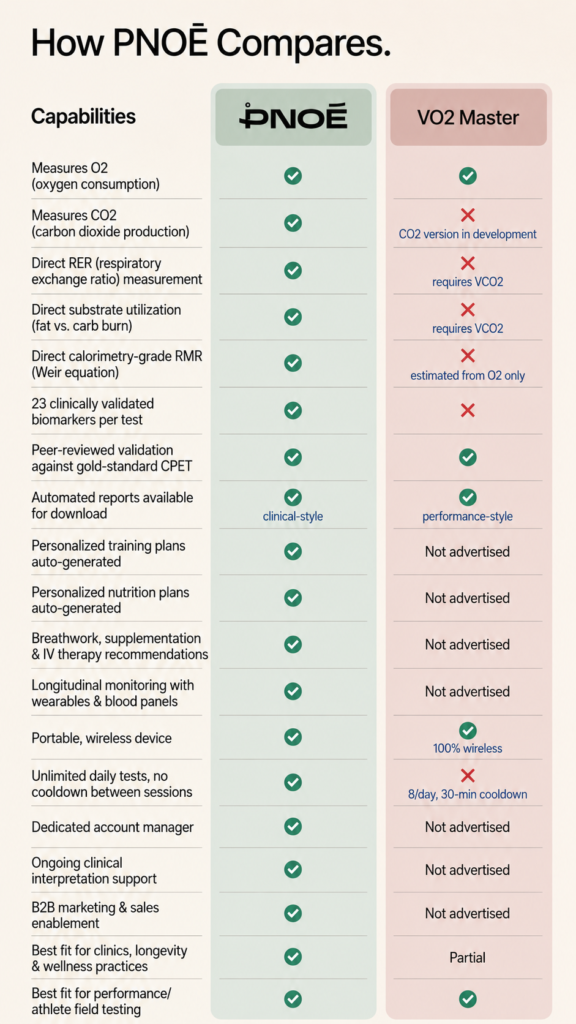
Quick Comparison: PNOĒ vs VO2 Master at a Glance
If you only have 30 seconds, this PNOĒ vs VO2 Master summary captures the essentials. Each row reflects documented, publicly verifiable capabilities of each platform as of the verification date in the header.
What Does Each Device Actually Measure?
This is where the PNOĒ vs VO2 Master comparison really begins, because everything downstream — reports, programs, ROI — depends on the quality and breadth of the underlying data. Get the PNOĒ vs VO2 Master measurement layer right, and every other decision becomes easier.
PNOĒ measures both oxygen and carbon dioxide
PNOĒ performs full breath-by-breath analysis, capturing both the oxygen your client consumes (VO2) and the carbon dioxide they produce (VCO2). That dual measurement is what unlocks the deeper layer of metabolic insight. In a single 8–10 minute test, PNOĒ generates 23 clinically validated biomarkers, including:
- VO2 Max
- Resting Metabolic Rate (RMR)
- Substrate utilization — exact fat-vs-carbohydrate burn at rest and at every exercise intensity
- Ventilatory thresholds (VT1, VT2) — measured, not estimated
- Respiratory Exchange Ratio (RER)
- Breathing efficiency and mechanics
- Cardiovascular efficiency, oxygen pulse, and recovery markers
Every metric appears in a structured report that’s easy to walk a client through. You can show the precise heart rate at which they shift from burning mostly fat to mostly carbs, identify their true aerobic and anaerobic thresholds, and prescribe training zones based on physiology rather than population averages.
PNOĒ’s accuracy has been independently validated. In a peer-reviewed Frontiers in Sports and Active Living study, researchers compared PNOĒ against the COSMED Quark CPET — a previously validated stationary metabolic cart — across a four-stage incremental cycling protocol, and found strong correlations between the two devices in VO2, VCO2, ventilation (VE), and respiratory quotient (RQ). Correlations were r = 0.98 (p < 0.001) for VO2, VCO2, and VE, and r = 0.91 (p < 0.001) for RQ.
VO2 Master measures oxygen only (today)
VO2 Master is currently a single-sensor analyzer that measures oxygen consumption (VO2). According to VO2 Master’s own FAQ, a CO2 version is in development, but no release date has been announced. The company describes its current device as providing “lab-quality measurements for VO2, RMR, ventilatory thresholds, and more” in a portable form factor, with an Oxygen Sensor Accuracy of ±1% and Flow Sensor Accuracy of ±2% with syringe calibration (VO2 Master Features).
The trade-off of measuring O2 only is what happens without VCO2. Because indirect calorimetry derives substrate utilization and energy expenditure from the ratio of CO2 produced to O2 consumed, several core metabolic markers require a CO2 measurement to be calculated directly. The Respiratory Exchange Ratio is defined as RER = VCO2 / VO2, and different RER values indicate the body’s primary fuel source — an RER close to 0.70 suggests the body is predominantly burning fats for energy. Indirect calorimetry uses the Weir equation — EE (kcal/day) = ([VO2×3.941] + [VCO2×1.11]) × 1440 — to calculate energy expenditure from both gas measurements.
Without a CO2 sensor, those values cannot be calculated by the Weir equation as written and must instead be estimated from O2 uptake alone. For performance-focused clients where the priority is VO2 Max and training zones, that’s a reasonable simplification. For practices where weight management, substrate utilization, and clinical-grade RMR matter, the underlying data isn’t fully there in the current model.
Bottom line on PNOĒ vs VO2 Master measurement depth: PNOĒ gives you the full metabolic picture — oxygen and energy utilization, both measured directly. VO2 Master gives you a focused, well-engineered snapshot of oxygen uptake.
Reporting and Software: What Happens After the Test?
In any PNOĒ vs VO2 Master comparison, the reporting layer is where the practical day-to-day difference becomes obvious. Both companies offer reports — but the nature of those reports is meaningfully different.
PNOĒ: a full software ecosystem
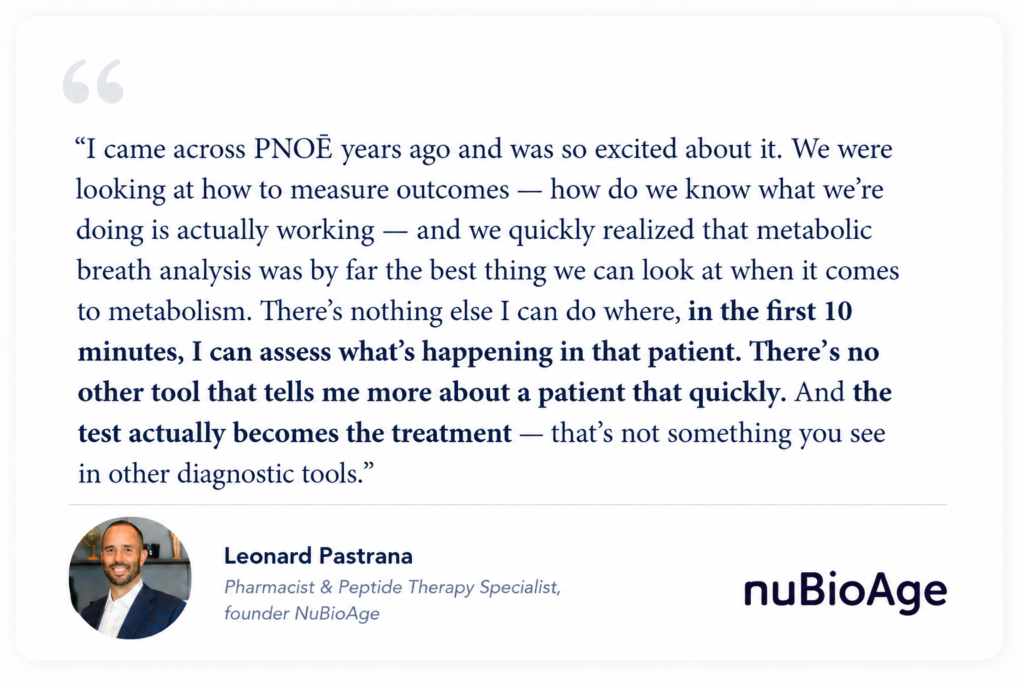
PNOĒ is not just a device — it’s a connected platform. The test feeds directly into:
- Automated, branded clinical-style reports that clients can take home, share, or revisit
- The PNOĒ Precision app, which auto-generates personalized training, nutrition, breathwork, supplementation, IV therapy, and bio-optimization plans from each test
- The PNOĒ Monitor platform, which tracks ongoing progress using wearables, blood panels, and follow-up tests
- Service recommendations built into every report, so clients see clearly what to do next and what to sign up for
This is what turns a one-time assessment into an ongoing client relationship — and a recurring revenue stream.
VO2 Master: performance-style reports, no integrated programming
VO2 Master also produces reports. Per VO2 Master’s FAQ, “assessment reports are provided instantly at your request and are available for download FREE of charge.” Per VO2 Master’s product page, reports cover “essential training zone metrics, VO2 Max, Heart Rate and RMR values, plus many others used in training optimization.” Data can be exported in CSV data tables and FIT file formats.
Based on VO2 Master’s publicly listed offerings, the platform does not advertise an auto-generated personalized nutrition or training plan engine, an integrated longevity or wellness programming layer, or a built-in client-facing recommendations engine. That work — interpreting the data clinically and turning it into a personalized plan — sits with the operator. For a solo coach focused on training zones, that’s manageable. For a clinic running ten clients a week with comprehensive wellness deliverables, it adds significant operator time per session.
Daily Throughput: How Many Tests Can You Actually Run?
Throughput is one of the most underrated factors in the PNOĒ vs VO2 Master decision — and it’s easy to overlook until it bites you on a busy day.
According to VO2 Master’s own FAQ, the maximum number of daily sessions is 8. Each session is limited to a maximum of one hour, with a 30-minute downtime required between sessions. For a solo coach with a handful of weekly clients, that’s a non-issue. For a clinic running back-to-back consultations, a wellness retreat, a corporate screening event, or a group of athletes, that ceiling becomes a real operational constraint.
PNOĒ has no daily test cap and no mandatory cooldown between sessions — you can run consecutive clients all day. If you’re scaling a practice, hosting events, or building a high-throughput service line, that flexibility matters.
Business Support: A Device vs a Growth System
This is the dimension that surprises most buyers in the PNOĒ vs VO2 Master decision, because it’s hard to evaluate on a spec sheet.
VO2 Master support
Per VO2 Master’s homepage, “VO2 Master provides training videos, live support, and a detailed manual. The app is very user friendly.” It’s a clean, well-executed handoff that gets you running tests quickly. After that, the relationship is largely transactional — you own the device, you run it.
Based on the services VO2 Master publicly lists on its website, the platform does not advertise:
- An ongoing program for clinical interpretation of results
- Auto-generated nutrition or exercise plan design
- Business enablement, marketing, or service packaging for B2B operators
This is consistent with how the company is publicly positioned — its strategic focus is hardware and app for the athlete, research, and performance market. VO2 Master’s “Our Story” page lists Nike, Trek, Adidas, “and many national federations, coaching businesses, and fitness centres” among its customers, and the company offers a free Garmin Connect IQ data field for live data on Garmin watches. It’s a focused, performance-first proposition.
PNOĒ support
PNOĒ is built around the assumption that the device is one piece of a larger business system. That means every account gets:
- A dedicated account manager for ongoing operational support
- Clinical and scientific support for interpreting complex cases
- Nutrition and training program templates built from validated methodologies
- Marketing materials, sales scripts, and service packaging to help you sell premium offerings
- Regular software updates and new feature releases
If you’re trying to grow a wellness, longevity, or performance practice — not just run tests — that infrastructure is the difference between owning a device and operating a service line.

Market Positioning: Different Devices for Different Buyers
In any PNOĒ vs VO2 Master comparison, it’s worth being plain about who each product is really for, because the marketing on both sides can blur this.
VO2 Master is positioned across both B2B and B2C, with strong traction in the fitness and performance community. Per VO2 Master’s “Our Story” page, the company’s customers include “Nike, Trek, Adidas, and many national federations, coaching businesses, and fitness centres.” Per the same page, the company’s stated mission is “the democratization of valuable performance and health information.” Based on its publicly listed services, VO2 Master’s strategic direction continues to point at hardware-plus-app for the athlete and performance market, rather than toward integrated clinical workflows or recurring service ecosystems.
PNOĒ is positioned as a clinical and professional wellness solution. It’s built for medical practices, longevity clinics, premium gyms, corporate wellness programs, dietitians, and any practice that wants to operate at the intersection of performance and health. The deeper data set, automated reporting, and integrated programming reflect that audience.
Neither approach is wrong. They’re answers to different questions.
Portability: Real, but Not the Decisive Factor
Portability is the one area in the PNOĒ vs VO2 Master comparison where VO2 Master has a clear, narrow advantage worth acknowledging.
Per VO2 Master’s blog, the analyzer is “light and small at just 230 grams,” and per the VO2 Master features page, it is “100% wireless” and Bluetooth-enabled, eliminating “the hassle of hoses, cables, and wires.” For mobile coaches doing field testing or pop-up assessments with minimal setup, that’s a real advantage.
PNOĒ is also portable: a small analyzer that clips to a harness or sits on a table, with cloud-connected software that runs from any device. It’s not pocket-sized, but it’s a long way from being tied to a lab — and it has been independently validated for use in both stationary and walking/ambulatory protocols.
The honest question is what you’re optimizing for. If you need the absolute smallest, simplest field unit and you only need VO2, VO2 Master wins on that axis. If you want a portable system that still delivers full O2/CO2 analysis, automated clinical-style reports, and integrated programming, PNOĒ is the better fit.
Frequently Asked Questions
These are the questions buyers most commonly ask us when researching PNOĒ vs VO2 Master. Each answer below links back to public sources where the underlying data can be verified.
What’s the main difference between PNOĒ and VO2 Master?
PNOĒ measures both oxygen and carbon dioxide, producing 23 clinically validated biomarkers and a full automated clinical-style report. VO2 Master currently measures oxygen only and provides VO2-focused performance reports; per VO2 Master’s own FAQ, a CO2 version is in development but has no announced release date. PNOĒ is a complete software-and-services platform with integrated programming; VO2 Master is a hardware-and-app device focused on training zone metrics.
Is PNOĒ accurate?
Yes. PNOĒ has been peer-reviewed against the COSMED Quark CPET — a previously validated stationary metabolic cart — and showed correlations of r = 0.98 for VO2, VCO2, and ventilation, and r = 0.91 for respiratory quotient, with strong test-retest reliability (Tsekouras et al., 2019).
Is VO2 Master accurate?
VO2 Master is accurate for measuring oxygen uptake and estimating VO2 Max in performance contexts. Per VO2 Master’s features page, the device specifies an Oxygen Sensor Accuracy of ±1% and Flow Sensor Accuracy of ±2% with syringe calibration, and the company describes its analyzer as offering “lab-grade accuracy” backed by peer-reviewed validation. The limitation is what it can’t measure directly — because the current model lacks a CO2 sensor, RER, substrate utilization, and direct-calorimetry RMR cannot be measured the way they can with a full O2/CO2 analyzer.
How much does a VO2 Master cost?
Per the VO2 Master product page, the analyzer is currently listed at $7,595 USD (reduced from a list price of $7,795 USD) at the time of this article’s verification date. Pricing is offered in Essentials and Professional kit configurations. Prices are subject to change; check vo2master.com for current pricing. Ongoing costs include consumable filter discs, desiccant cartridges, AA batteries, and annual service.
How much can I charge per metabolic test with each device?
Based on PNOĒ’s observation of the market, clinics using VO2 Master commonly charge end clients in the $75–$100 per test range, while practices using PNOĒ commonly charge $250 or more per test. These are observed ranges; per-test pricing varies considerably by region and practice positioning. Neither figure is set or endorsed by the device manufacturer.
Can I use VO2 Master for resting metabolic rate (RMR) testing?
VO2 Master can produce an RMR estimate based on O2 consumption, and the company describes the device as providing “lab-quality measurements for VO2, RMR, ventilatory thresholds, and more.” However, because the current model lacks a CO2 sensor, it cannot apply the full Weir equation that uses both VO2 and VCO2 directly. For clinical RMR work, weight management, and substrate-utilization analysis, an O2/CO2 analyzer like PNOĒ offers a more complete measurement.
How many tests can I run per day on each device?
Per VO2 Master’s FAQ, the maximum number of daily sessions with the VO2 Master Analyzer is 8, with a 30-minute downtime required between sessions and a maximum session length of 1 hour. PNOĒ has no daily cap and no mandatory cooldown, supporting back-to-back testing for clinics, group events, and high-throughput practices.
Is PNOĒ worth the higher investment compared to VO2 Master?
If you only need a VO2 Max number for performance coaching, VO2 Master is a capable option. If you’re building a premium wellness, longevity, or clinical practice that needs full metabolic data, automated clinical-style reports, integrated programming, and ongoing business support, PNOĒ delivers significantly more value per test and per client.
Does VO2 Master include automated reports?
Yes. Per VO2 Master’s FAQ: “Assessment reports are provided instantly at your request and are available for download FREE of charge.” These reports are performance-oriented — per the VO2 Master product page, they provide “essential training zone metrics, VO2 Max, Heart Rate and RMR values, plus many others used in training optimization.” Based on the services VO2 Master publicly advertises, the platform does not auto-generate personalized nutrition or training plans the way PNOĒ does.
Which is better for a clinic vs. an individual coach?
For an individual coach or athlete focused purely on performance testing, VO2 Master is a strong, portable choice. For a clinic, longevity practice, or any business where comprehensive reporting, integrated programming, throughput, and recurring client value matter, PNOĒ is built for that environment.
The Bottom Line on PNOĒ vs VO2 Master
Choosing in the PNOĒ vs VO2 Master decision isn’t really a question of which device is “better.” It’s a question of which one matches the business you’re trying to build.
If your work is performance coaching, you primarily need VO2 Max and training zones, you value a compact field unit, and you’re comfortable building your own programming around the data, VO2 Master is a well-engineered, focused tool that does its job at a clear one-time price point.
If you’re building a premium wellness, longevity, or clinical practice — where clients expect a comprehensive report, a personalized plan, and a clear next step — then PNOĒ’s full O2/CO2 measurement, automated clinical-style reporting, integrated programming, unlimited daily throughput, and ongoing business support are designed for exactly that work.
Your clients deserve more than a number. If you’re ready to give them a complete answer — and give your practice a system that grows with it — PNOĒ is built for that.
Want to see what a PNOĒ test and report actually look like? Book a demo or explore the PNOĒ platform to see the full workflow in action.
Sources & References
All factual claims in this article about VO2 Master are sourced directly from VO2 Master’s own publicly published materials. All factual claims about PNOĒ are sourced from PNOĒ’s own publications and from peer-reviewed validation studies. Information was last verified as of the date in this page’s header.
Peer-reviewed validation studies
- Tsekouras YE, Tambalis KD, Sarras SE, Antoniou AK, Kokkinos P, Sidossis LS. Validity and Reliability of the New Portable Metabolic Analyzer PNOE. Frontiers in Sports and Active Living, 2019. DOI: 10.3389/fspor.2019.00024. Frontiers | PubMed Central
- Validity and Reliability of the Portable Metabolic Analyzer PNOĒ to assess cardiometabolic capacity during walking exercise. ResearchGate, 2023. Link
- Validity and Reliability of the VO2 Master Pro for Oxygen Consumption Assessment. PubMed Central. Link
Sources for VO2 Master claims (all from vo2master.com)
- VO2 Master Analyzer — Product Page (pricing, kit contents, accuracy specs, batteries, calibration syringe, consumables, lab-quality measurements claim): vo2master.com/product/analyzer
- VO2 Master — Features Page (100% wireless, Bluetooth, ±1% O2 sensor accuracy, ±2% flow sensor accuracy, CSV/FIT exports): vo2master.com/features
- VO2 Master — Frequently Asked Questions (8 sessions/day limit, 30-min cooldown, 1-hour max session, reports provided FREE for download, free app/cloud access, additional costs, AAA→AA batteries note, CO2 version in development): vo2master.com/frequently-asked-questions
- VO2 Master — Annual Service Page (annual service required, on-site service kit option, send-in Complete Annual Service): vo2master.com/product/annual-service
- VO2 Master — Our Story (customer references: Nike, Trek, Adidas, national federations, coaching businesses, fitness centres; company mission statement): vo2master.com/our-story
- VO2 Master — Face Mask & Headgear ($220 USD listing): vo2master.com/product/face-mask
- VO2 Master — Homepage (lab-grade accuracy claim, peer-reviewed validation, training videos / live support / detailed manual): vo2master.com
- VO2 Master — Blog: “Portable Metabolic Analyzers Are Making Lab Carts Obsolete” (230-gram device weight): vo2master.com/blog/lab-carts-vs-portable-metabolic-analyzers/
- VO2 Master Garmin Data Field — Garmin Connect IQ Store: apps.garmin.com
Scientific references on indirect calorimetry
- Delsoglio M, Achamrah N, Berger MM, Pichard C. Indirect Calorimetry in Clinical Practice (Weir equation, RER, role of VCO2): PMC
- Respiratory Exchange Ratio (RER) — definition and calculation. Biology Insights: Link
- Robergs RA. Indirect Calorimetry: principles and measurement. University of New Mexico (Exercise Physiology): PDF
Related Posts
PNOĒ vs CORTEX: Which Metabolic Device Is Right for Your Business? [2026]
PNOĒ vs SpiroFit: Which Metabolic Testing System Is Right for Your Business? [2026]