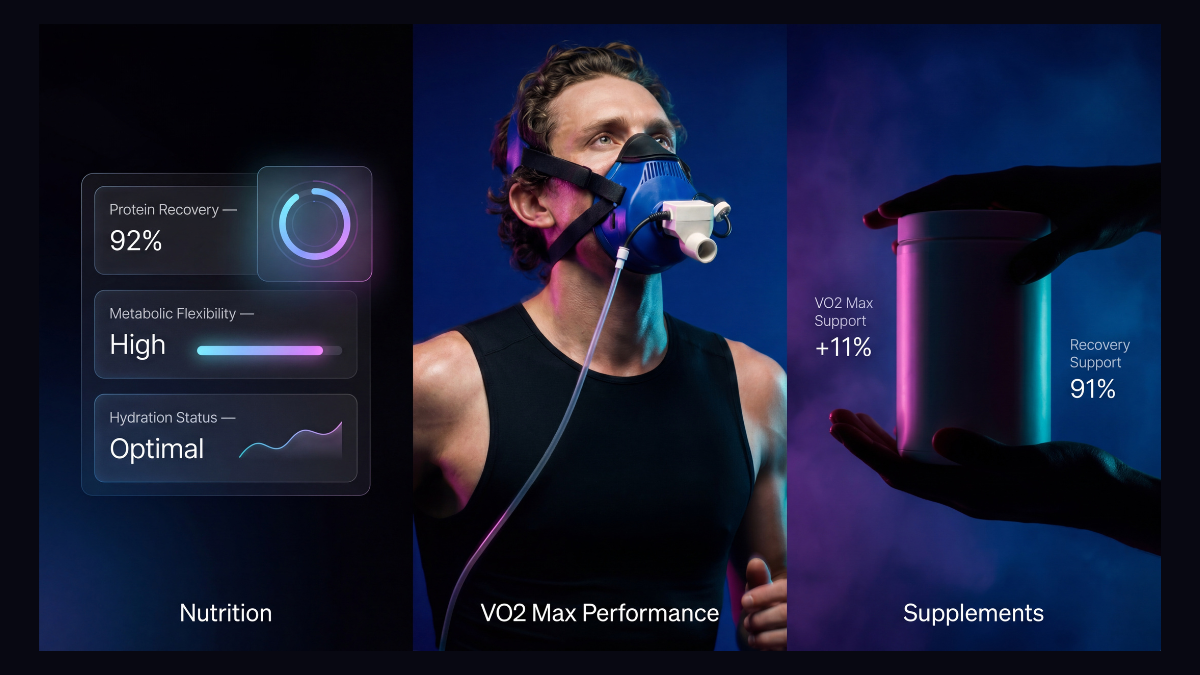
VO2 max nutrition is one of the most overlooked factors in aerobic performance. Training drives VO2 max improvement, but your nutrition determines whether your body can actually adapt. Underfueling, micronutrient deficiencies, and poor body composition management are among the most common hidden reasons VO2 max plateaus — and they are entirely fixable once you have the right data.
This guide covers the evidence-based VO2 max nutrition strategies and supplements that support aerobic improvement, explains how body composition affects your score, and shows why measuring your resting metabolic rate (RMR) through metabolic testing is the foundation of any effective VO2 max nutrition plan.
How VO2 Max Nutrition Affects Your Aerobic Ceiling
Your VO2 max reflects the integrated function of your lungs, heart, and mitochondria. VO2 max nutrition influences all three systems: oxygen-carrying capacity depends on iron and hemoglobin status, mitochondrial energy production requires specific cofactors, and the quality of your training — the primary driver of VO2 max — depends on adequate fueling.
Poor VO2 max nutrition does not just slow improvement. It can actively suppress your score by degrading training quality, impairing recovery, accelerating muscle loss, and triggering metabolic adaptation (metabolic slowdown).
Key Nutrients for VO2 Max Nutrition
Iron: The Most Critical VO2 Max Nutrition Factor
Iron is essential for hemoglobin (in red blood cells) and myoglobin (in muscle tissue), both of which transport oxygen. Even subclinical iron deficiency — low ferritin without full-blown anemia — can suppress VO2 max by 5–10%. This makes iron the single most impactful micronutrient for aerobic performance.
High-risk groups include female athletes, vegetarians and vegans, high-volume endurance athletes (due to foot-strike hemolysis and sweat losses), and adults over 50. Monitor ferritin levels at least annually. Optimal ferritin for aerobic performance is generally above 40–50 ng/mL — well above the clinical “normal” threshold.
Iron-rich foods include red meat, organ meats, dark poultry, lentils, spinach, and fortified cereals. Pair plant-based iron sources with vitamin C to enhance absorption.
Dietary Nitrate: Beetroot Juice in VO2 Max Nutrition
Dietary nitrate — found abundantly in beetroot juice, leafy greens (arugula, spinach, kale), and root vegetables — enhances nitric oxide production. Nitric oxide improves blood vessel dilation, increasing blood flow and oxygen delivery to working muscles.
Multiple studies show that beetroot juice supplementation (typically 300–600 mg of nitrate, consumed 2–3 hours before exercise) modestly but consistently improves exercise efficiency, time to exhaustion, and repeated sprint performance. While beetroot juice does not directly raise VO2 max in all studies, it improves the efficiency with which your body uses oxygen — meaning you get more performance from the same VO2 max.
CoQ10: Mitochondrial Support in VO2 Max Nutrition
Coenzyme Q10 is a cofactor in the mitochondrial electron transport chain — the final step where oxygen is used to produce ATP. CoQ10 levels decline with age, potentially contributing to age-related VO2 max reduction. Some evidence supports CoQ10 supplementation (100–300 mg/day) for improving mitochondrial efficiency, particularly in adults over 40 working to improve their aerobic capacity.
Omega-3 Fatty Acids for VO2 Max Support
Omega-3s (EPA and DHA from fish oil or algae) support mitochondrial membrane integrity, reduce exercise-induced inflammation, and may improve oxygen delivery by enhancing red blood cell deformability. A daily intake of 1–3g of combined EPA/DHA supports the recovery and cellular health that underpin VO2 max adaptation.
Vitamin D and VO2 Max
Vitamin D deficiency is associated with reduced cardiovascular function and impaired muscle performance. Maintaining adequate levels (above 40 ng/mL) supports the cardiovascular and muscular systems that drive VO2 max. Supplement if your blood levels are below optimal, particularly during winter months or if you train predominantly indoors.
→ How to improve VO2 max with evidence-based training protocols
VO2 Max Nutrition Fueling Strategy
Know Your RMR Before Setting VO2 Max Nutrition Targets
Every effective VO2 max nutrition plan starts with knowing your actual resting metabolic rate — not an estimate from an online calculator. RMR formulas can be off by 200–500+ calories per day for any individual. A PNOĒ metabolic test measures your exact RMR through breath analysis, giving you the precise caloric baseline from which to calculate training-day and rest-day VO2 max nutrition.
→ What a PNOĒ metabolic test measures
Fuel VO2 Max Sessions With Carbohydrate
VO2 max interval training depletes glycogen rapidly. Arriving at these sessions with low glycogen stores reduces the intensity you can sustain, limiting the stimulus that drives adaptation.
Consume a carbohydrate-rich meal 2–3 hours before VO2 max sessions. For sessions lasting over 60 minutes total, consider 30–60g of intra-workout carbohydrate.
Adequate Protein in Your VO2 Max Nutrition Plan
Protein supports muscle repair, mitochondrial biogenesis, and the maintenance of lean mass — all of which influence VO2 max. Target 1.6–2.2 g/kg/day, distributed across 3–4 meals. This range supports both strength and aerobic adaptations.
Body Composition and VO2 Max Nutrition
Because VO2 max is expressed per kilogram of body weight (mL/kg/min), excess body fat directly lowers your score. Losing 5 kg of fat without any change in cardiovascular fitness produces a measurable VO2 max improvement simply from the better ratio. This makes body composition management a critical part of VO2 max nutrition.
However, aggressive dieting undermines VO2 max improvement. Rapid weight loss sacrifices muscle, reduces training capacity, and triggers adaptive thermogenesis — a measurable decline in RMR. A moderate caloric deficit (300–500 kcal/day below measured total expenditure) guided by PNOĒ’s RMR data ensures fat loss without metabolic damage. The goal is losing fat without losing the muscle and metabolic rate that support your aerobic ceiling.
→ VO2 max norms by age and gender — see where your score falls
The Bottom Line on VO2 Max Nutrition
Training is the primary driver of VO2 max improvement, but VO2 max nutrition is the environment in which that adaptation occurs. Ensure adequate iron status, fuel high-intensity sessions with carbohydrate, maintain sufficient protein, consider evidence-supported supplements (beetroot juice, CoQ10, omega-3s), and manage body composition using RMR data from metabolic testing — not guesswork.
The difference between guessing at calories and fueling from measured RMR data is the difference between a VO2 max nutrition plan that works and one that holds you back.
References
- Jones AM. “Dietary Nitrate Supplementation and Exercise Performance.” Sports Medicine. 2014;44(Suppl 1):S35–S45. https://pubmed.ncbi.nlm.nih.gov/25355187/
- Burden RJ, Morton K, Richards T, et al. “Is Iron Treatment Beneficial in Iron-Deficient but Non-Anaemic (IDNA) Endurance Athletes? A Systematic Review and Meta-Analysis.” British Journal of Sports Medicine. 2015;49(21):1389–1397. https://pubmed.ncbi.nlm.nih.gov/26062954/
- Mandsager K, Harb S, Cremer P, et al. “Association of Cardiorespiratory Fitness With Long-term Mortality.” JAMA Network Open. 2018;1(6):e183605. https://jamanetwork.com/journals/jamanetworkopen/fullarticle/2707428
- Frankenfield D, Roth-Yousey L, Compher C. “Comparison of Predictive Equations for Resting Metabolic Rate.” Journal of the American Dietetic Association. 2005;105(5):775–789. https://pubmed.ncbi.nlm.nih.gov/15883556/
- Tsekouras YE, Tambalis KD, Sarras SE, et al. “Validity and Reliability of the New Portable Metabolic Analyzer PNOE.” Frontiers in Sports and Active Living. 2019;1:24. https://www.frontiersin.org/journals/sports-and-active-living/articles/10.3389/fspor.2019.00024/full
Related Posts
Brain Fog and Metabolism: What Your Breath Reveals About Focus
VO2 Max and Brain Health: How Fitness Protects Your Cognition