Menopause doesn’t just change how you feel. It changes how fast you age at a cellular level.
A landmark study published in the Proceedings of the National Academy of Sciences (PNAS) — analyzing over 3,100 women across four large cohorts including the Women’s Health Initiative — found that menopause significantly accelerates epigenetic aging in blood. Earlier menopause was associated with faster biological aging. Longer time since menopause compounded the effect. And surgical menopause (bilateral oophorectomy) accelerated the process even further.
This isn’t a fringe finding. It’s a direct, measurable link between reproductive aging and biological age at menopause — confirmed through DNA methylation-based epigenetic clocks, the gold standard of biological aging measurement.
But here’s what most women aren’t told: the metabolic drivers of that acceleration — declining VO2 Max, muscle loss, visceral fat gain, reduced fat oxidation, and insulin resistance — are all measurable. And many of them are reversible.
The Metabolic Cascade That Drives Biological Aging
Menopause triggers a cascade of metabolic changes that go far beyond hot flashes and mood shifts. A 2026 paper in PMC described perimenopause as “a critical window of heightened metabolic sensitivity” — a period where physiological and behavioral changes converge to accelerate cardiovascular risk and metabolic decline.
Here’s what the research shows happening simultaneously:
Muscle loss accelerates sharply. A cross-sectional study of 144 women found that appendicular lean mass index was 10% lower in late perimenopausal women compared to early perimenopausal women — a sharp decline in a short window. The prevalence of sarcopenia jumped from 3% in early perimenopause to 30% in late perimenopause. A 2026 UK Biobank study of 68,064 postmenopausal women confirmed that a distinctive metabolomic signature — spanning 86 metabolites across lipid, amino acid, and glycolytic pathways — tracks time since menopause and partly mediates the association with sarcopenia.
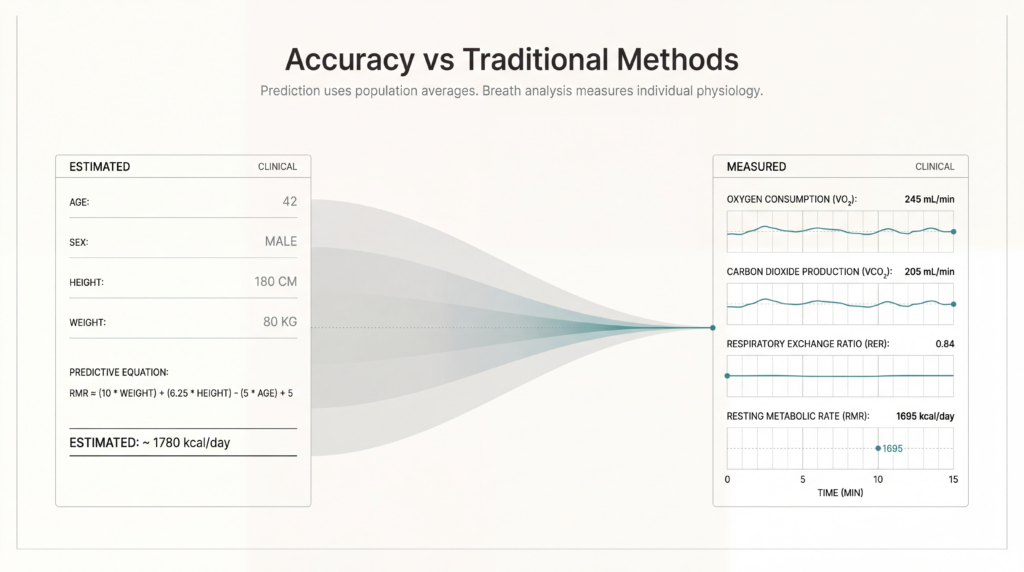
Resting metabolic rate drops. Skeletal muscle has a metabolic rate more than three times higher than adipose tissue. As muscle declines, so does baseline energy expenditure. This isn’t just about weight gain — it reflects declining mitochondrial activity and cellular energy production. A comprehensive review in PMC noted that the decrease in estradiol, combined with body composition changes, plays a central role in reducing basal metabolic rate during and after the menopausal transition.
Visceral fat expands — even without weight gain. Perimenopause shifts fat storage from subcutaneous (under the skin) to visceral (around the organs). This redistribution occurs even when total body weight stays stable, which is why the scale misses it entirely. Visceral fat drives hepatic insulin resistance, increases free fatty acid flux, and secretes inflammatory cytokines that accelerate vascular aging.
Fat oxidation declines during exercise. Research published in Menopause found that postmenopausal women have significantly decreased whole-body fat oxidation during exercise compared to premenopausal women. A 2025 cross-sectional study in the Journal of the International Society of Sports Nutrition confirmed that perimenopause marks the onset of unfavorable metabolic characteristics — including higher body fat percentage and altered fat-to-lean ratios — even after adjusting for age and hormone levels.
VO2 Max declines significantly. Postmenopausal women show a measurable drop in maximal oxygen consumption — the single strongest predictor of all-cause mortality and cardiovascular disease risk. Studies confirm that this decline is linked to both hormonal changes and the loss of lean mass that accompanies the menopausal transition. A 2025 study found that the GrimAge epigenetic clock — the biological aging measure most strongly associated with functional capacity — showed a significant negative correlation with VO2 Max across adulthood. Higher VO2 Max meant slower biological aging. Lower VO2 Max meant faster.
VO2 Max: The Most Actionable Biological Age Marker
Epigenetic clocks are powerful research tools. But for most women, the most actionable biological age marker available today is VO2 Max.
A 2025 study published in PMC found that individuals in the high-fitness group (based on VO2 peak) had epigenetic age acceleration that was 2.0 years lower in women than in the medium-to-low fitness group. VO2 peak and ventilatory threshold were more strongly associated with epigenetic age acceleration than grip strength or leg extension power — meaning cardiovascular fitness predicted biological aging better than raw strength.
A separate 12-year longitudinal study in the Journal of Cachexia, Sarcopenia and Muscle confirmed that moderate-to-vigorous physical activity was associated with decreased epigenetic aging across multiple clocks, reinforcing that exercise — particularly aerobic exercise — is one of the most potent geroprotectors available.
For women in perimenopause and menopause, the implication is clear: VO2 Max is not just a fitness metric. It’s a biological aging metric. And it’s measurable in a single breath test.
What Breath Testing Measures — And Why It Matters More Than a Number
Biological age testing through epigenetic clocks gives you a number — but it doesn’t tell you which metabolic levers to pull. A PNOĒ breath test does both: it gives you a biological age estimate and the functional metabolic data that explains it.
VO2 Max reflects cardiovascular and mitochondrial fitness — the strongest correlate of biological aging in the research. If it’s declining during menopause, your biological age is likely accelerating.
Resting metabolic rate (RMR) shows whether muscle loss is suppressing your baseline energy expenditure. A dropping RMR during perimenopause is an early warning of sarcopenia and metabolic adaptation.
Fat oxidation rate reveals how efficiently your mitochondria burn fat for fuel. Declining fat oxidation during menopause reflects the downregulation of beta-oxidation genes caused by estradiol loss — and it’s directly measurable through breath.
Metabolic flexibility indicates how well your body switches between fuel sources. Poor metabolic flexibility signals insulin resistance — one of the central metabolic consequences of menopause and a driver of both visceral fat gain and biological age acceleration.
Together, these four markers paint a complete picture of your metabolic age — not a static number, but a dynamic profile that shows where your body is, which systems are declining, and what to do about it.
What You Can Do About It
The research is clear: the metabolic drivers of biological aging during menopause are modifiable. The interventions that move the needle are specific and measurable.
Resistance training 2–3x per week directly counteracts sarcopenia by stimulating muscle protein synthesis. It’s the most effective non-pharmacological tool for preserving lean mass and RMR during the menopausal transition.
Zone 2 aerobic training improves mitochondrial density, fat oxidation, and VO2 Max — the metabolic markers most strongly correlated with slower biological aging. A PNOĒ test identifies your personal Zone 2 heart rate range based on your metabolic data.
Protein intake of 1.2–1.6 g/kg/day supports muscle preservation and repair. During menopause, when appetite may shift and lean mass is under threat, protein becomes a non-negotiable macronutrient.
Metabolic testing every 3–6 months tracks whether these interventions are working. VO2 Max trending up? RMR stable? Fat oxidation improving? That’s proof your biological age trajectory is changing — in real numbers.
The Bottom Line: Measure It, Then Move It
Menopause accelerates biological aging. That’s what the epigenetic data shows, and it’s what the metabolic data confirms. But acceleration is not destiny. The same research that documents the decline also documents the reversal: exercise slows epigenetic aging, higher VO2 Max correlates with younger biological age, and metabolic health is the system that ties it all together.
Your biological age isn’t set by your birthday or your hormones. It’s shaped by how your metabolism performs — and that’s something you can measure, track, and change.
SOURCES
- PNAS — Levine et al., “Menopause accelerates biological aging” (2016): https://www.pnas.org/doi/full/10.1073/pnas.1604558113
- PMC — “Perimenopause as an obesogenic sensitive period: Contributions to elevated cardiovascular risk” (2026): https://pmc.ncbi.nlm.nih.gov/articles/PMC12818170/
- PMC — “Menopause and the Loss of Skeletal Muscle Mass in Women” (2021): https://pmc.ncbi.nlm.nih.gov/articles/PMC7956097/
- ScienceDirect — “Time since menopause and a circulating metabolomic signature for sarcopenia risk: Data from 68,064 women” (2026): https://www.sciencedirect.com/science/article/abs/pii/S0378512226000526
- PMC — “Energy Metabolism Changes and Dysregulated Lipid Metabolism in Postmenopausal Women” (2021): https://pmc.ncbi.nlm.nih.gov/articles/PMC8704126/
- PubMed — “Metabolic effects of menopause: cross-sectional characterization of body composition and exercise metabolism” (2022): https://pubmed.ncbi.nlm.nih.gov/35231009/
- PMC — “Exercise as a geroprotector: focusing on epigenetic aging” (2025): https://pmc.ncbi.nlm.nih.gov/articles/PMC12339019/
- PMC — “Biological Ageing Acceleration and Functional Capacities Across the Lifespan” (2025): https://pmc.ncbi.nlm.nih.gov/articles/PMC12355191/
- PMC — “Physical Activity Is Associated With Decreased Epigenetic Aging” (2025): https://pmc.ncbi.nlm.nih.gov/articles/PMC12163535/
Related Posts

Mitochondrial Health: The Foundation of Energy and Longevity

Does Methylene Blue Work? How to Actually Measure the Effect