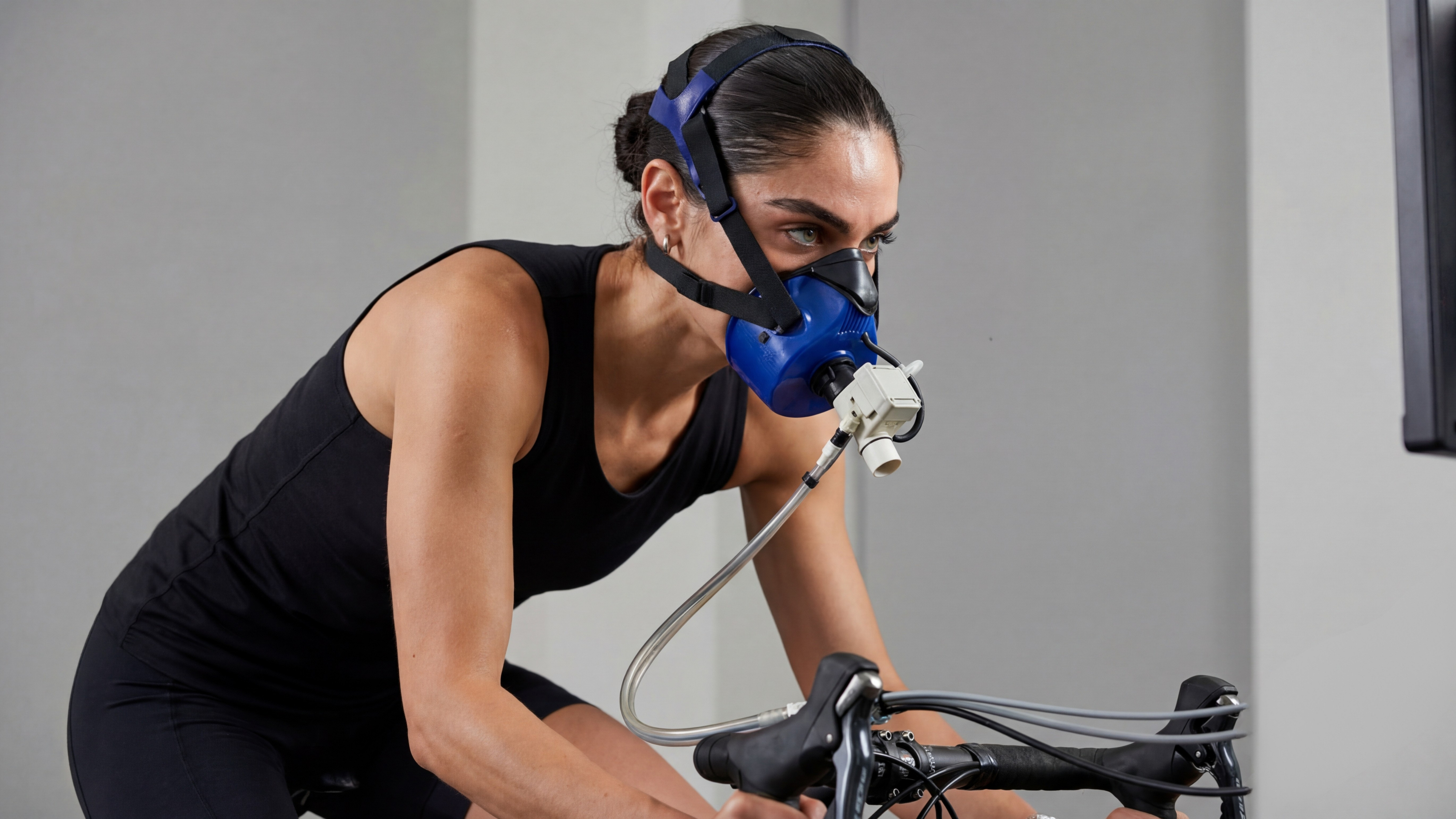
The demand for accurate VO2 max equipment has expanded far beyond university labs. Gyms, wellness clinics, longevity centers, corporate wellness programs, and individual consumers all want access to VO2 max testing, but the VO2 max equipment landscape is confusing. VO2 max devices range from $50,000+ stationary metabolic carts to $400 smartwatches that claim to measure the same thing.
They do not measure the same thing.
This guide breaks down every category of VO2 max equipment, explains what each VO2 max machine or device actually measures (versus what it estimates), and helps you decide which VO2 max testing equipment fits your goals, whether you are an individual looking for a single test, a coach building a VO2 max testing program, or a clinic evaluating capital investments in metabolic testing equipment.
Category 1: Stationary Metabolic Carts – Lab-Grade VO2 Max Equipment
Stationary metabolic carts are the traditional gold-standard VO2 max machines. These are the large, clinical-grade VO2 max testing systems found in hospital exercise physiology labs, university research facilities, and some high-end sports performance centers.
How This VO2 Max Equipment Works
The person exercises on a treadmill or cycle ergometer while breathing through a sealed mask connected to the VO2 max machine via tubing. The metabolic cart contains precision gas analyzers that measure oxygen (O2) and carbon dioxide (CO2) concentrations in inspired and expired air, along with flow sensors that measure ventilation volume. This VO2 max equipment collects breath-by-breath data in real time, providing the most direct measurement of VO2 max available.
Key VO2 Max Equipment Manufacturers
Major stationary VO2 max machine manufacturers include COSMED (Quark CPET), MGC Diagnostics (Ultima), Vyaire Medical (Vyntus), and Jaeger (Oxycon Pro). These VO2 max testing systems have decades of clinical validation and serve as the reference standard in published research.
Strengths of Stationary VO2 Max Equipment
This VO2 max equipment offers the highest measurement precision. Stationary metabolic carts are validated across thousands of clinical studies, accepted for insurance-reimbursable cardiopulmonary exercise testing (CPET), and capable of producing a full suite of metrics – VO2, VCO2, RER, ventilatory equivalents, O2 pulse, anaerobic threshold, respiratory compensation point, and more.
Limitations of Lab-Based VO2 Max Machines
Cost is the primary barrier for this VO2 max equipment. A complete metabolic cart system (including the VO2 max analyzer, mixing chamber, calibration gases, software, treadmill or ergometer, and installation) typically costs $40,000-$80,000 or more. Ongoing expenses include regular calibration, maintenance contracts, consumables, and trained technician labor.
This VO2 max equipment is not portable. It requires a dedicated testing room, a stable power supply, and environmental controls. Testing throughput is limited – 15-30 minutes of preparation for a 10-15 minute VO2 max test means a single machine can only process a handful of clients per day.
For hospitals and research institutions, stationary VO2 max machines remain essential. For clinics and gyms looking to offer VO2 max testing at scale, the economics and logistics of this equipment are challenging.
Category 2: Portable VO2 Max Analyzers – Clinical-Grade VO2 Max Equipment, Anywhere
Portable VO2 max analyzers represent the most significant evolution in VO2 max equipment over the past decade. These VO2 max devices deliver lab-grade gas exchange measurement in a wireless, lightweight form factor that can be used anywhere.
How Portable VO2 Max Equipment Works
Like stationary carts, portable VO2 max machines use indirect calorimetry to measure O2 and CO2 concentrations in expired air. The gas sensors, flow meters, and processing electronics are miniaturized and integrated into the mask or a compact unit attached to it. Data from this VO2 max equipment is transmitted wirelessly to a tablet or software platform for real-time display and post-test analysis.
PNOĒ: The Leading Portable VO2 Max Machine With Clinical Precision
PNOĒ is the leading portable VO2 max testing device that has been independently validated against gold-standard lab VO2 max equipment. In controlled studies comparing PNOĒ to the COSMED Quark CPET (one of the most respected stationary VO2 max machines) researchers found near-perfect agreement across all major metrics: VO2, VCO2, RQ, and ventilation. PNOĒ achieved correlation coefficients around r = 0.98 and test-retest reliability of approximately ICC = 0.98.
What sets PNOĒ apart from other portable VO2 max equipment is not just measurement accuracy but the breadth of output. A single 10-minute test with this VO2 max device generates 23 biomarkers:
- VO₂ peak (VO2 max): Your aerobic ceiling, measured with clinical precision
- Resting metabolic rate (RMR): Exact caloric burn at rest
- Ventilatory thresholds (VT1 and VT2): Precise training zone boundaries derived from your actual VO2 max test
- Respiratory exchange ratio (RER): Metabolic flexibility and fuel utilization
- Fat and carbohydrate oxidation rates: How efficiently you burn each fuel source
- O2 pulse: Cardiovascular efficiency per heartbeat
- VE/VCO2: Ventilatory (lung) efficiency
- Biological age: Based on your VO2 max relative to population norms
- Tidal volume peak (VT Peak): Breathing mechanics assessment
- And 14 additional biomarkers spanning lung, heart, and cellular health
Beyond raw biomarkers, this VO2 max equipment includes an AI engine that generates personalized training plans, nutrition protocols, and recovery recommendations. The PNOĒ platform integrates with wearable data (Apple Watch, Garmin, WHOOP, Fitbit) and lab results (blood, urine, saliva) into a unified health dashboard.
For clinics, gyms, and wellness centers, PNOĒ VO2 max equipment is designed as a revenue-generating service, a metabolic testing program that drives client acquisition, improves retention through measurable VO2 max progress tracking, and creates upsell opportunities for nutrition counseling, personal training, and recovery modalities.
Strengths of Portable VO2 Max Equipment Like PNOĒ
Clinical accuracy combined with operational flexibility is the core advantage of portable VO2 max machines. A PNOĒ VO2 max test takes under 10 minutes with minimal setup, in any location, operated by a trained staff member. This makes high-volume VO2 max testing feasible – a single device can test 8-12 clients per day.
Cost of ownership for this VO2 max equipment is a fraction of stationary carts. There is no need for a dedicated lab, calibration gases, or expensive maintenance contracts.
Considerations When Choosing Portable VO2 Max Equipment
Portable VO2 max devices require operator training to ensure consistent mask seal, proper calibration, and correct test protocols. PNOĒ addresses this with standardized onboarding, in-app guidance, and automatic quality checks. As with any VO2 max machine, test quality depends partly on the operator and the client’s effort during the test.
Category 3: Consumer Wearables – VO2 Max Estimates, Not VO2 Max Equipment
Every major smartwatch brand now displays a “VO2 max” score. Apple Watch, Garmin, Fitbit, WHOOP, Polar, and COROS all offer this feature. It is important to understand that wearables are not VO2 max equipment in the clinical sense, they are estimation devices.
How Wearables Estimate VO2 Max Without VO2 Max Equipment
Wearables do not contain gas analyzers. Unlike actual VO2 max machines, they never measure oxygen consumption. Instead, they use algorithms that correlate heart rate data with movement data (pace, power, cadence) during outdoor activities to predict VO2 max based on population-level models.
The underlying logic comes from the known relationship between heart rate and oxygen consumption. Wearables apply this using proprietary algorithms (Garmin uses Firstbeat Analytics, Apple uses its own model, WHOOP uses a combination of physiological inputs) to generate an estimated VO2 max score.
How Accurate Are Wearable VO2 Max Estimates Compared to VO2 Max Equipment?
Research comparing wearable VO2 max estimates to values measured by actual VO2 max equipment shows typical errors of 5-15%. Wearable VO2 max scores are less accurate for:
- Beginners and very unfit individuals (algorithms calibrated on moderately active populations)
- Highly trained athletes (wearables often underestimate elite VO2 max)
- People with atypical heart rate responses (medications, cardiac conditions)
- Indoor activities (most wearable VO2 max features require GPS-based outdoor movement)
Wearable VO2 max scores work best as trend trackers over time. If your number increases over several months, your fitness has probably improved. But these scores should not be used for training zone prescription, clinical decisions, or precise benchmarking against VO2 max norms, that requires actual VO2 max testing equipment.
What Wearables Cannot Do (That VO2 Max Equipment Can)
No consumer wearable provides any of the following, all of which are standard outputs from VO2 max equipment like PNOĒ:
- Resting metabolic rate (RMR) measurement
- Fat oxidation rate and crossover point
- Ventilatory thresholds (VT1, VT2) for precise training zones
- Lung efficiency metrics (VE/VCO2)
- O2 pulse for cardiovascular efficiency assessment
- Tidal volume and breathing mechanics analysis
- Metabolic flexibility quantification (RER)
- Biological age based on measured VO2 max data
- Personalized nutrition and training plans from metabolic data
Wearables complement VO2 max equipment but do not replace it. They are daily tracking tools that pair well with periodic clinical-grade VO2 max testing.
→ Apple Watch vs. Garmin vs. WHOOP vs. PNOĒ: Full VO2 max accuracy comparison
Category 4: Field Tests – Estimating VO2 Max Without Equipment
For people who want a rough VO2 max estimate without any specialized VO2 max equipment, several validated field test protocols exist:
Cooper 12-Minute Run Test. Run as far as possible in 12 minutes on a flat surface. Distance is used to estimate VO2 max via a validated formula. Free and simple, but VO2 max accuracy depends on pacing and motivation.
1.5-Mile Run Test. Run 1.5 miles as fast as possible. Completion time estimates VO2 max. Similar limitations to the Cooper test.
Rockport 1-Mile Walk Test. Walk one mile as fast as possible, record time and immediate heart rate. A formula estimates VO2 max. More accessible for lower-fitness individuals who cannot sustain a run.
20-Meter Shuttle Run (Beep Test). Run back and forth between markers at increasing speeds. The level reached estimates VO2 max. Common in team sports and military fitness testing.
These tests provide ballpark VO2 max estimates, useful for initial screening when no VO2 max equipment is available, but far less precise than direct measurement. They cannot identify your VO2 max limiter, measure metabolic rate, or provide personalized training zone data.
VO2 Max Equipment Comparison: Which Is Right for You?
The best VO2 max equipment depends on who you are and what you need:
Hospitals and research institutions: Stationary metabolic cart VO2 max equipment remains the standard for clinical CPET and insurance-reimbursable testing. Consider supplementing with portable VO2 max equipment for outreach or field testing.
Gyms, wellness clinics, and longevity centers: Portable VO2 max equipment like PNOĒ offers the best balance of clinical accuracy, operational efficiency, and revenue potential. Stationary VO2 max machines are overkill for this setting; wearables provide insufficient data for professional use.
Personal trainers and coaches: A portable VO2 max device enables you to offer VO2 max testing as a premium service, differentiate from competitors, and build training programs on objective data instead of guesswork.
Individual consumers seeking a one-time VO2 max test: Find a facility that uses validated VO2 max equipment, either a portable analyzer like PNOĒ or a clinical lab. Avoid basing training decisions solely on wearable VO2 max estimates. Many PNOĒ partner locations offer single VO2 max test appointments.
Budget-conscious individuals without access to VO2 max equipment: Use a validated field test (Cooper, Rockport) to establish a baseline VO2 max estimate, then invest in a proper VO2 max test with clinical-grade equipment when you are ready to optimize.
→ Find a PNOĒ VO2 max testing location near you
The Future of VO2 Max Equipment and Testing Technology
VO2 max testing technology is moving toward greater accessibility, higher accuracy in smaller devices, and deeper integration with digital health ecosystems. Portable VO2 max equipment like PNOĒ leads this trend, bringing clinical-grade VO2 max precision to any environment.
As VO2 max testing becomes a standard component of preventive health care, fitness programming, and longevity medicine, the question is shifting from “Do I need VO2 max equipment?” to “Which VO2 max device delivers the best combination of accuracy, actionable data, and operational value?”
For clinics and practitioners evaluating VO2 max equipment, the answer increasingly points to portable analyzers that match lab accuracy while fitting seamlessly into existing workflows, and PNOĒ leads that category.
References
- Tsekouras YE, Tambalis KD, Sarras SE, et al. “Validity and Reliability of the New Portable Metabolic Analyzer PNOE.” Frontiers in Sports and Active Living. 2019;1:24. https://www.frontiersin.org/articles/10.3389/fspor.2019.00024
- Kwok MMY, Ng SSM, et al. “Validity and Between-Days Reliability of Two Different Metabolic Systems for Measuring Gas Exchange During Walking.” Sensors. 2024. https://www.researchgate.net/publication/387479340
- Ross R, Blair SN, Arena R, et al. “Importance of Assessing Cardiorespiratory Fitness in Clinical Practice: A Case for Fitness as a Clinical Vital Sign.” Circulation. 2016;134(24):e653–e699. https://www.ahajournals.org/doi/full/10.1161/CIR.0000000000000461
- Assessing Cardiorespiratory Fitness in Clinical and Community Settings: Lessons and Advancements in the 100th Year Anniversary of VO2max. Progress in Cardiovascular Diseases. 2024. https://www.sciencedirect.com/science/article/abs/pii/S0033062024000306
- Guidetti L, Meucci M, Bolletta F, et al. “Validity, Reliability and Minimum Detectable Change of COSMED K5 Portable Gas Exchange System in Breath-by-Breath Mode.” PLOS ONE. 2018;13(12):e0209925. https://journals.plos.org/plosone/article?id=10.1371/journal.pone.0209925
- Mandsager K, Harb S, Cremer P, et al. “Association of Cardiorespiratory Fitness With Long-term Mortality Among Adults Undergoing Exercise Treadmill Testing.” JAMA Network Open. 2018;1(6):e183605. https://jamanetwork.com/journals/jamanetworkopen/fullarticle/2707428
Related Posts

Repeated Sprint Ability: Why Soccer Is Really an Aerobic Sport

Soccer Player VO2 Max: How World Cup Athletes Compare to You

Brain Fog and Metabolism: What Your Breath Reveals About Focus