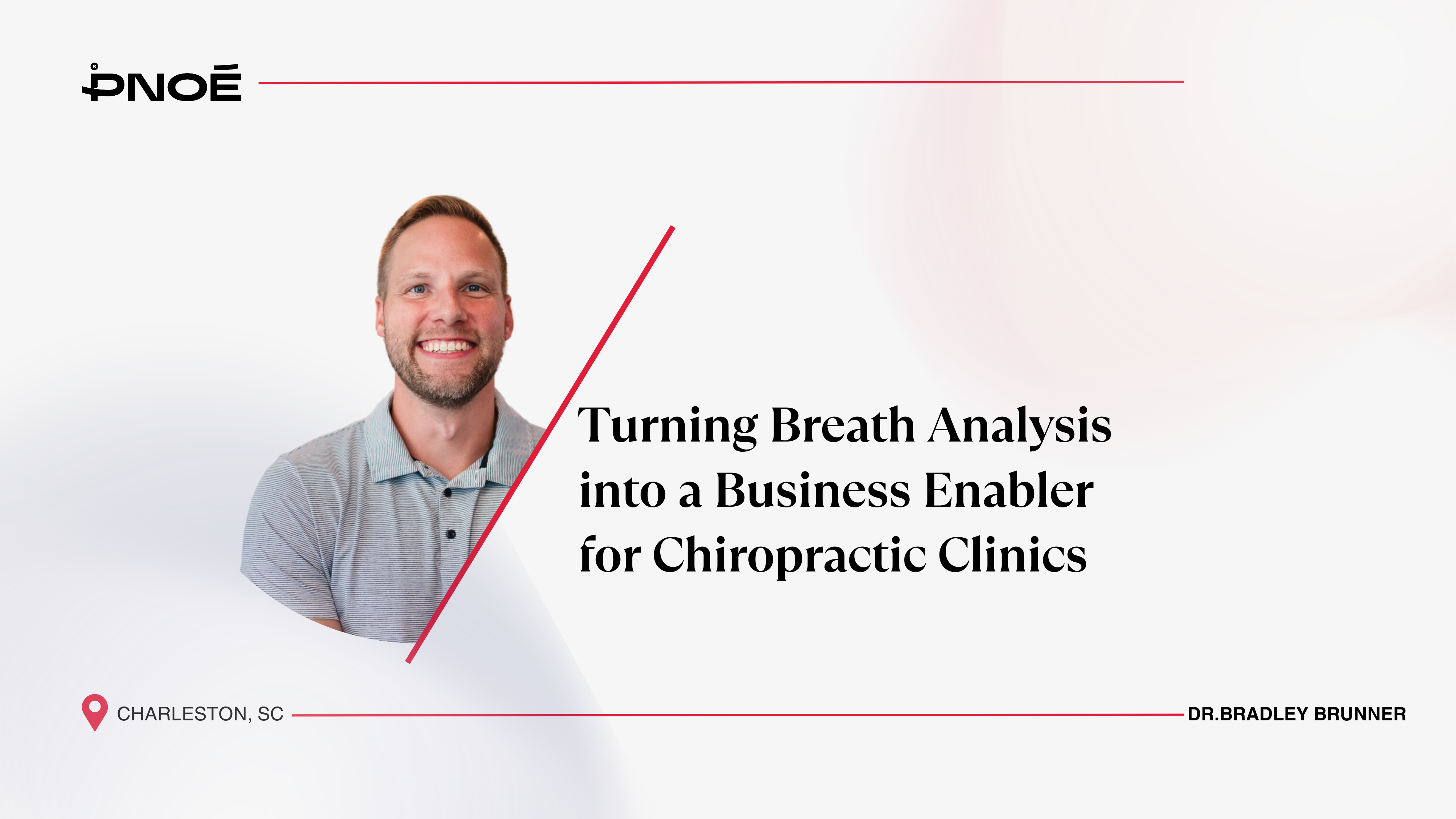
Welcome to the ChiroEconomics Webinar Series. In this session, we explore how breath analysis can become a true business enabler for chiropractic clinics supporting better outcomes, stronger retention, and higher client satisfaction through objective metabolic and cardio-respiratory data.
This webinar, Turning Breath Analysis into a Business Enabler for Chiropractic Clinics, is sponsored by PNOĒ and features Dr. Bradley Brunner and Panos Papadiamantis. Together, they break down what breath analysis is, why it’s considered one of the most holistic assessments of human physiology, and how chiropractors can integrate it into a scalable care model from baseline testing and progress tracking to program packaging, referrals, and complementary modality upsells.
Dr. Brunner also shares how breath analysis fits into a broader “quantified wellness” framework inside a modern chiropractic practice, including how he uses a test–retest model, program tiers, and the Superhuman Protocol to improve client buy-in and long-term engagement.
This webinar is ideal for chiropractors and clinic owners who want to modernize their care model, expand beyond pain-only services, and build a sustainable revenue engine around measurable health optimization.
Follow PNOĒ on Instagram: @pnoe_analytics
Gloria Hall: Hello everyone, welcome to the Chiropractic Economics webinar series. I’m Gloria Hall, Editor-in-Chief of Chiropractic Economics, and I’ll serve as your moderator today. Today’s webinar, Turning Breath Analysis into a Business Enabler for Chiropractic Clinics, is sponsored by PNOĒ and presented by Dr. Bradley Brunner and Panos Papadiamantis. This program is being recorded and will be archived on the Chiropractic Economics website. Within the next 24 hours, you’ll receive an email with the recording. There will be time for Q&A. Please submit questions through the Q&A feature not the chat.
Gloria Hall: Dr. Bradley Brunner is a chiropractor known for integrating advanced breath analysis and holistic programming into his practice enhancing retention, revenue, and client satisfaction. Panos Papadiamantis is an engineer and inventor focused on helping people live longer and better through breath analysis, and the co-founder of PNOĒ, a rapidly evolving precision health technology company trusted by thousands of health professionals, athletes, research centers, and longevity pioneers. Panos, over to you.
Panos Papadiamantis: Hi everyone. Gloria, thank you, and Dr. Bradley, it’s great to be here. This is a great opportunity to discuss what breath analysis is and how it can help a chiropractic clinic. We started PNOĒ back in 2016 with a vision of making breath analysis something every health professional can leverage in their practice. Today our clients range from fitness centers to longevity centers, integrative medicine practices, and chiropractic clinics. They use breath analysis to better understand physiology, create holistic programs, and evaluate how different modalities in their treatment plans are impacting client physiology.
Panos Papadiamantis: Dr. Bradley has been a PNOĒ customer for some time and has really mastered implementation. He’s also a Superhuman Protocol user. I’ll let Dr. Bradley share more about his practice and approach, then I’ll give a breath analysis overview, and we’ll get into how he uses PNOĒ in his business. Dr. Bradley, over to you.
Dr. Bradley Brunner: Thank you, Panos. I’m a board-certified chiropractic sports physician in downtown Charleston, South Carolina. My practice is centered on quantifying wellness, and PNOĒ helps me do that. Whether a client’s primary bucket is longevity, performance, or general health, I’m helping identify biomarkers in those areas. People are used to blood work and optimal ranges. I want the same standard for strength and conditioning. PNOĒ covers the conditioning side very well. I also use equipment called the Proteus for strength, power, and speed metrics. Together, this creates a strong continuum of care to serve clients where they are and guide them through their health and longevity journey.
Panos Papadiamantis: Thank you for sharing that. Many people may be familiar with breath analysis, and many may not, so let’s cover the basics. Breath analysis has been around for about 100 years. It measures oxygen consumption and carbon dioxide production often referred to as VO2 testing or metabolic testing. It began in the early 1900s as the first method used to quantify human energy expenditure and how many calories the body burns. Over time, it evolved into cardiopulmonary exercise testing, used widely in cardiology and pulmonology, and it’s known to be complex in both execution and interpretation.
Panos Papadiamantis: Despite the complexity, it’s considered one of the most holistic assessments of human biology because it can assess the efficiency of the oxygen chain lungs, heart, and cells. Humans rely on aerobic metabolism. Oxygen is absorbed through the lungs, pumped by the heart, delivered via blood circulation, used by cells to burn nutrients and generate CO₂, and then CO₂ is cleared through respiration. The oxygen chain also affects the nervous system through breathing regulation, and respiration can influence posture through abdominal pressure regulation.
Panos Papadiamantis: Major medical organizations recognize breath analysis as valuable including the American Heart Association, American Thoracic Society, and others because it can provide insights into heart function, metabolism, and lung function. Historically, it was underutilized because devices were expensive, operation was inefficient, and interpreting the data required specialized expertise. Beyond getting raw numbers, you still needed a system to translate results into personalized programming, which increased cost.
Panos Papadiamantis: At PNOĒ, we addressed this by building an independently validated cardio-metabolic analyzer with clinical-grade accuracy that is more accessible and easy to use. Then we built the software and service ecosystem clinics need to turn the data into actionable plans including intuitive reporting, and infrastructure to support personalized nutrition and training programming. Today, PNOĒ is used across high-end wellness, hospitality, and fitness environments, alongside medical and longevity-oriented practices.
Panos Papadiamantis: Technically, the device captures three signals: airflow (inhalation/exhalation), oxygen concentration, and CO₂ concentration. Analyzing these breath-by-breath allows us to calculate 23 biomarkers. Some are well-known, like VO2 Max, but there are many others that matter clinically and practically like oxygen pulse and markers related to fuel utilization. You can measure fat and carbohydrate oxidation at rest and during exercise, identify predisposition to metabolic disorders, and do it non-invasively.
Panos Papadiamantis: There are two main tests: a resting test and an exercise test. They measure the same underlying physiology, but in different conditions. Together, they provide a more complete picture. Key outputs include a biological age estimation using VO2 Max, metabolic rate, fuel utilization and macro guidance, system limitations that inform training structure, and personalized training zones. We also integrate clinic services into the reporting so that recommendations can align with what the clinic offers, based on detected biological limitations.
Panos Papadiamantis: Dr. Bradley, could you share how breath analysis fits into your clinic and what makes your approach different?
Dr. Bradley Brunner: PNOĒ makes things turnkey, which I love. I use a test–retest model and a systems approach. I can gather objective biomarkers, build a plan, and show progress so it’s not all subjective or based on “how someone feels.” The reports help create early wins and buy-in, then we can move clients into higher packages and longer programs. The expert staff and nutrition support have been very helpful, and the app improves accountability without requiring me to handhold as much. It’s been a game-changer.
Panos Papadiamantis: You’re also a Superhuman Protocol user. Can you explain what it includes and how you use breath analysis to support it?
Dr. Bradley Brunner: The Superhuman Protocol is a three-step sequence. First is PEMF to support grounding and improve cellular function. Second is exercise with oxygen typically intervals on an air bike or zone-based work depending on the person’s ability and testing limitations. Third is red light and near-infrared to support circulation, inflammation control, and cellular energy support. It’s powerful, and we can see changes through PNOĒ testing markers move back toward normal ranges, and it gives us objective justification for treatment cadence and plan structure.
Panos Papadiamantis: What we’ve seen across many Superhuman Protocol clinics is that clients often feel early benefits, but visible changes can take time. Breath analysis allows clinics to quantify improvements quickly, which helps retention. You can see faster shifts in fuel utilization and physiology than you might with slower-moving metrics like body composition.
Dr. Bradley Brunner: Exactly. With body comp scans, results take longer. With PNOĒ, I can see fat-carb utilization change faster, VO2 Max improve, and that creates excitement and momentum. It helps clients stay consistent because they can see objective progress.
Panos Papadiamantis: How do you use biological age and VO2 Max to drive acquisition and get people through the door?
Dr. Bradley Brunner: I’m part of a gym called the Longevity Club, and the audience expects longevity-focused services. Biological age becomes an incredible proxy and motivator, especially when tied to VO2 Max. People start comparing biological age, and it becomes a fun competition. It also lets me educate them on breathwork, zone 2, and interval work and we can see limitations clearly in the data, including how training emphasis shows up in results.
Panos Papadiamantis: Do you see better retention when you add nutrition and training programming alongside the Superhuman Protocol?
Dr. Bradley Brunner: Yes, because it accelerates outcomes. With repeated checkpoints and measurable trend lines, people stay engaged and accountable.
Panos Papadiamantis: How frequently do you retest, and do you do both resting and active tests?
Dr. Bradley Brunner: It depends. Often, I do them together, especially if the initial limitation is significant. If someone is very low in VO2 Max or fuel metrics, I’ll retest sooner, maybe every 2–3 months. If someone is already elite, I can push retesting further out 6 to 12 months. Early on, shorter intervals help drive results and momentum.
Panos Papadiamantis: What type of clients show the biggest uptake, and what are their goals?
Dr. Bradley Brunner: Typically ages 35 to 50. They’re professionals high-performing at work, trying to sustain energy for career and family. Many delayed health while building professional success and now want a data-driven baseline so we’re not guessing. We assess what’s limiting them and optimize from there.
Panos Papadiamantis: That matches what we see broadly. Most people are using this for longevity and disease prevention, not athletic optimization. Breath analysis has historically been associated with athletes, but the largest demand today is proactive health and longevity, and for people managing chronic metabolic, cardiovascular, or pulmonary issues.
Dr. Bradley Brunner: Absolutely. It’s medicine 3.0 proactive and preventative. Even if someone enters because of pain or dysfunction, I work to transition them along a continuum from pain to performance to long-term sustainability.
Panos Papadiamantis: Let’s zoom out into clinic growth. In my view, PNOĒ becomes the result of a clinic owner asking how to make their clinic better. Dr. Bradley, walk us through your systems approach.
Dr. Bradley Brunner: I start with PNOĒ resting testing to dial in nutrition calories and macros. Then I use the active test to understand recovery capacity and VO2 Max how well oxygen and blood are delivered. From there, I add strength, stamina, and stability metrics using Proteus to evaluate strength and stability throughout the body. I compare clients to normative values and retest over time. This improves outcomes and supports revenue growth because it represents a higher standard of care comprehensive, not narrow.
Dr. Bradley Brunner: PNOĒ was turnkey. It didn’t require me to change my philosophy just gave me the right tool to implement it. The reports are client-friendly, and I can tailor the conversation depending on goals.
Panos Papadiamantis: This is why we built a full ecosystem. Most traditional breath analysis reports only output two numbers VO2 Max and resting metabolic rate which aren’t prescriptive. Our reporting aims to identify limitations, guide next steps, and support services recommendations aligned with the clinic’s offering, plus nutrition and training programming support.
Gloria Hall: Let’s open it up to questions. Please use the Q&A feature.
Panos Papadiamantis: Great question cost and pricing. The PNOĒ device comes with services built in. At the end of the contract, the clinic owns the hardware. Pricing depends on the package and clinic needs. The best next step is to schedule a call with our team to review options and find the right fit. For demos or personal tests, we have many affiliates where you can get tested, and we also do demonstrations at events and expos. Again, the easiest step is to schedule time with our team.
Panos Papadiamantis: Dr. Bradley, can you share how you price PNOĒ testing and how it fits alongside your Superhuman Protocol services?
Dr. Bradley Brunner: Sure. I charge $150 per session. Resting test is $150, active test is $150, and nutrition is $150. So it scales: $150, $300, or $450 depending on what they do. We then review findings and build packages based on what the person needs. I’ve done an initial bundle before, but I generally don’t discount it. The value is high, and I’m straightforward about that.
Panos Papadiamantis: That structure is very common among affiliates. Dr. Bradley, how do you market this service?
Dr. Bradley Brunner: I reach out to gyms and practitioners who already hear about VO2 Max and zone 2 from major voices in the space. I position it as co-management. I’m not trying to take clients, I’m providing data to strengthen what they’re already doing. People are excited because it aligns with what they’re learning, and it gives objective proof and direction.
Panos Papadiamantis: On nutrition: we support personalized plans through our app and registered dietitians. Plans can be tailored to preferences and lifestyle, within safe guidelines, and aligned to metabolic data plus questionnaire inputs.
Gloria Hall: I don’t see additional open questions. Thank you both, this was very informative. This webinar was recorded and will be available on the Chiropractic Economics website. Thank you to PNOĒ and to both presenters for sharing your expertise.
Panos Papadiamantis: Thank you, Gloria, for organizing, and Dr. Bradley, thank you for joining and sharing how you’re using PNOĒ in practice.
Dr. Bradley Brunner: Thank you all.
Watch the full webinar HERE.
Related Posts

PNOĒ & PEMF: A Powerful Combo for Physical Therapy Facilities
Transform your Training & Rehab Facility into a Longevity Clinic with PNOĒ
Missing the Fat-Burning Sweet Spot? Unlock Zone 2 Training with PNOĒ