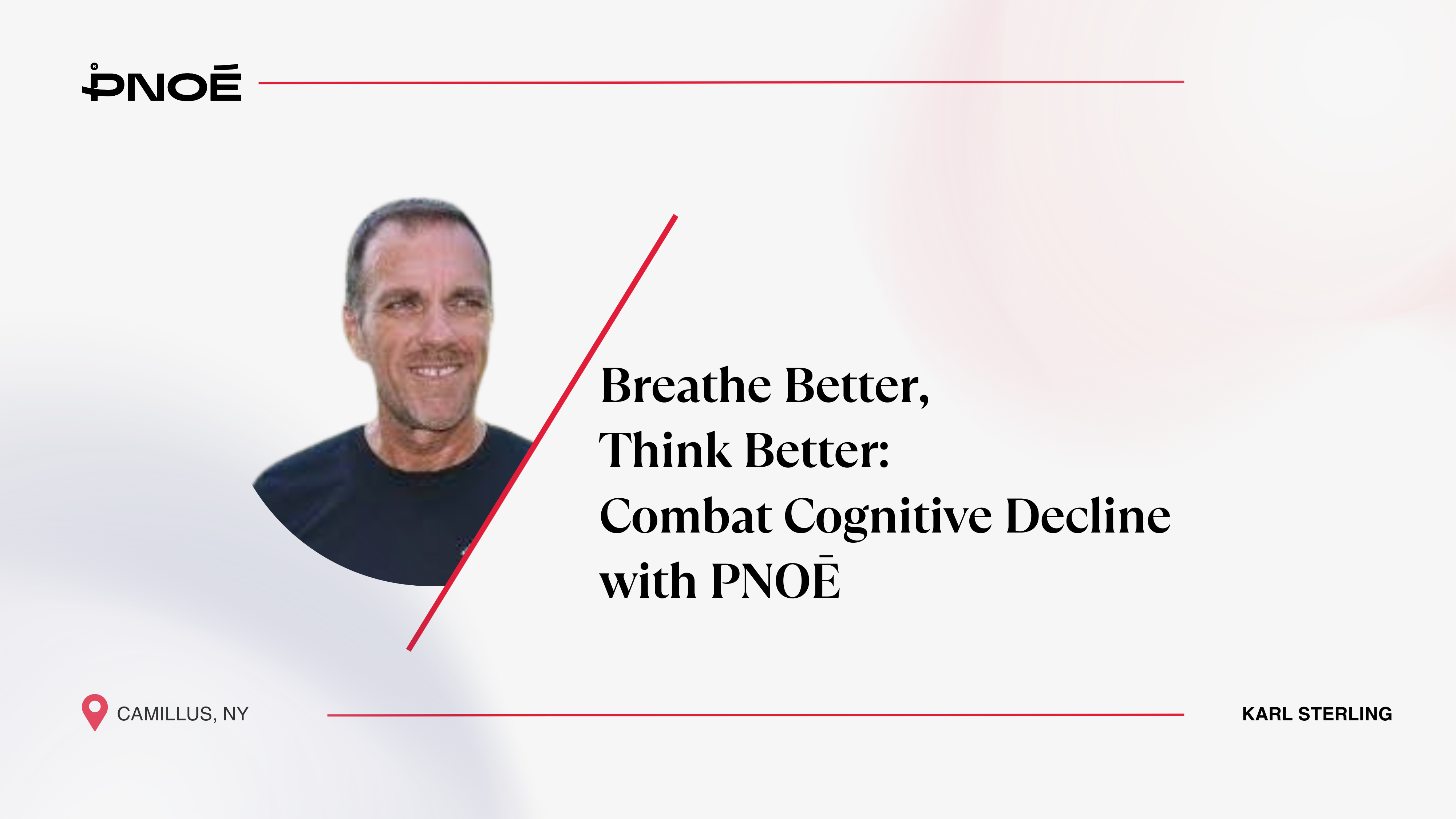
Welcome to this edition of the PNOĒ Webinar Series, where clinicians, performance specialists, and health practitioners explore how breath analysis and metabolic testing can be used to improve brain health, physical performance, and long-term longevity.
In this session, we examine a critical but often underappreciated connection: how breathing efficiency, VO2 Max, and cardio-metabolic health directly influence cognitive function and the risk of neurological decline. How does oxygen delivery to the brain affect memory, focus, and executive function? And how can objective data from metabolic breath analysis guide more precise exercise, nutrition, and lifestyle interventions aimed at preserving brain health?
If you’re looking for science-led, practical insights that can be applied in clinical practice or personal health optimization, this webinar brings together real-world case examples and actionable frameworks for combating cognitive decline, supporting neuroplasticity, and extending healthspan through personalized, data-driven programming.
Unlock deeper insight into brain and metabolic health with PNOĒ.
Learn how precision testing supports smarter decisions in longevity, performance, and neurological resilience.
Follow PNOĒ on Instagram: @pnoe_analytics
Panos Papadiamantis:
Hello everyone, I’m Panos Papadiamantis, Co-Founder of PNOĒ. Today, we’re joined by Dr. Karl Sterling. Karl is a long-time PNOĒ affiliate and has been using PNOĒ extensively in his practice in New York.
His primary focus is neuromotor training, training the neurological system to combat conditions such as mild cognitive impairment, Alzheimer’s disease, and other neurodegenerative disorders. A core aspect of his work is understanding how breathing mechanics and oxygen utilization influence brain function and neurological health.
Karl has integrated breath analysis, personalized nutrition, and targeted exercise programming derived from metabolic testing to improve outcomes for individuals dealing with neurological and cognitive challenges. Karl, thank you for being with us today. We’re very much looking forward to this discussion.
Dr. Karl Sterling:
Thank you, Panos. It’s an honor to be here, and I appreciate everyone taking the time to join.
I’m based in central New York, outside of New York City. Before entering this field, I spent 35 years as a professional drummer, starting at age 14. In 2008, I made a career transition after experiencing serious health issues. At the time, I was obese, dealing with diabetes, high blood pressure, neuropathy, and cardiovascular complications.
Those experiences led me back to school to study nutrition and eventually neuromotor rehabilitation. That journey fundamentally shaped the work I do today always seeking the most effective tools, strategies, and interventions that create meaningful change, especially as we age.
Dr. Karl Sterling:
A key concept I want to introduce early is the difference between lifespan and healthspan. Living longer does not necessarily mean living well. The goal is to preserve physical, cognitive, and metabolic function for as long as possible.
There are strong correlations between muscle mass, strength, and longevity. Grip strength, for example, is a well-established predictor of lifespan. Movement quality, balance, and aerobic fitness are all deeply connected to cognitive function and neurological resilience.
When muscle mass declines, balance often deteriorates. This increases fall risk, fracture risk, and ultimately accelerates physical and cognitive decline. This cycle sometimes referred to as the “death spiral” is one of the most common pathways toward loss of independence and dementia.
Dr. Karl Sterling:
We know that muscle mass naturally declines with age, but that decline can be slowed and even partially reversed. Resistance training, aerobic conditioning, and proper recovery all play a role. When movement decreases, circulation declines, glucose utilization worsens, inflammation rises, and the risk of cognitive decline increases.
There is also a strong relationship between metabolic dysfunction, insulin resistance, and neurological disease. Conditions such as Alzheimer’s disease are increasingly viewed through a vascular and metabolic lens, rather than solely as protein-accumulation disorders.
Dr. Karl Sterling:
This is where metabolic testing becomes essential. Using PNOĒ, we can objectively assess VO2 Max, resting metabolic rate, breathing efficiency, and substrate utilization. These metrics provide a comprehensive snapshot of an individual’s cardio-metabolic and neurological health.
VO2 Max, in particular, is one of the strongest predictors of longevity. Research shows that improving VO2 Max from a low percentile to even average levels can reduce all-cause mortality risk by approximately 50%. Moving from average to above average can reduce risk even further.
This data allows us to create precision exercise prescriptions, determining how much time should be spent in resistance training, Zone 2 aerobic work, and higher-intensity intervals.
Dr. Karl Sterling:
Beyond cardiovascular fitness, aerobic exercise has profound effects on the brain. Regular aerobic activity stimulates neurogenesis, enhances synaptic plasticity, and increases production of brain-derived neurotrophic factor (BDNF) , a key molecule involved in learning, memory, and neuronal survival.
Strength training is equally critical. Emerging research shows that resistance training may be one of the most powerful tools for delaying or slowing neurodegenerative disease. It supports muscle mass, balance, and metabolic health, all of which directly influence brain function.
Dr. Karl Sterling:
Breathing is central to all of this. Efficient breathing improves oxygen delivery to the brain. Poor breathing mechanics such as chronic hyperventilation, shallow breathing, or respiratory muscle dysfunction can reduce cerebral oxygenation and impair cognitive performance.
In our practice, breath analysis frequently reveals breathing impairments that individuals were unaware of. Many people adapt to suboptimal breathing patterns and accept reduced performance as normal.
Panos Papadiamantis:
From a data perspective, this aligns with what we see across thousands of PNOĒ tests conducted globally. Breathing impairments whether pulmonary or respiratory-mechanical are among the most common findings.
Pulmonary issues involve the lung tissue itself, such as asthma or COPD. Respiratory issues involve breathing mechanics, diaphragm function, and neuromuscular coordination. Either can reduce oxygen delivery to the brain and body.
These issues are often subclinical, meaning they may not trigger concern in traditional medical settings, yet they have significant long-term consequences.
Dr. Karl Sterling:
Exactly. Oxygen is foundational to life. When breathing is inefficient, the brain is often the first system to suffer. Many neurodegenerative conditions are now being viewed as disorders of vascular and oxygen delivery rather than isolated brain pathology.
Dr. Karl Sterling:
Exercise remains one of the most powerful interventions we have. Strength training, aerobic conditioning, and interval work all support brain health in different ways. When combined with data from VO2 Max testing and resting metabolic testing, we can design programs that are far more effective and safer.
Dr. Karl Sterling:
I’ll share a personal example. After years of chronic respiratory infections and early-stage COPD, PNOĒ testing helped me identify limitations and adjust my training accordingly. Over time, my oxygen diffusion capacity improved dramatically, and today I feel better than I ever have at 63 years old.
That improvement was not accidental. It was guided by data, retesting, and targeted interventions.
Dr. Karl Sterling:
We see similar transformations in clients. Longitudinal metabolic testing allows us to track improvements in fat oxidation, aerobic capacity, breathing stability, and overall metabolic health. These changes directly reduce the risk of adverse health events and cognitive decline.
Dr. Karl Sterling:
The key takeaway is this: precision matters. Knowing where to focus whether resistance training, aerobic conditioning, breathing retraining, or nutrition requires objective data. PNOĒ provides that clarity.
Panos Papadiamantis:
That’s exactly why PNOĒ was built to move beyond a single VO2 Max number and deliver actionable insight into the underlying biological systems.
Karl, thank you for sharing your experience, your data, and your work. This has been an extremely valuable discussion on how breath analysis, metabolic testing, and targeted programming can support brain health and longevity.
Dr. Karl Sterling:
Thank you, Panos. I appreciate the opportunity. If anyone would like to learn more about breathing and neuromotor health, they can visit my website or reach out directly. I’m always happy to continue the conversation.
Panos Papadiamantis:
Thank you again, Karl. This session is recorded and will be available on YouTube shortly. We appreciate everyone who joined us today.
Watch the full episode HERE.
Related Posts
Turning Breath Analysis into a Business Enabler for Chiropractic Clinics

PNOĒ & PEMF: A Powerful Combo for Physical Therapy Facilities