The PNOĒ vs KORR CardioCoach comparison is not only about which system can perform a VO2 Max or resting metabolic rate test. Both companies provide metabolic-testing technology, but they are built around different operating models.
KORR CardioCoach is a family of clinic-based analyzers designed to measure VO2, heart-rate zones, energy expenditure, and, with selected models, carbon dioxide and substrate utilization. PNOĒ combines portable O2 and CO2 analysis with a broader platform that connects assessment results to nutrition, training, treatments, client monitoring, and retesting.
The practical difference: KORR helps a facility perform and explain a metabolic test. PNOĒ helps a facility use that test as the entry point to an ongoing client program.
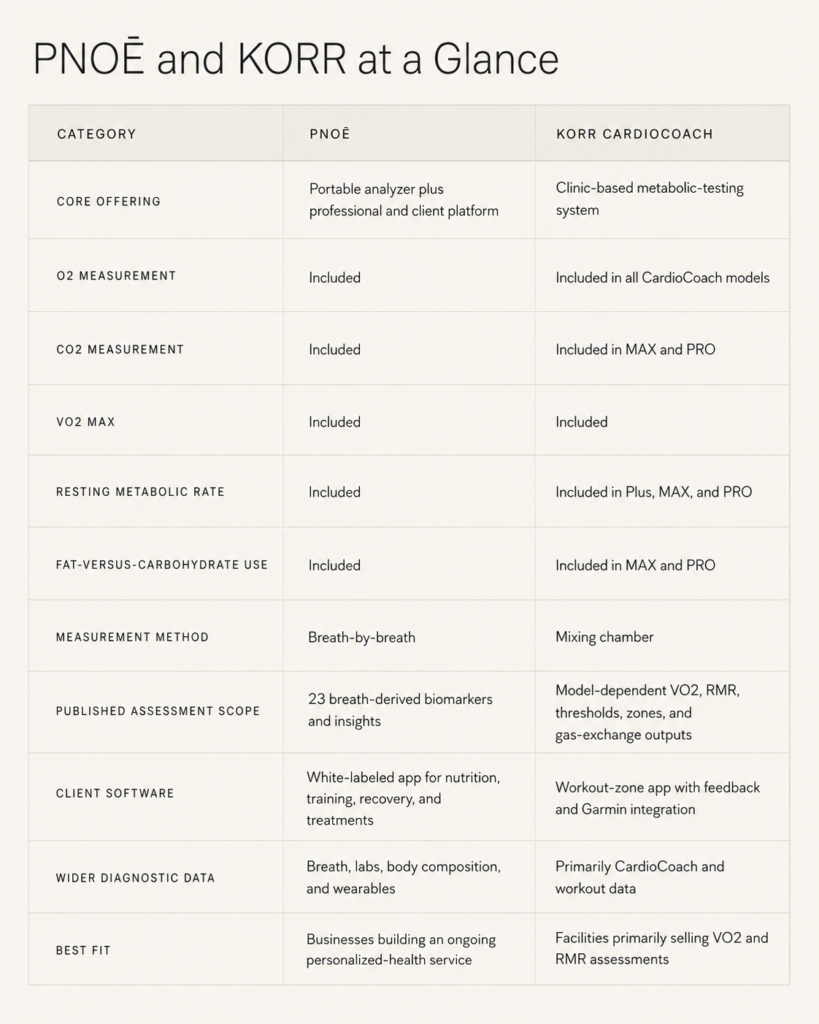
KORR currently offers four CardioCoach configurations. Basic and Plus use oxygen measurement, while MAX and PRO add carbon dioxide measurement and fuel-utilization information. The closest comparison to PNOĒ is therefore CardioCoach MAX or PRO, not the oxygen-only Basic model.
What Does KORR CardioCoach Measure?
The CardioCoach line is structured around different levels of testing:
- Basic: VO2 Max, submaximal testing, thresholds, heart-rate zones, and exercise calorie expenditure.
- Plus: Adds oxygen-based resting metabolic rate.
- MAX: Adds CO2 measurement, RER, RMR, and fat-versus-carbohydrate utilization.
- PRO: Adds extended testing, resting RER, analysis tools, and Moxy integration.
KORR also produces customizable printouts displaying key results, fitness level, heart-rate zones, recovery information, and recommendations added by the facility. Its CardioCoach app applies results to workouts through zone guidance, voice prompts, calorie estimates, custom workouts, and Garmin connectivity.
These features support the metabolic-testing and exercise-guidance workflow. The practitioner remains responsible for building the wider nutrition, treatment, service, and retention strategy around those results.
What Does PNOĒ Measure?
PNOĒ measures oxygen uptake, carbon dioxide production, ventilation dynamics, respiratory exchange ratio, and metabolic thresholds. These signals are interpreted collectively to provide 23 biomarkers and insights related to metabolism, respiratory function, cardiovascular efficiency, cellular fitness, and biological aging.
The assessment can include:
- VO2 Max
- Resting metabolic rate
- Biological age
- Ventilatory thresholds
- Personalized training zones
- Fat-versus-carbohydrate utilization
- Metabolic flexibility
- Breathing efficiency
- Cardiovascular efficiency
- Oxygen pulse
- Recovery-related insights
PNOĒ’s current public page describes the assessment as taking under ten minutes. More importantly, the test is not treated as the final deliverable. Results flow directly into reports, programming, service recommendations, and follow-up workflows.
Accuracy and Validation
KORR states that CardioCoach has been independently evaluated at the University of Southern California and Oregon State University.
The Oregon State summary available through KORR’s website compared CardioCoach with the Parvo Medics TrueOne 2400 in five young athletic participants. The summary reported statistically similar VO2 peak values and concluded that CardioCoach could be used to measure VO2 peak. It also recommended repeating the study with more subjects to improve statistical power.
PNOĒ was evaluated in a peer-reviewed study against the COSMED Quark CPET, a previously validated stationary metabolic cart.
The study involved 22 participants, with ten returning for test-retest analysis. Researchers reported correlations of:
- 0.98 for VO2
- 0.98 for VCO2
- 0.98 for ventilation
- 0.91 for respiratory quotient
No statistically significant differences were found between the systems for those variables, and the study reported strong test-retest reliability. The authors concluded that PNOĒ could accurately determine respiratory gases across multiple exercise intensities in healthy individuals under controlled laboratory conditions.
The public evidence reviewed therefore gives PNOĒ a broader whole-system validation case across several gas-exchange variables, rather than VO2 peak alone.
What Happens After the Test?
This is the central distinction.
KORR provides metabolic data, customizable reports, heart-rate zones, workout guidance, and a mobile app centered on applying test results during cardiovascular exercise.
PNOĒ continues further. The Health Dashboard can combine breath-analysis results with bloodwork, saliva, urine, stool, body-composition, and wearable data. PNOĒ advertises support for more than 225 biomarkers across cardiovascular, metabolic, hormonal, respiratory, and neurological systems.
The platform can then generate or support:
- Personalized calorie and macronutrient targets
- Meal plans and grocery lists
- VO2-based endurance and interval training
- Strength, mobility, functional, and rehabilitation programming
- Breathwork and recovery protocols
- Supplement and IV schedules
- Laboratory follow-ups
- Longevity and recovery services
- Retesting pathways
PNOĒ’s Logic Builder allows operators to connect biomarker thresholds to services they already offer, define frequency and duration, and schedule retests and follow-ups.
Programs are delivered through a white-labeled client app under the provider’s own brand. The app can combine nutrition, training, recovery, treatments, wearable information, and follow-up assessments in one calendar-based experience.
The difference is straightforward:
KORR applies metabolic-test results mainly to workouts. PNOĒ applies them to the client’s complete nutrition, training, recovery, treatment, and retesting journey.
PNOĒ vs KORR: Which Is the Better Fit?
KORR may fit your business when:
You primarily want to sell VO2 Max, RMR, heart-rate-zone, and substrate-utilization assessments. Your staff already has the expertise and software required to interpret results, create programs, and manage the client after the test.
The system is most relevant when the assessment itself is the primary service.
PNOĒ may fit your business when:
You want metabolic testing to become the front door to an ongoing health, longevity, weight-management, rehabilitation, or performance program.
You need testing, interpretation, nutrition, training, treatments, client engagement, and retesting to operate inside one connected platform. You also want findings to help direct clients toward the services your business already provides.

Frequently Asked Questions
Does KORR measure carbon dioxide?
CardioCoach MAX and PRO measure O2 and CO2. Basic and Plus use oxygen measurement, with Plus adding oxygen-based RMR.
Does KORR have a client app?
Yes. The CardioCoach app provides workout-zone guidance, voice coaching, workout feedback, calorie information, and Garmin connectivity. PNOĒ’s app covers a broader client program that can include nutrition, training, recovery, supplements, treatments, and retesting.
Is PNOĒ independently validated?
Yes. PNOĒ was evaluated against COSMED Quark CPET in a peer-reviewed study that reported strong agreement for VO2, VCO2, ventilation, and respiratory quotient.
The Bottom Line
KORR CardioCoach performs metabolic assessments and provides reports and workout guidance. It may be suitable for a facility that wants a clinic-based testing system and intends to build the remaining client workflow independently.
PNOĒ combines the assessment with interpretation, cross-diagnostic data, personalized programs, service recommendations, a branded client app, and retesting infrastructure.
In the PNOĒ vs KORR decision, the question is not simply whether either system can measure VO2.
It is:
Do you want to sell metabolic tests – or build a complete, recurring service around every assessment?
For clinics and wellness businesses focused on personalization, retention, and connecting data to their wider service menu, PNOĒ provides the more complete solution.
See how PNOĒ can fit into your business. Book a personalized demonstration.
Related Posts
PNOĒ vs CORTEX: Which Metabolic Device Is Right for Your Business? [2026]
PNOĒ vs SpiroFit: Which Metabolic Testing System Is Right for Your Business? [2026]
PNOĒ vs COSMED: Which Metabolic Testing System to Choose? [2026]