The PNOE vs COSMED comparison requires separating COSMED’s different products.
COSMED offers several systems for metabolic and cardiopulmonary testing. The wearable K5 is the closest hardware comparison to PNOĒ, while the Quark CPET is a stationary metabolic cart designed for clinical cardiopulmonary exercise testing. COSMED also provides indirect-calorimetry and professional software products.
PNOĒ offers portable breath-by-breath analysis too, but it is built around a wider client and business workflow. The assessment feeds into personalized nutrition, training, recovery, services, monitoring, and retesting.
The practical difference: COSMED provides equipment and software for professional metabolic and CPET testing. PNOĒ connects metabolic testing to the complete client program that follows it.
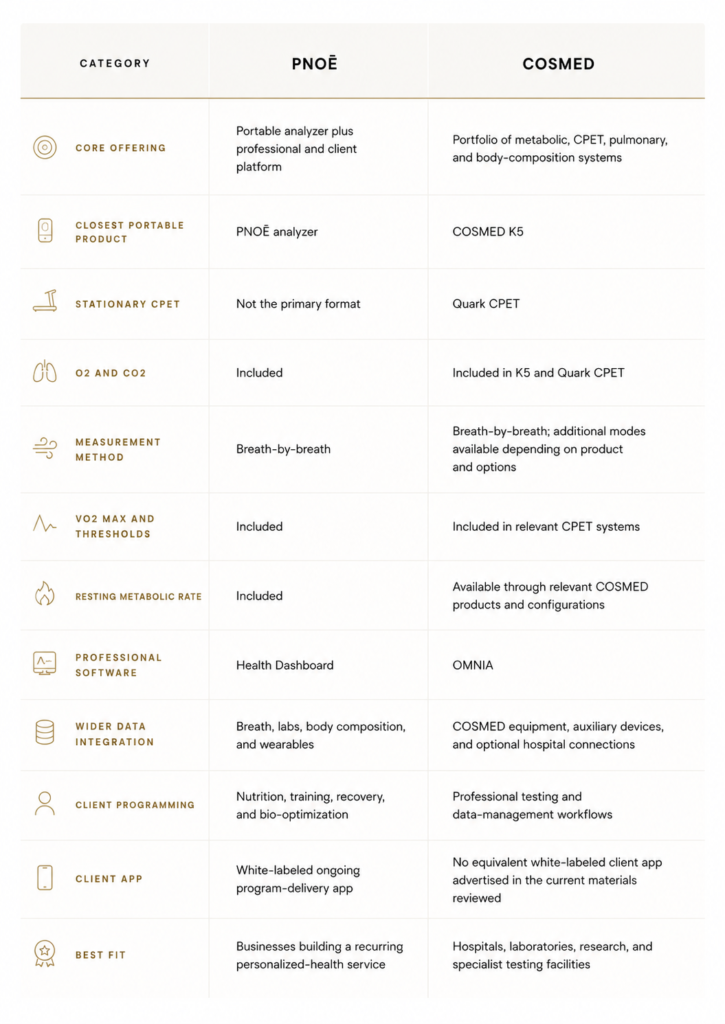
The K5 should be compared with PNOĒ when portability is the main requirement. Quark CPET is more relevant when the buyer wants a fixed clinical metabolic cart with CPET and hospital-system capabilities.
What Does the COSMED K5 Offer?
The K5 is a wearable metabolic system for laboratory and field testing. It includes OMNIA software and integrates with heart-rate and sport-sensor technologies.
Depending on configuration, the K5 can be extended with:
- IntelliMET dual sampling, allowing breath-by-breath and micro-dynamic mixing-chamber measurements
- Long-range data transmission up to 1,000 meters
- ANT+ connections to external sensors
- Walk-test capabilities
- An Aquatrainer accessory for swimming measurements
These are optional modules or accessories and should not be assumed to be included in every K5 package.
The K5 is primarily designed for professional testing environments where operators want direct control over gas-exchange measurement, external sensor connections, and field data collection.
What Does Quark CPET Offer?
Quark CPET is a stationary metabolic cart for cardiopulmonary exercise testing. It includes breath-by-breath sampling, while a physical mixing chamber is available for selected high-intensity testing.
COSMED also lists:
- Spirometry and exercise flow-volume loops
- Optional walking-test modules
- ECG integration
- Hospital and electronic-record connections using HL7, DICOM, or GDT
- OMNIA software
These functions are relevant to hospitals, cardiopulmonary laboratories, and clinical testing departments. They are less central to a wellness facility whose primary need is to assess clients and immediately move them into personalized programs.
What Does PNOĒ Measure?
PNOĒ measures oxygen uptake, carbon dioxide production, ventilation dynamics, respiratory exchange ratio, and metabolic thresholds. The system translates these signals into 23 biomarkers and insights related to respiratory function, cardiovascular efficiency, cellular fitness, metabolism, and biological aging.
The assessment can include:
- VO2 Max
- Resting metabolic rate
- Biological age
- Ventilatory thresholds
- Personalized training zones
- Fat-versus-carbohydrate utilization
- Metabolic flexibility
- Breathing efficiency
- Cardiovascular efficiency
- Oxygen pulse
- Recovery-related insights
PNOĒ’s differentiation is not that COSMED cannot produce detailed metabolic data. COSMED can.
The difference is that PNOĒ standardizes the information into an understandable client assessment and connects it to the programs, services, and follow-up that create ongoing value for the business.
Accuracy and Scientific Validation
COSMED publishes validation resources for its products and is used across clinical, research, and performance-testing settings. Product evidence should be assessed for the exact COSMED device, sampling mode, and configuration being purchased.
PNOĒ has a directly relevant validation study because the portable PNOĒ analyzer was tested against COSMED Quark CPET.
The peer-reviewed study involved 22 participants, with ten returning for test-retest analysis. Researchers reported correlations of:
- 0.98 for VO2
- 0.98 for VCO2
- 0.98 for ventilation
- 0.91 for respiratory quotient
No statistically significant differences were reported between the devices for those variables. The authors concluded that PNOĒ could accurately determine respiratory gases across several exercise intensities in healthy individuals under controlled laboratory conditions.
This does not mean that PNOĒ replaces every COSMED product or clinical configuration. It does demonstrate that PNOĒ’s portable system achieved strong agreement with the stationary COSMED Quark CPET used as its comparison device.
For wellness and performance operators, that is an important distinction: portability and ease of deployment do not require abandoning documented agreement with an established metabolic cart.
Portability and Testing Workflow
K5 and PNOĒ are both body-worn systems, but they are organized around different workflows.
K5 emphasizes professional testing flexibility. Optional configurations support alternative sampling, long-range telemetry, external sport sensors, walking protocols, and swimming assessments.
PNOĒ emphasizes efficient deployment across clinics, gyms, wellness centers, mobile events, and multiple locations. Its validation study describes a battery-powered analyzer transmitting respiratory and heart-rate information wirelessly during exercise.
For a research project requiring synchronized external devices or specialized field protocols, K5 options may be relevant.
For a client-facing business that needs to test efficiently and immediately turn results into programs and services, PNOĒ offers a more structured operating workflow.
OMNIA vs the PNOĒ Platform
OMNIA is COSMED’s professional data-management platform. It can connect to COSMED products and auxiliary devices, share databases across networks, and – through optional modules – communicate with hospital or electronic medical-record systems.
Its purpose is to manage testing, diagnostic data, devices, and professional workflows across the COSMED ecosystem.
PNOĒ’s Health Dashboard is designed around the complete client journey. It can centralize:
- Breath-analysis results
- Bloodwork
- Saliva, urine, and stool testing
- Body composition
- Wearable data
PNOĒ advertises more than 225 biomarkers across cardiovascular, metabolic, hormonal, respiratory, and neurological systems.
The Logic Builder then connects biomarker thresholds to services, supplements, IVs, longevity modalities, and follow-up assessments. Operators define frequency, duration, and cadence while maintaining control over the final program.
OMNIA manages professional testing and data across COSMED equipment. PNOĒ connects diagnostic data directly to the continuing services delivered by the business.
What Happens After the Assessment?
COSMED provides metabolic, CPET, indirect-calorimetry, and related diagnostic data. Professionals can use those results to inform clinical decisions, nutrition, exercise, or research workflows.
The wider client journey must then be created through the facility’s own staff and additional systems.
PNOĒ can use metabolic, laboratory, body-composition, and wearable data to create or support:
- Personalized calorie and macronutrient targets
- Meal plans and grocery lists
- VO2-based training
- Strength, mobility, interval, and rehabilitation programs
- Breathwork and recovery
- Supplements
- IV and longevity-service schedules
- Laboratory follow-ups
- Retesting
Programs are delivered through a white-labeled client app combining biometrics, nutrition, training, recovery, and treatments under the practice’s brand.
PNOĒ also structures the business workflow from measurement to analysis, program creation, service implementation, and retesting.
PNOE vs COSMED: Which Is the Better Fit?
COSMED may fit your organization when:
You require specialist CPET, pulmonary testing, hospital integrations, advanced research protocols, external sensor connections, or a multi-device diagnostic environment.
You have qualified personnel and separate systems for interpreting data and delivering the programs that follow.
PNOĒ may fit your business when:
You want metabolic testing to initiate an ongoing wellness, longevity, weight-management, rehabilitation, or performance service.
You need testing, interpretation, nutrition, training, treatments, client engagement, and retesting inside one connected platform.
Frequently Asked Questions
Is PNOĒ validated against COSMED?
Yes. PNOĒ was evaluated directly against COSMED Quark CPET in a peer-reviewed study.
Does COSMED generate complete nutrition or training programs?
COSMED provides professional metabolic and energy-expenditure data that practitioners can use to inform decisions. The current public materials reviewed do not advertise an equivalent combined nutrition, multimodality training, treatment-planning, service-recommendation, and white-labeled client platform.
The Bottom Line
COSMED provides professional equipment and software for metabolic, CPET, clinical, and research workflows.
PNOĒ combines portable metabolic testing with peer-reviewed validation, standardized interpretation, broader diagnostic data, personalized programs, service recommendations, a branded client app, and retesting.
In the PNOE vs COSMED decision, the real question is:
Do you need a diagnostic-testing ecosystem – or a platform that turns every metabolic assessment into a continuing client relationship?
For clinics and wellness businesses focused on personalization, retention, and connecting test results to the services they deliver, PNOĒ provides the more complete solution.
See how PNOĒ can fit into your business. Book a personalized demonstration.
Sources & References
https://pnoe.com/ap-breath-analysis/
Peer-reviewed PNOĒ validation study
https://www.cosmed.com/en/
https://www.cosmed.com/en/products/cardio-pulmonary-exercise-test
https://www.cosmed.com/en/products/cardio-pulmonary-exercise-test/k5
https://www.cosmed.com/en/products/cardio-pulmonary-exercise-test/quark-cpet
Related Posts
PNOĒ vs CORTEX: Which Metabolic Device Is Right for Your Business? [2026]
PNOĒ vs SpiroFit: Which Metabolic Testing System Is Right for Your Business? [2026]