You do not need a sports lab to get a useful estimate of your aerobic fitness. A VO2 max test at home — using nothing more than a stopwatch, a measured distance, and a few simple calculations — can give you a reasonable starting point, track your progress over time, and tell you roughly where you stand for your age and sex.
But there is an important caveat worth stating up front: an at-home VO2 max test produces an estimate, not a measurement. The methods below use validated formulas to predict your score from how fast you can run, walk, or recover — they do not directly measure the oxygen your body uses. The good news is that you no longer have to choose between convenience and accuracy: portable clinical-grade testing now delivers true, measured results outside the lab, a point we will return to below.
This guide covers the four most reliable ways to test your VO2 max at home, the exact protocols and formulas for each, how accurate they really are, and how to get a lab-grade result without setting foot in a hospital.
Can You Really Test Your VO2 Max at Home?
Yes — with a clear understanding of what you are getting. A true VO2 max test uses a metabolic analyzer and a face mask to directly measure the oxygen you consume and the carbon dioxide you produce while exercising. That is the gold standard, and it traditionally required equipment that only hospitals and university labs owned.
A DIY VO2 max test at home works differently. It relies on the well-established relationship between exercise performance and aerobic capacity: in general, the faster you can cover a set distance, or the lower your heart rate at a given effort, the higher your VO2 max. Researchers have built regression equations from lab data that convert your performance into a predicted score.
These equations are genuinely useful — but their accuracy depends on how closely you match the population the formula was built on, how hard you push, and how precisely you measure your time and heart rate. Expect a margin of error of roughly ±5 mL/kg/min for most at-home methods.
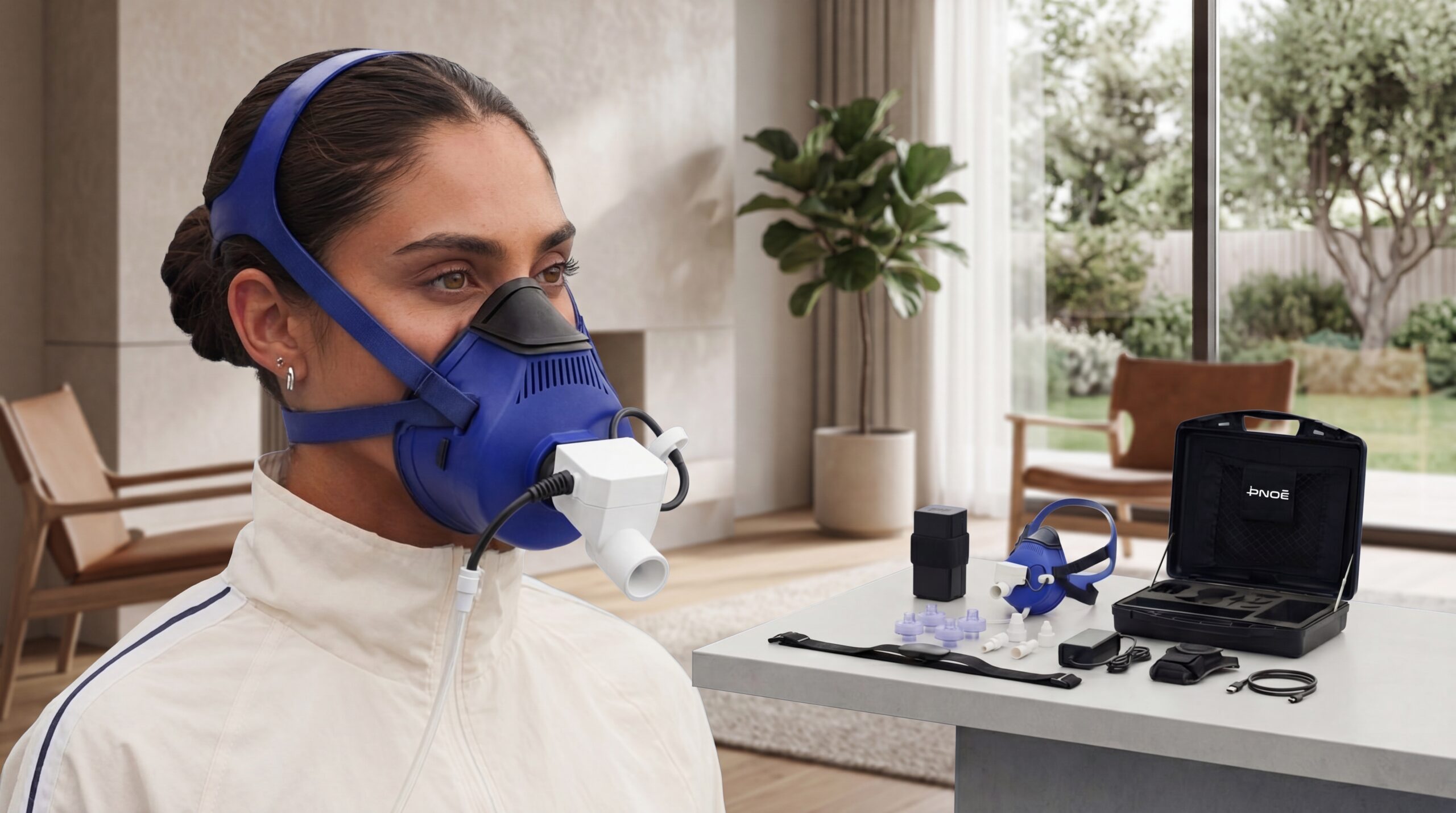
It is worth knowing from the outset that there is now a third option between a rough DIY estimate and a hospital lab: portable metabolic analyzers like PNOĒ deliver a fully accurate, measured VO2 max in a device that travels to any gym, clinic, or studio. You get the convenience of testing outside a lab with none of the accuracy compromise of a DIY method.
4 Ways to Test Your VO2 Max at Home
1. The Cooper 12-Minute Run Test
The Cooper test is the most widely used VO2 max test at home for people who can run. Developed by Dr. Kenneth Cooper in 1968 for U.S. military fitness assessment, it is simple: run as far as you possibly can in exactly 12 minutes on a flat surface, ideally a 400m track where distance is easy to measure.
The formula: VO2 max = (distance in meters − 504.9) ÷ 44.73
So if you cover 2,800 meters in 12 minutes: VO2 max = (2,800 − 504.9) ÷ 44.73 = 51.3 mL/kg/min
Best for: Reasonably fit people comfortable running at maximum effort. Accuracy: Good, but highly dependent on pacing and motivation. Going out too fast and fading will lower your distance and underestimate your score.
2. The Rockport 1-Mile Walk Test
If running at maximum effort is not safe or comfortable for you, the Rockport walk test is the best VO2 max test at home. It was specifically designed for people who cannot or should not run — older adults, deconditioned individuals, those recovering from injury, and anyone significantly overweight.
The protocol: Walk one mile as fast as you can on a flat surface. Record your finishing time and measure your heart rate immediately at the finish (count your pulse for 15 seconds and multiply by 4).
The formula (men): VO2 max = 139.168 − (0.388 × age) − (0.077 × weight in lbs) − (3.265 × walk time in minutes) − (0.156 × ending heart rate)
The formula (women): Same equation, but remove the +6.315 male constant (i.e., subtract an additional 6.315).
Best for: Beginners, older adults, and anyone who prefers not to run. Accuracy: Validated in the original Kline et al. (1987) study with a standard error of approximately ±5 mL/kg/min — strong accuracy for a walking test. Most reliable for adults aged 30–69.
3. The 1.5-Mile Run Test
A middle ground between the Cooper test and the walk test, the 1.5-mile run is a classic military and athletic assessment. Run 1.5 miles as fast as possible and record your time; a validated equation converts it into a VO2 max estimate.
Best for: Active adults who want a slightly shorter maximal effort than the Cooper test. Accuracy: Comparable to the Cooper test — dependent on genuine all-out effort and even pacing.
4. The Resting Heart Rate (Non-Exercise) Estimate
The least demanding VO2 max test at home requires no exercise at all. Non-exercise estimates use your age, sex, resting heart rate, and self-reported activity level in a regression formula. The “World Fitness Level” calculator developed from large Norwegian population studies (the HUNT study) is the best-known version.
Best for: People who cannot or do not want to exercise to estimate fitness, or who want a quick baseline. Accuracy: Surprisingly reasonable at the population level, but the least precise of these methods for any individual. Best used as a rough starting point.

How Accurate Is an At-Home VO2 Max Test?
Here is the honest answer: an at-home VO2 max test is accurate enough to track your own progress over time, but not accurate enough for precision training or clinical decisions.
The key limitations:
Estimation error. Most at-home methods carry a margin of error of roughly ±5 mL/kg/min. For someone with a true VO2 max of 40, that is a potential swing of 12% in either direction.
Protocol-locked. A VO2 max test at home is only useful for comparison against itself. A Cooper test result cannot be reliably compared to a Rockport walk result or to a lab number — each uses a different formula built on a different population.
Effort-dependent. Maximal field tests (Cooper, 1.5-mile) only work if you genuinely push to your limit with smart, even pacing. Most people either pace poorly or hold back, which skews the result.
No physiological context. This is the biggest limitation. An at-home test gives you a single estimated number. It cannot tell you why your VO2 max is what it is — whether your lungs, heart, or mitochondria are the limiting factor — or what your actual training zones, resting metabolic rate, or fat-burning efficiency are.
For tracking whether your fitness is trending up or down, a VO2 max test at home is a perfectly good tool. For an accurate number and the metabolic context behind it, you need direct measurement — which, thanks to portable analyzers, no longer means a hospital visit.
The Portable Middle Ground: Clinical Accuracy Without the Lab
For years the choice felt binary: a convenient but rough DIY estimate, or an accurate but hard-to-access hospital lab test. PNOĒ removes that trade-off entirely.
PNOĒ is a portable metabolic analyzer that delivers the same breath-by-breath measurement as a hospital metabolic cart — in a lightweight device that works on any treadmill or bike, at a gym, clinic, or wellness center near you. It has been independently validated to produce near-identical results to gold-standard lab systems, which means the portability comes with zero accuracy compromise. This is the same technology the “field testing” used by professional sports scientists is built on, now accessible to everyday people.
In a single 10-minute test, PNOĒ measures your true VO2 max plus 22 other biomarkers — your resting metabolic rate, fat-burning efficiency, personalized training zones, ventilatory thresholds, and biological age. Instead of an estimate with a ±5 mL/kg/min margin of error, you get a measured result and the full metabolic picture behind it.
In other words: PNOĒ delivers the convenience an at-home VO2 max test promises, with the accuracy an at-home test simply cannot. You do not have to choose between the two.
Many people use both approaches together — a quick DIY VO2 max test at home to track week-to-week trends, and a periodic PNOĒ test to establish an accurate baseline, set precise training zones, and verify real physiological progress.
The Bottom Line on Testing VO2 Max at Home
A VO2 max test at home is a genuinely useful tool — free, accessible, and good enough to track your own fitness trend over time. The Cooper test works well if you can run hard; the Rockport walk test is the better choice if you cannot. Just remember that every at-home method gives you an estimate with a meaningful margin of error, locked to its own protocol.
When you want to move from “roughly how fit am I” to “exactly what is my VO2 max, and how do I improve it,” you no longer need a hospital lab. A portable PNOĒ test gives you clinical-grade accuracy wherever you train — the best of both worlds.
Sources
- Kline GM, Porcari JP, Hintermeister R, et al. “Estimation of VO2max from a One-Mile Track Walk, Gender, Age, and Body Weight.” Medicine & Science in Sports & Exercise. 1987;19(3):253–259. https://pubmed.ncbi.nlm.nih.gov/3600239/
- Cooper KH. “A Means of Assessing Maximal Oxygen Intake: Correlation Between Field and Treadmill Testing.” JAMA. 1968;203(3):201–204. https://pubmed.ncbi.nlm.nih.gov/5694044/
- Nes BM, Janszky I, Wisløff U, et al. “Age-Predicted Maximal Heart Rate in Healthy Subjects: The HUNT Fitness Study.” Scandinavian Journal of Medicine & Science in Sports. 2013;23(6):697–704. https://pubmed.ncbi.nlm.nih.gov/22376273/
- Mandsager K, Harb S, Cremer P, et al. “Association of Cardiorespiratory Fitness With Long-term Mortality Among Adults Undergoing Exercise Treadmill Testing.” JAMA Network Open. 2018;1(6):e183605. https://jamanetwork.com/journals/jamanetworkopen/fullarticle/2707428
- Tsekouras YE, Tambalis KD, Sarras SE, et al. “Validity and Reliability of the New Portable Metabolic Analyzer PNOE.” Frontiers in Sports and Active Living. 2019;1:24. https://www.frontiersin.org/journals/sports-and-active-living/articles/10.3389/fspor.2019.00024/full
Related Posts

Repeated Sprint Ability: Why Soccer Is Really an Aerobic Sport
Soccer Player VO2 Max: How World Cup Athletes Compare to You

Brain Fog and Metabolism: What Your Breath Reveals About Focus