Full-body MRI has become the most talked-about longevity test of 2026. Companies like Prenuvo and Ezra have scanned hundreds of thousands of people. Kim Kardashian called it “a life saving machine.” Time magazine devoted a feature to the debate. The appeal is clear: a radiation-free, head-to-toe scan that can detect tumors, aneurysms, and organ abnormalities before symptoms appear.
So is a full-body MRI worth it? It depends on what you’re looking for. If you want to find hidden structural problems — tumors, aneurysms, organ abnormalities — it has clear value for some people. But if you want to understand how well your body actually works, how efficiently your heart delivers oxygen, how your mitochondria produce energy, or how your metabolism handles demand, an MRI can’t help you. These functional markers don’t just matter for fitness. They’re the strongest predictors of how long you’ll live.
Understanding what a full-body MRI reveals, what it misses, and what only breath analysis can measure is essential for anyone serious about longevity.
What a Full-Body MRI Actually Measures
A full-body MRI uses magnetic fields and radio waves to generate detailed images of internal organs, bones, soft tissues, and blood vessels. It’s a structural assessment — a snapshot of anatomy.
In the context of longevity screening, it can detect solid organ tumors (kidney, liver, pancreatic), brain aneurysms and vascular malformations, spinal abnormalities and disc pathology, organ enlargement or inflammation, and fatty liver disease. These are meaningful findings. Time magazine reported real cases of early-stage cancers caught by Prenuvo scans — kidney tumors, brain aneurysms, breast lesions — that led to life-saving interventions. Prenuvo has completed over 150,000 scans since 2018, and Ezra reports that nearly 5% of scans produce a highly suspicious finding requiring follow-up.
But the structural picture has limits. No major medical association currently recommends full-body MRI for asymptomatic adults. The American College of Radiology stated in 2023 that there is no documented evidence full-body screening is cost-efficient or effective in prolonging life. The U.S. Preventive Services Task Force has not endorsed it. And the false-positive problem is real: incidental findings are common, often benign, and can trigger cascades of follow-up imaging, biopsies, and anxiety that provide no health benefit.
Most importantly, structural imaging tells you nothing about how your cardiovascular, metabolic, and mitochondrial systems actually perform.
What Metabolic Testing Actually Measures
Cardiopulmonary exercise testing — the clinical foundation of what PNOĒ delivers — is recognized as the gold-standard method for evaluating the integrated performance of the cardiovascular, respiratory, and musculoskeletal systems. Unlike imaging, it doesn’t show you anatomy. It measures physiology — how your body functions under real metabolic demand.
A PNOĒ breath test captures four primary functional markers:
VO2 Max measures the maximum rate at which your body consumes oxygen during exercise. It reflects the integrated capacity of your lungs, heart, blood, and mitochondria. It is the single most powerful predictor of all-cause mortality — more powerful than smoking, hypertension, high cholesterol, or type 2 diabetes, according to the American Heart Association’s landmark scientific statement.
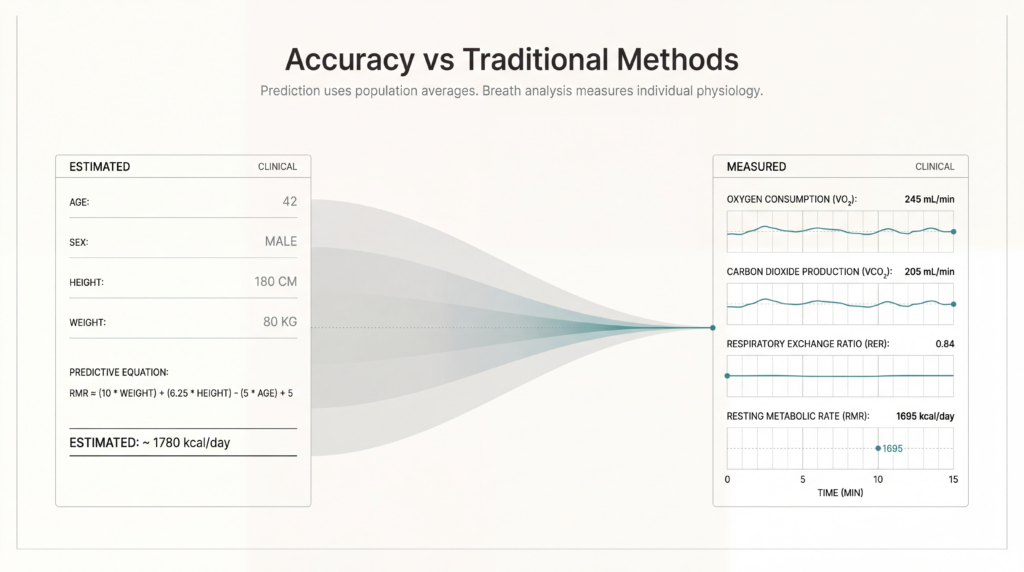
Resting Metabolic Rate (RMR) measures baseline energy expenditure at rest. It reflects how much energy your mitochondria produce to sustain basic functions — circulation, respiration, temperature regulation, cellular repair. A declining RMR signals muscle loss, metabolic adaptation, or mitochondrial dysfunction — none of which an MRI can detect.
Fat Oxidation Rate reveals how efficiently your cells burn fat for fuel. Healthy mitochondria oxidize fat readily and efficiently. Poor fat oxidation — a shift toward carbohydrate dependence — is a marker of metabolic inflexibility and insulin resistance, conditions that drive cardiovascular disease, diabetes, and accelerated aging.
Metabolic Flexibility measures how smoothly your body switches between fat and carbohydrate fuel sources based on demand. It’s a direct proxy for insulin sensitivity and mitochondrial health — two of the most important determinants of long-term health outcomes.
The Mortality Question: What Predicts How Long You’ll Live?
This is where the comparison becomes most striking. A full-body MRI can find disease that already exists. Metabolic testing reveals the functional capacity that predicts whether disease will develop.
In 2016, the American Heart Association published a scientific statement — authored by over a dozen leading researchers — concluding that cardiorespiratory fitness, quantifiable as VO2 Max, should be categorized as a “clinical vital sign” and routinely assessed in clinical practice. The statement summarized decades of evidence showing that low CRF is associated with high risk of cardiovascular disease, all-cause mortality, and mortality from various cancers.
A 2024 update to that statement, published in Progress in Cardiovascular Diseases, reinforced the original conclusions: CRF remains a more powerful predictor of mortality than traditional risk factors. The update also explored the association between CRF and healthcare costs, finding that higher fitness is associated with substantially lower lifetime medical expenditure.
A JAMA meta-analysis of 33 studies involving over 100,000 participants found that each 1-MET increase in cardiorespiratory fitness was associated with a 13% reduction in all-cause mortality and a 15% reduction in cardiovascular mortality.
No structural imaging test — MRI, CT, or ultrasound — can capture this. You can have a perfectly clean MRI and still have a dangerously low VO2 Max. You can have organs that look structurally healthy while your mitochondria are underperforming, your fat oxidation is impaired, and your metabolic rate is declining. The MRI misses the engine. The breath test measures it.
What Wearables Get Wrong
Wearables like Apple Watch, Garmin, and WHOOP estimate VO2 Max using heart rate algorithms and movement data. These estimates are useful for general trends but are not clinically accurate. Published validation studies report mean absolute errors that can place individuals in entirely different fitness categories — the difference between “above average” and “poor” — depending on the device and population.
Wearables also cannot measure RMR, fat oxidation rate, or metabolic flexibility at all. These markers require direct breath-by-breath gas exchange analysis — the measurement of oxygen consumed and carbon dioxide produced — which is only possible through clinical-grade breath testing.
For general fitness tracking, wearables are valuable. For longevity-grade metabolic assessment, they are not a substitute for CPET-based breath analysis.
The Complete Longevity Testing Stack
The most informed approach to longevity testing isn’t choosing between structure and function. It’s combining both — along with biomarker data — to build a complete picture.
Structural imaging (MRI) answers: What’s inside? Are there hidden masses, malformations, or organ changes? This is the “find what’s broken” layer.
Biomarker testing (blood panels) answers: What’s circulating? Are hormone levels, lipids, glucose, and inflammatory markers within healthy ranges? This is the “track the chemistry” layer.
Functional metabolic testing (breath analysis) answers: How well does the system perform? Is cardiovascular fitness adequate? Are mitochondria producing energy efficiently? Is the body metabolically flexible? This is the “measure the engine” layer — and it’s the one most strongly predictive of all-cause mortality.
Each layer fills a gap the others can’t. But if you could only choose one test to predict how long and how well you’ll live, the evidence is unambiguous: measure your VO2 Max.
The Bottom Line: See the Picture. Then Measure the Engine.
Full-body MRIs are valuable tools when used appropriately. They can catch structural abnormalities early, provide peace of mind, and flag conditions that warrant clinical follow-up. But they cannot assess the metabolic and cardiovascular function that most strongly predicts longevity.
Breath-based metabolic testing measures VO2 Max, RMR, fat oxidation, and metabolic flexibility — the functional markers that tell you not just what’s inside, but how well it works. That’s the data that drives actionable, personalized decisions about training, nutrition, and long-term health strategy.
The smartest longevity protocol doesn’t choose between structure and function. It measures both. But if the goal is to understand how well you’re actually aging — and what to do about it — start with your metabolism.
SOURCES
- AHA Scientific Statement — Ross et al., “Importance of Assessing Cardiorespiratory Fitness in Clinical Practice: A Case for Fitness as a Clinical Vital Sign” (Circulation, 2016): https://pubmed.ncbi.nlm.nih.gov/27881567/
- Update to AHA CRF Statement — Kaminsky et al., “Update to the 2016 American Heart Association cardiorespiratory fitness statement” (Progress in Cardiovascular Diseases, 2024): https://pubmed.ncbi.nlm.nih.gov/38387825/
- JAMA — Kodama et al., “Cardiorespiratory Fitness as a Quantitative Predictor of All-Cause Mortality and Cardiovascular Events in Healthy Men and Women” (2009): https://pubmed.ncbi.nlm.nih.gov/19454641/
- ACSM — “The Importance of Cardiorespiratory Fitness, A 10-Year Update” (2025): https://acsm.org/cardiorespiratory-fitness-10-year-update/
- ScienceDirect — “Assessing cardiorespiratory fitness in clinical and community settings: Lessons and advancements in the 100th year anniversary of VO2max” (2024): https://www.sciencedirect.com/science/article/abs/pii/S0033062024000306
- Time — “A Full-Body MRI Scan Could Save Your Life. Or Ruin It.” (March 2026): https://time.com/7275819/should-you-get-full-body-mri-scan/
- Time — “Can a Full-Body MRI Help You Live Longer?” (January 2026): https://time.com/collections/future-of-living/7341603/emi-gal-ezra-full-body-mri/
- Axios — “Debate over full-body scans” (July 2025): https://www.axios.com/newsletters/axios-finish-line-a9536a50-63fc-11f0-bfab-c55c2e9a1bce
Related Posts

Mitochondrial Health: The Foundation of Energy and Longevity

Does Methylene Blue Work? How to Actually Measure the Effect