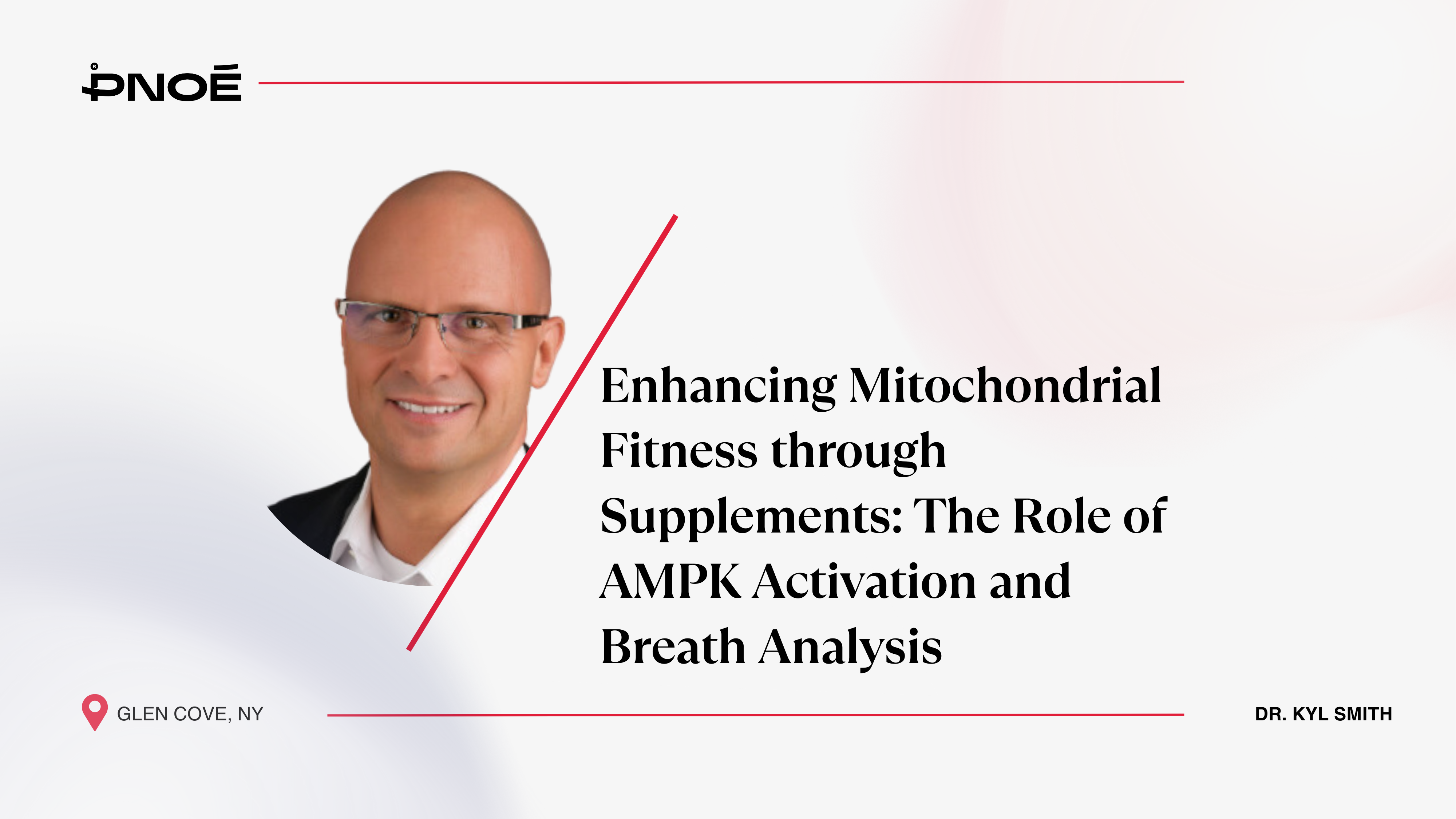
Welcome to this edition of the PNOĒ Webinar Series, where leading clinicians and health innovators explore how metabolic testing, mitochondrial health, and evidence-based interventions can be used to optimize metabolism, performance, and longevity.
In this session, we take a deep dive into the role of AMPK activation as a central regulator of metabolic flexibility, fat oxidation, and mitochondrial fitness. How does AMPK influence energy production, insulin sensitivity, inflammation, and healthy aging? And how can targeted supplementation, exercise, and lifestyle strategies measurably improve metabolic outcomes?
This webinar also presents real-world validation data using PNOĒ metabolic breath analysis, demonstrating how objective measurements can quantify shifts in substrate utilization and metabolic efficiency following supplementation.
If you’re looking for science-led, practical insights that can be applied immediately in clinical practice, coaching, or personal health optimization, this session delivers actionable frameworks grounded in metabolic physiology and validated by data.
Discover how PNOĒ enables precision decision-making in metabolism, longevity, and performance.
Follow PNOĒ on Instagram: @pnoe_analytics
Panos Papadiamantis:
Hello everyone, I’m Panos Papadiamantis from PNOĒ. Today, I’m very pleased to welcome Dr. Kyle Smith. Dr. Smith is a well-recognized clinician in the fields of longevity and integrative medicine.
As part of his work, Dr. Smith has been instrumental in developing a novel supplement designed to enhance AMPK activation. AMPK has gained significant attention as a master regulator of metabolism, influencing both metabolic rate and fat oxidation.
A few months ago, Dr. Smith approached us with the opportunity to collaborate on a validation study using PNOĒ metabolic testing. The goal was to objectively assess whether this supplement could measurably impact metabolism and fat-burning efficiency. The results were compelling, and today’s webinar will focus on both the science behind AMPK and the outcomes of that study.
Dr. Smith will begin by explaining what AMPK is and why it matters for longevity, mitochondrial health, and overall metabolic function. We’ll then review strategies for improving AMPK activation and discuss the study results generated using PNOĒ breath analysis. Dr. Smith, thank you for joining us.
Dr. Kyle Smith:
Thank you, Panos. I’m truly honored to be here and excited to share this information. I’ve practiced clinical nutrition for over 30 years, and I can honestly say I wish I had access to a tool like PNOĒ decades ago.
The ability to establish a baseline metabolic assessment, implement an intervention, and then retest to confirm real physiological change is incredibly powerful. This is where theory meets reality. You’re measuring metabolism directly, not speculating.
My goal today is to provide clinicians, health coaches, and fitness professionals with actionable insights they can use immediately. By the end of this session, you’ll understand how to leverage AMPK activation to improve patient outcomes.
Dr. Kyle Smith:
AMPK stands for adenosine monophosphate-activated protein kinase. It is often referred to as the “guardian of metabolism.” This enzyme regulates basal metabolic rate, determines whether the body burns fat or carbohydrates, and plays a central role in metabolic flexibility.
Individuals who can easily shift between fat oxidation and carbohydrate utilization tend to have higher AMPK activity. When AMPK function is impaired, metabolic flexibility declines, contributing to weight gain, insulin resistance, and metabolic disease.
Dr. Kyle Smith:
The scientific literature on AMPK is extensive. Research published in Nature describes AMPK as a key regulator of metabolic and mitochondrial homeostasis. More recent studies demonstrate its role in autophagy, cellular renewal, and protection against age-related diseases.
Autophagy is the body’s ability to identify dysfunctional cells and remove them, making room for healthier replacements. This process is essential for healthy aging and disease prevention. AMPK activation strongly supports this mechanism.
Dr. Kyle Smith:
AMPK also plays a significant role in maintaining muscle mass, reducing inflammation, and improving insulin sensitivity. As muscle mass declines with age, metabolic health and functional capacity decline as well. Supporting muscle through metabolic signaling is essential for preserving healthspan.
Research also shows that AMPK activation can reduce inflammatory pain by improving mitochondrial function and decreasing neuroinflammation. This has major implications for individuals experiencing chronic pain despite conventional interventions.
Dr. Kyle Smith:
At the cellular level, AMPK enhances mitochondrial biogenesis, the creation of new, healthy mitochondria. Mitochondria are the engines of the cell, responsible for producing ATP, the molecule that powers nearly every biological process.
As we age, mitochondrial number and efficiency often decline, contributing to fatigue, cognitive decline, and metabolic dysfunction. Supporting mitochondrial health is foundational to longevity and cognitive performance.
Dr. Kyle Smith:
The brain, in particular, is highly energy-dependent. Adequate ATP is required for neurotransmitter production, cellular repair, and cognitive function. When mitochondrial output declines, the brain’s ability to perform these tasks is compromised.
Maintaining mitochondrial health allows the brain to sustain focus, memory, mood regulation, and executive function. This is why metabolic health and brain health are inseparable.
Dr. Kyle Smith:
AMPK activity naturally declines with age and is influenced by genetics, diet, physical activity, and lifestyle factors. Diets high in refined carbohydrates, chronic insulin elevation, lack of exercise, and exposure to certain chemicals all suppress AMPK function.
Conversely, intense exercise, caloric restriction, and specific phytonutrients can robustly activate AMPK.
Dr. Kyle Smith:
There are three primary ways to increase AMPK activation. The first is exercise, specifically high-intensity exercise that rapidly depletes ATP. This creates a strong AMPK signal.
The second is fasting. Intermittent fasting can be effective, though it may be challenging for individuals with poor metabolic flexibility.
The third approach involves fasting and exercise mimetics natural compounds that mimic the metabolic effects of fasting or exercise at the cellular level.
Dr. Kyle Smith:
Based on decades of clinical experience and extensive literature review, I formulated a supplement containing seven phytonutrient “superstars” shown to support AMPK activation. These include quercetin, curcumin, berberine, resveratrol, green tea extract, moringa leaf, and pomegranate.
To maximize absorption, these compounds are delivered in a liposomal formulation, which enhances bioavailability and ensures consistent dosing.
Dr. Kyle Smith:
We then partnered with PNOĒ to independently validate whether this formulation could produce measurable metabolic changes. This is where objective testing becomes invaluable.
Panos Papadiamantis:
Using PNOĒ metabolic breath analysis, we conducted resting and exercise tests before and after supplementation. We focused primarily on respiratory exchange ratio (RER), which reflects the balance between fat and carbohydrate oxidation.
A lower RER indicates greater reliance on fat as a fuel source. Across participants, we observed a consistent downward shift in RER, indicating enhanced fat oxidation.
Panos Papadiamantis:
During exercise testing, we also saw improvements in FatMax and a rightward shift in the crossover point, meaning participants were able to sustain fat oxidation at higher exercise intensities. This is a strong indicator of improved mitochondrial fitness and metabolic health.
Such changes are rarely observed acutely, making these findings particularly compelling.
Dr. Kyle Smith:
From a clinical perspective, this is extremely meaningful. One of the biggest challenges in practice is motivating patients to exercise consistently. When individuals can see that they are getting more metabolic benefit from each session, adherence improves.
This data provides both motivation and validation.
Panos Papadiamantis:
We covered a significant amount of material today. This session has been recorded and will be available on our YouTube channel. For those interested in learning more about PNOĒ, metabolic testing, or incorporating this supplement into practice, our team will be happy to connect.
Dr. Kyle Smith:
Thank you again for the opportunity. I’m deeply impressed by what PNOĒ enables practitioners to do measure metabolism in real time and adjust interventions with precision. This is truly where healthcare should be headed.
Panos Papadiamantis:
Thank you, Dr. Smith, and thank you to everyone who joined us today. We look forward to seeing you in our next webinar.
Watch the full episode HERE.
Related Posts

Breathe Better, Think Better: Combat Cognitive Decline with PNOĒ

The Mouth-Longevity Connection