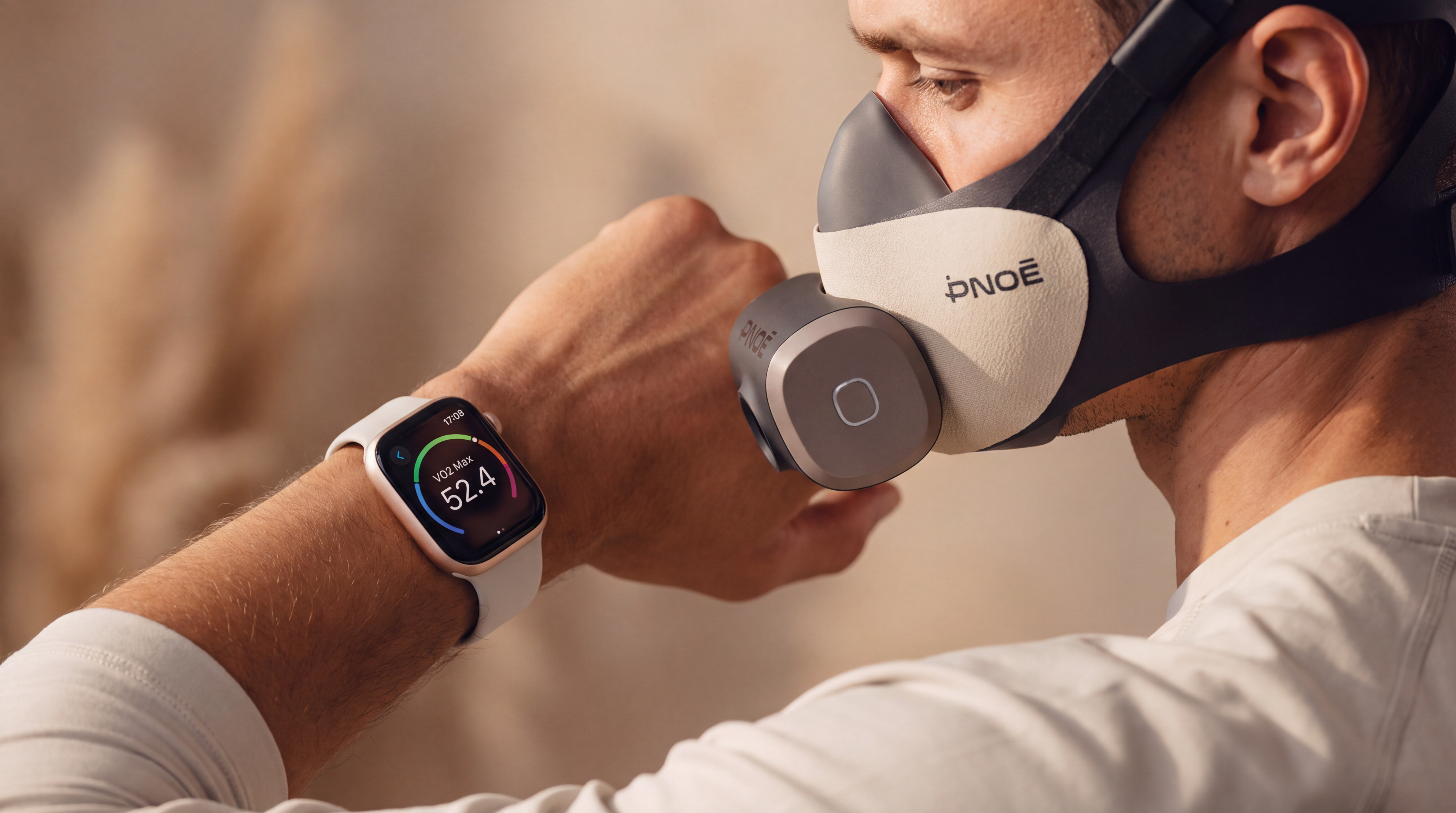
Your watch shows a VO2 Max number. Apple now folds it into its Health Age feature, Garmin and WHOOP display it too, and longevity apps treat it as a headline metric. But a fair question follows: is Apple Watch VO2 Max accurate enough to act on, or is it just a rough guess on your wrist?
The short answer: wearable VO2 Max is useful for tracking your trend over time, but it is not accurate enough at the individual level to treat as a true measurement. Peer-reviewed studies show Apple Watch underestimates VO2 Max by about 6 mL/kg/min on average, enough to misplace someone by a full fitness category. Here is what the research shows, and what to do if you want a number you can actually rely on.
Is Apple Watch VO2 Max Accurate?
No, not at the individual level. Apple Watch VO2 Max is a reasonable population-level estimate but shows poor agreement for any single person. A 2026 study in Mayo Clinic Proceedings: Digital Health tested the Apple Watch Series 10 against lab-grade indirect calorimetry in 40 healthy adults. The watch underestimated VO2 Max by 6.25 mL/kg/min on average, with a mean absolute percentage error of 13.2% and wide limits of agreement (from roughly 18 below to 6 above the true value). The authors concluded the estimates showed “poor individual-level agreement” with the criterion measure.
An earlier 2025 study in PLOS ONE found almost identical results: a 6.07 mL/kg/min underestimate and a 13.3% error rate. Two independent studies, the same conclusion.
How Big Is the Error, Really?
A typical wearable VO2 Max error of about 6 to 7 mL/kg/min is large enough to move you one or two fitness categories. VO2 Max categories (from “poor” to “excellent”) are often separated by just a few mL/kg/min. So an error of this size can tell a genuinely fit person they are average, or reassure an at-risk person that they are fine. For a number increasingly used to estimate biological age and longevity, that gap matters.
For context, lab-based indirect calorimetry, the gold-standard method, has a measurement error of roughly 5% (about 2.5 mL/kg/min across a large meta-analysis). Wearable estimates fall two to three times outside that range.
Why Can’t a Watch Measure VO2 Max Directly?
A watch cannot measure VO2 Max directly because it has no way to analyze your breath. True VO2 Max is the maximum volume of oxygen your body uses during exercise, so measuring it requires analyzing the oxygen and carbon dioxide in the air you breathe. A watch has no gas sensors. Instead, it estimates VO2 Max from heart rate and movement (pace, GPS) using population-based algorithms. That is an inference, not a measurement, and it inherits all the variability of those inputs, which is why it struggles with very fit and very unfit individuals most.
Why Is Wearable VO2 Max Still Useful?
Wearable VO2 Max is genuinely useful for one thing: tracking your trend over time. While the absolute number may be off, the direction of change is meaningful. If your watch shows a steadily rising VO2 Max over eight to twelve weeks of training, your fitness is almost certainly improving. Researchers consistently note that reliability (consistency) is better than validity (accuracy) for these devices, so they are good for spotting change, less good for telling you where you truly stand right now.
Used this way, as a daily trend tracker rather than a diagnostic number, a wearable is a valuable tool.
How Do You Get an Accurate VO2 Max?
To get an accurate VO2 Max, you need a test that analyzes your breath directly, known as indirect calorimetry or breath analysis. This is the gold-standard method and the same approach used in the lab studies that evaluate wearables. Instead of inferring your oxygen use from heart rate, a breath test measures the oxygen you consume and the carbon dioxide you produce, breath by breath.
A PNOĒ breath test does exactly this. In about eight minutes, it measures your VO2 Max directly, along with 22 other breath biomarkers across your heart, lungs, brain, cells and metabolism. It has been independently validated in a peer-reviewed study against a gold-standard laboratory metabolic cart, showing a 0.98 correlation. The result is a number you can actually build a training or health plan around, rather than a wrist estimate you have to second-guess.
The Bottom Line
So, is Apple Watch VO2 Max accurate? It is accurate enough to track your progress over time, but not accurate enough to trust as a precise, individual measurement. The research is consistent: wearables underestimate VO2 Max by around 6 mL/kg/min, enough to misread your fitness by a full category. Use your watch for the trend. When you want the real number, the kind you can act on, measure it with breath analysis.
Frequently Asked Questions
Is Apple Watch VO2 Max accurate?
Not at the individual level. Peer-reviewed studies show Apple Watch underestimates VO2 Max by about 6 mL/kg/min, with a mean absolute percentage error of around 13%. It is useful for tracking your trend over time but not accurate enough to treat as a precise measurement.
How accurate is wearable VO2 Max in general?
Most wearables estimate VO2 Max from heart rate and movement, with errors typically in the 5 to 15% range depending on the device and person. Garmin tends to perform best (around 7% error); Apple Watch underestimates by about 13%. All are better at showing change over time than absolute accuracy.
Can a watch measure VO2 Max directly?
No. A watch cannot measure VO2 Max directly because it has no gas sensors to analyze your breath. It estimates the number from heart rate and pace using algorithms. True VO2 Max measurement requires breath analysis (indirect calorimetry).
What is the most accurate way to measure VO2 Max?
The most accurate way to measure VO2 Max is breath analysis (indirect calorimetry), which measures the oxygen and carbon dioxide in your breath during an exercise test. This is the gold-standard method and the same technology used to evaluate the accuracy of wearables.
References
- Lambe R, et al. “Accuracy of VO2 max Estimates From Apple Watch Series 10.” Mayo Clinic Proceedings: Digital Health. 2026;4(2):100357. https://pubmed.ncbi.nlm.nih.gov/42094313/
- “Investigating the accuracy of Apple Watch VO2 max measurements: A validation study.” PLOS ONE. 2025. https://journals.plos.org/plosone/article?id=10.1371/journal.pone.0323741
- Ross R, Blair SN, Arena R, et al. “Importance of Assessing Cardiorespiratory Fitness in Clinical Practice: A Case for Fitness as a Clinical Vital Sign.” Circulation. 2016;134(24):e653-e699. https://www.ahajournals.org/doi/full/10.1161/CIR.0000000000000461
- Tsekouras YE, Tambalis KD, Sarras SE, et al. “Validity and Reliability of the New Portable Metabolic Analyzer PNOE.” Frontiers in Sports and Active Living. 2019;1:24. https://www.frontiersin.org/articles/10.3389/fspor.2019.00024/full
Related Posts

Repeated Sprint Ability: Why Soccer Is Really an Aerobic Sport

Soccer Player VO2 Max: How World Cup Athletes Compare to You

Brain Fog and Metabolism: What Your Breath Reveals About Focus