
The longevity world is suddenly obsessed with putting a number on your health. Wearables forecast your future from your heart rate. Apps estimate your biological age. In November 2026, the Gerontological Society of America even proposed a “Unit of Health,” one added day of healthy life, as a currency for measuring what your habits are worth. The instinct is right: health, like money, is easier to manage when you can measure it. But the hard question is how to measure your health in a way that actually means something, rather than generating a number that looks precise and tells you very little.
The short version: most consumer health scores are estimates, not measurements, and the difference matters. Here is what separates the two, and how to measure the things that genuinely predict how long and how well you will live.
How to Measure Your Health: What It Really Means
To measure your health means capturing something your body is actually doing, directly, rather than inferring it from a proxy. A measurement observes the thing itself. An estimate guesses at it from something easier to collect. A bathroom scale measures your weight. A wearable that predicts your VO2 Max from your pulse is estimating it. Both give you a number, but only one is a measurement, and when you are making decisions about your health, that distinction is everything.
This is the gap the Gerontological Society of America flagged in its own report. Wearables and health records can link your daily habits to a forecast of your future, but the report warns that a precise personal forecast can mislead or distress people, and even create “data anxiety” when users fixate on daily fluctuations. A number without context, in other words, can do more harm than good.
Why Most Health Scores Are Estimates, Not Measurements
Most consumer health scores are estimates because the devices producing them cannot measure the underlying biology directly. A smartwatch has no way to measure the oxygen your body uses, so it infers your VO2 Max from heart rate and movement using population-based algorithms. That inference carries real error: peer-reviewed research has found wearable VO2 Max estimates can be off by well over 10%, enough to place someone in the wrong fitness category entirely.
The same limitation applies across the board. A step count is a proxy for activity. A resting heart rate is a proxy for recovery. An epigenetic clock estimates biological age from DNA methylation patterns, but it gives you a number without telling you which lever to pull. These tools are useful for spotting trends over time. They are not the same as measuring what is happening inside your body right now.
Which Health Numbers Actually Predict How Long You Will Live?
The health number with the strongest evidence behind it is VO2 Max, your cardiorespiratory fitness. The American Heart Association calls cardiorespiratory fitness a clinical vital sign and a stronger predictor of mortality than smoking, high blood pressure, high cholesterol, or type 2 diabetes. A large meta-analysis found that each 1-MET improvement in fitness is associated with a meaningful reduction in all-cause mortality.
Its predictive power reaches further than the heart. A 2026 follow-up of the Generation 100 study found that higher baseline VO2 Max in older adults predicted larger cortical brain volume and better performance on a memory task nearly a decade later, independent of which exercise program people followed. VO2 Max, measured properly, is one of the most telling numbers in all of health, which is exactly why it deserves to be measured rather than estimated.
How Do You Measure Your Health Accurately?
To measure your health accurately, you need tools that observe your biology directly rather than inferring it. For metabolic and cardiorespiratory health, that means breath analysis, also called indirect calorimetry, the gold-standard method for measuring metabolism and VO2 Max.
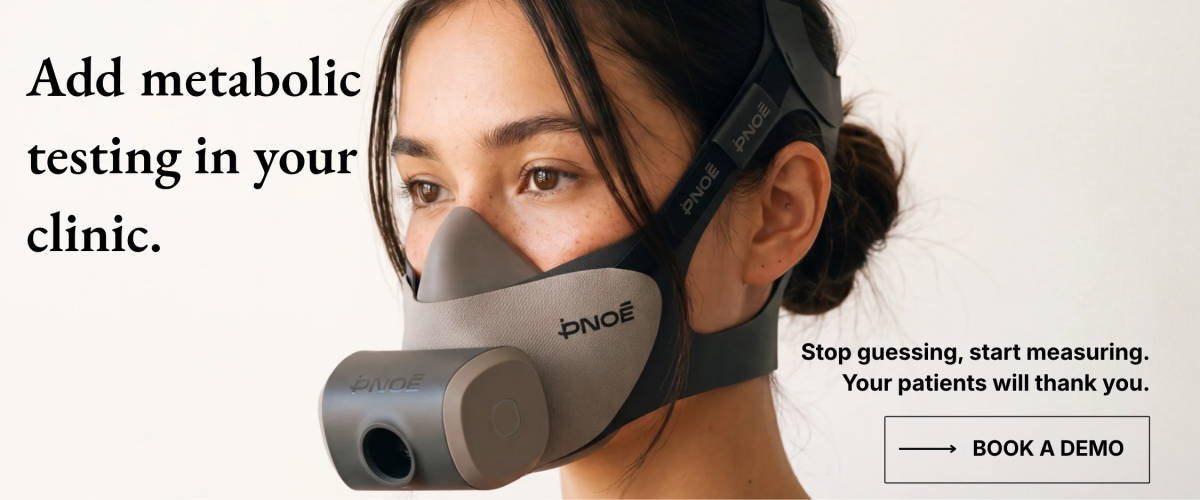
Instead of guessing from your pulse, breath analysis measures the oxygen your body consumes and the carbon dioxide it produces, breath by breath, during an 8-minute test. From that, it captures how your metabolism truly works across five systems: heart, lungs, brain, cells, and metabolism. A PNOĒ breath test measures:
- VO2 Max, directly measured rather than estimated, the strongest fitness-based predictor of longevity
- Resting metabolic rate, your baseline energy production
- Fat oxidation and metabolic flexibility, how efficiently your body switches between fuels
- Ventilatory thresholds, the precise zones for training
PNOĒ has been independently validated in a peer-reviewed study against a gold-standard laboratory metabolic cart, showing a 0.98 correlation. The result is not another score to worry about. It is a measurement, paired with a plan for what to do next.
The Bottom Line
Putting a number on your health is a good instinct, but only if the number is real. Most consumer scores are estimates built on proxies, and as the Gerontological Society of America warned, a precise-looking forecast can mislead as easily as it motivates. The way to measure your health is to measure what your body is actually doing, directly, starting with the metric that predicts longevity most powerfully: your VO2 Max. Measured through breath analysis, it comes with the context a wrist estimate never can.
Frequently Asked Questions
How do you actually measure your health?
You measure your health by capturing what your body is directly doing, rather than inferring it from a proxy. For metabolic and cardiorespiratory health, breath analysis (indirect calorimetry) is the gold-standard method: it measures the oxygen you use and the carbon dioxide you produce, breath by breath, rather than estimating from heart rate.
Is a health score from a wearable accurate?
Wearable health scores are useful for tracking trends but are estimates, not measurements. VO2 Max from a smartwatch, for example, can be off by well over 10% because it is inferred from heart rate and movement rather than measured from your breath.
What is the best single number to measure your health?
VO2 Max is among the most predictive single health measures. The American Heart Association calls cardiorespiratory fitness a clinical vital sign and a stronger predictor of mortality than smoking, high blood pressure, high cholesterol, or type 2 diabetes.
Why does a health number need context?
Because a number alone does not tell you what is driving it or what to change. The Gerontological Society of America warned that precise personal health forecasts can mislead or distress people. A measurement paired with context, such as what a VO2 Max result means and how to improve it, is far more useful than a score on its own.
References
- Gerontological Society of America, “Unit of Health: The Currency of Longevity” (November 2026): https://www.eurekalert.org/news-releases/1152108
- Ross R, Blair SN, Arena R, et al. “Importance of Assessing Cardiorespiratory Fitness in Clinical Practice: A Case for Fitness as a Clinical Vital Sign.” Circulation (2016): https://www.ahajournals.org/doi/full/10.1161/CIR.0000000000000461
- “Long-Term Effects of a 5-Year Randomized Controlled Exercise Trial on Brain Volumes and Cognitive Function in Older Adults: A 4-Year Post-Intervention Follow-Up Study.” Sports Medicine (2026): https://link.springer.com/article/10.1007/s40279-026-02434-3
- “Investigating the accuracy of Apple Watch VO2 max measurements: A validation study.” PLOS ONE (2025): https://journals.plos.org/plosone/article?id=10.1371/journal.pone.0323741
- Tsekouras YE, et al. “Validity and Reliability of the New Portable Metabolic Analyzer PNOE.” Frontiers in Sports and Active Living (2019): https://www.frontiersin.org/articles/10.3389/fspor.2019.00024/full
Related Posts
How to Use Your Health Data: From Metrics to a Plan
How Accurate Is a Metabolic Test? The Science Behind Breath Analysis

CGM vs Metabolic Testing: What’s the Difference?