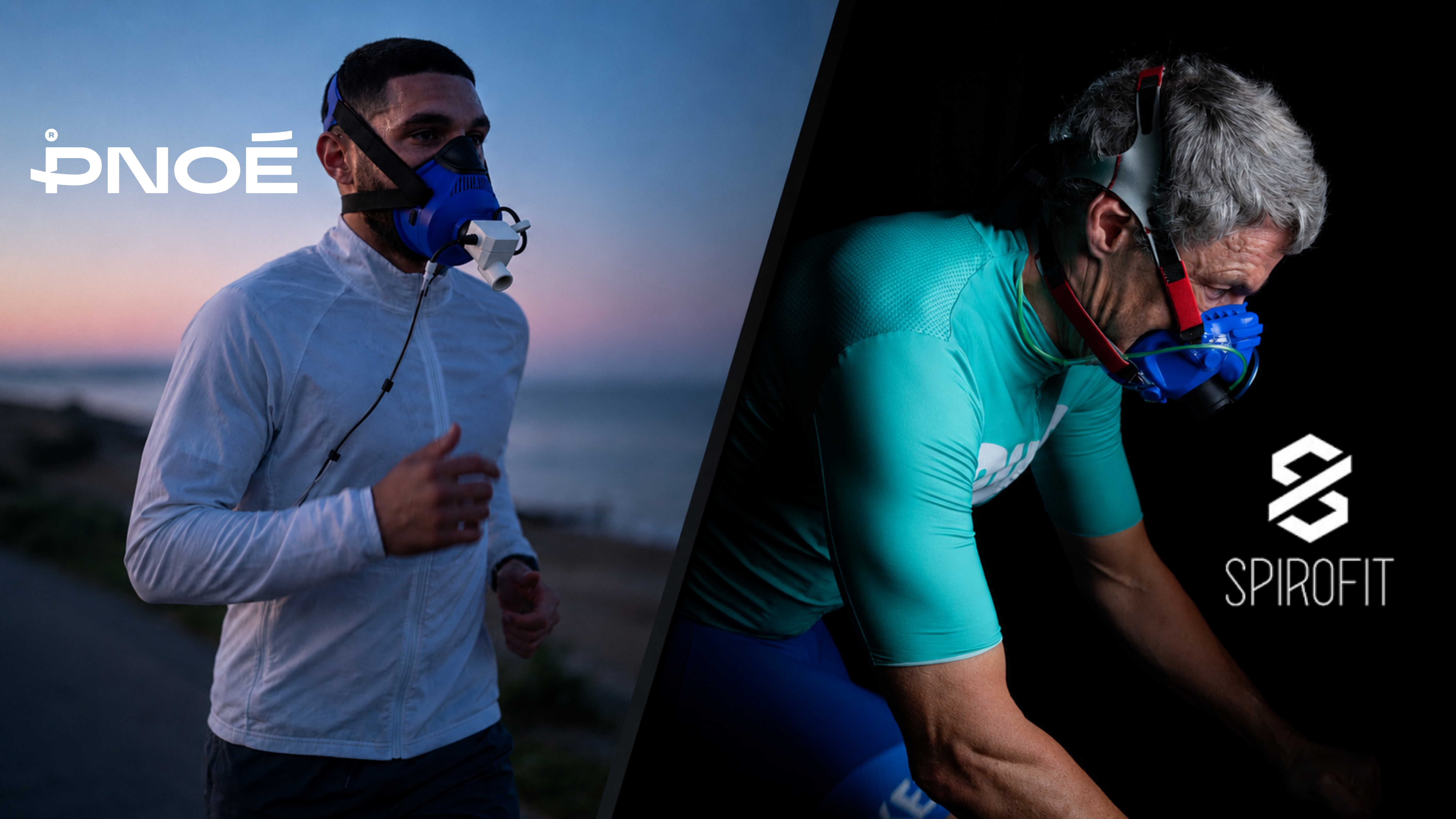
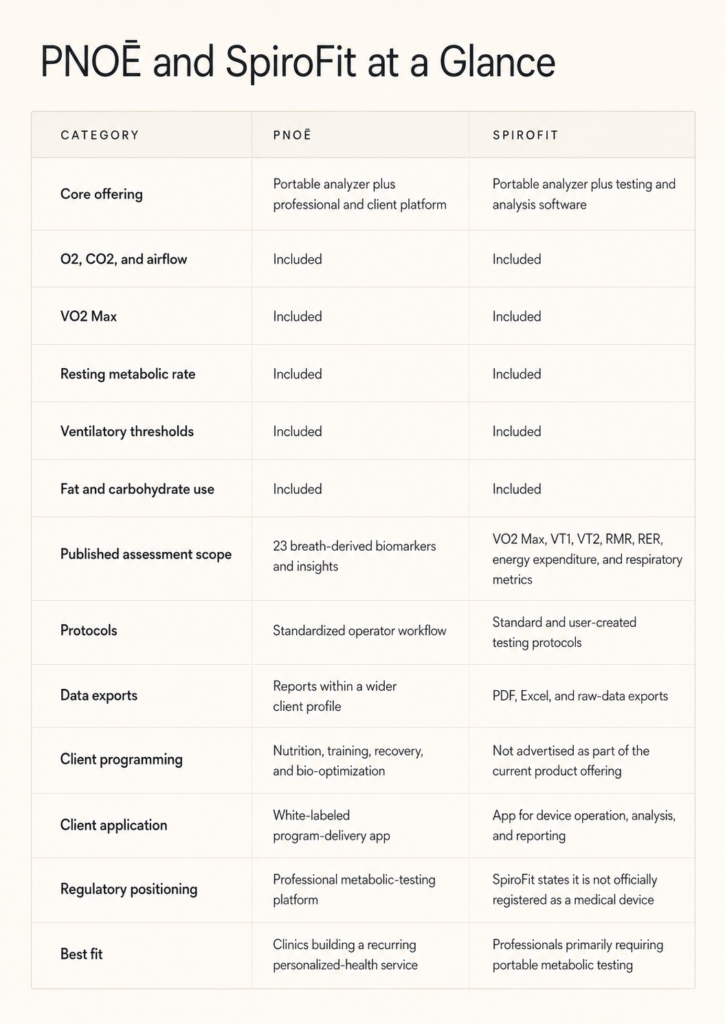
The PNOE vs SpiroFit comparison is close at the hardware level. Both systems are portable metabolic analyzers that measure oxygen consumption, carbon dioxide production, airflow, VO2 Max, resting metabolic rate, ventilatory thresholds, and substrate utilization.
The main difference is what happens after the assessment.
SpiroFit is designed primarily for professionals who want to perform metabolic tests, customize protocols, review results, and export reports or raw data. PNOĒ combines portable metabolic testing with a broader platform for interpretation, personalized nutrition and training, treatments, client monitoring, and retesting.
The practical difference: SpiroFit delivers a focused testing workflow. PNOĒ uses the assessment as the diagnostic entry point to an ongoing client program.
What Does PNOĒ Measure?
PNOĒ measures oxygen uptake, carbon dioxide production, ventilation, respiratory exchange ratio, and metabolic thresholds. The system interprets these measured signals collectively to generate 23 biomarkers and insights related to the lungs, heart, cells, metabolism, and biological aging.
The assessment can include:
- VO2 Max
- Resting metabolic rate
- Biological age
- Ventilatory thresholds
- Fat-versus-carbohydrate utilization
- Metabolic flexibility
- Respiratory efficiency
- Cardiovascular efficiency
- Oxygen pulse
- Recovery-related insights
PNOĒ’s assessment is designed to be completed in under ten minutes and to produce a standardized, client-facing interpretation rather than only raw gas-exchange outputs.
Both systems therefore measure meaningful metabolic variables. PNOĒ’s advantage is the system built around those measurements: interpretation, programming, service delivery, client engagement, and follow-up.
What Does SpiroFit Measure?
SpiroFit lists the following measurements and outputs:
- VO2 Max
- Resting metabolic rate
- VT1 and VT2
- Respiratory exchange ratio
- Fat-versus-carbohydrate use
- Energy expenditure
- Breathing frequency
- Tidal volume
- Heart rate
Users can run tests through the app, monitor data in real time, review historical results, and access reports through the cloud platform. SpiroFit also advertises custom testing protocols and data exports.
SpiroFit states that it is not officially registered as a medical device, although its website positions it for fitness, performance, professional, and selected rehabilitation applications.
Accuracy and Validation
SpiroFit does not publish one overall accuracy percentage for the complete analyzer. Its product page explains that real-world conditions vary and instead publishes individual sensor specifications:
- O2 static accuracy: ±0.15 volume percent
- CO2 static accuracy: ±0.1 volume percent
- Volume accuracy: ±3% at respiratory frequencies of 20–50 breaths per minute
SpiroFit states that its devices undergo factory testing and that the system uses ambient inhaled air as its reference, removing the need for an external calibration routine. Its FAQ also claims results comparable to laboratory analyzers. The official pages reviewed, however, do not link to a peer-reviewed human study validating the complete current analyzer.
That does not demonstrate that SpiroFit is inaccurate. It means its public evidence is currently presented primarily through manufacturer specifications and statements.
PNOĒ was evaluated in a peer-reviewed study against the COSMED Quark CPET.
The study included 22 participants and reported correlations of 0.98 for VO2, VCO2, and ventilation, and 0.91 for respiratory quotient. Researchers found no statistically significant differences between the devices for those variables and reported strong test-retest reliability.
Based on the publicly available evidence reviewed, PNOĒ provides the clearer whole-system human validation case.
Portability and Testing Workflow
SpiroFit attaches to the testing mask, connects through Bluetooth, and requires a smartphone or tablet and companion app for operation, data collection, visualization, and interpretation. The app is currently supported on iOS, while Android is described as planned for the future.
SpiroFit states that a standard test usually lasts 10–20 minutes and that the full process, including setup and cooldown, typically takes approximately 25 minutes.
PNOĒ is also body-worn, battery-powered, and wireless. Its validation study describes respiratory-gas and heart-rate data being transmitted during exercise. The current PNOĒ site positions the standard assessment as an under-ten-minute testing experience.
For professionals focused mainly on portable assessment, custom protocols, and raw-data access, SpiroFit provides the required testing tools.
For businesses focused on efficient client throughput and immediate delivery of actionable programs, PNOĒ’s workflow continues beyond the analyzer.
Software and What Happens After the Test
SpiroFit’s software supports the testing and analysis process. Practitioners can monitor tests, select or create protocols, review historical results, generate reports, and access cloud-based data. The company states that reporting is available through its platform without an additional platform charge.
The professional then determines how to translate the results into nutrition, training, recovery, treatments, or a continuing client service.
PNOĒ centralizes the metabolic assessment with other diagnostic and behavioral data. Its Health Dashboard can combine breath analysis with bloodwork, saliva, urine, stool, body composition, and wearables. The platform advertises support for more than 225 biomarkers across several physiological systems.
PNOĒ can then support:
- Personalized calorie and macronutrient targets
- Meal plans and grocery lists
- VO2-based cardiovascular training
- Strength, interval, mobility, and rehabilitation programs
- Breathwork and recovery
- Supplements and IV schedules
- Laboratory follow-ups
- Longevity and recovery services
- Retesting
The Logic Builder connects biomarker conditions to services the operator already offers and allows the business to define frequency, duration, and follow-up cadence.
The complete program can be delivered through a white-labeled client app under the practice’s own brand, combining biometrics, nutrition, training, recovery, and treatments in one calendar.
SpiroFit provides the test and its data. PNOĒ connects the test to what the client should do – and what the business should deliver – next.
Pricing and Commercial Model
SpiroFit currently lists pricing beginning at €5,495 net for its Principal Package. Buyers should verify current package contents and commercial terms directly because these can change.
PNOĒ is quoted according to the facility and selected package. Its commercial model includes more than hardware: professional software, reports, data integrations, personalized programs, the client app, follow-up workflows, and business infrastructure are part of the wider offering.
The prices are therefore not like-for-like. SpiroFit is a focused analyzer with testing software. PNOĒ is designed to operate a complete metabolic-testing and personalized-health service.

PNOE vs SpiroFit: Which Is the Better Fit?
SpiroFit may fit your business when:
You mainly require portable VO2 Max, RMR, threshold, and substrate-utilization testing. Your team has the expertise and separate systems required to interpret results, build programs, and manage follow-up.
You value custom test protocols, raw-data exports, and a transparent hardware purchase.
PNOĒ may fit your business when:
You want the assessment to begin an ongoing weight-management, longevity, rehabilitation, wellness, or performance program.
You need testing, interpretation, nutrition, training, treatments, client engagement, and retesting inside one connected system.

Frequently Asked Questions
Is PNOĒ independently validated?
Yes. PNOĒ was evaluated against COSMED Quark CPET in a peer-reviewed study involving 22 participants.
Is SpiroFit independently validated?
SpiroFit publishes sensor specifications and manufacturer statements about laboratory-comparable results. The official pages reviewed do not link to a peer-reviewed whole-system human validation study for the current analyzer.
Does SpiroFit generate nutrition or training plans?
SpiroFit advertises custom testing protocols, reports, historical analysis, and data exports. Its current public materials do not advertise an equivalent automated nutrition, training, treatment-planning, and white-labeled client ecosystem, like PNOĒ.
Yes. PNOĒ was evaluated against COSMED Quark CPET in a peer-reviewed study involving 22 participants.
SpiroFit publishes sensor specifications and manufacturer statements about laboratory-comparable results. The official pages reviewed do not link to a peer-reviewed whole-system human validation study for the current analyzer.
SpiroFit advertises custom testing protocols, reports, historical analysis, and data exports. Its current public materials do not advertise an equivalent automated nutrition, training, treatment-planning, and white-labeled client ecosystem, like PNOĒ.
The Bottom Line
SpiroFit is a portable metabolic analyzer for professionals who need testing, protocols, reports, and data access.
PNOĒ combines portable testing with peer-reviewed validation, multi-system interpretation, other diagnostic data, personalized programs, service recommendations, a branded client app, and retesting.
In the PNOE vs SpiroFit decision, the question is:
Do you need a focused portable analyzer – or a platform that turns each assessment into a complete client program?
For clinics and wellness businesses focused on personalization, retention, and delivering more than a one-time test, PNOĒ provides the more complete solution.
See how PNOĒ can fit into your business. Book a personalized demonstration.
Sources & References
Peer-reviewed PNOĒ validation study
https://spirofit.de/, https://spirofit.de/product/, https://spirofit.de/frequently-asked-questions/, https://spirofit.de/our-team/
Related Posts
PNOĒ vs CORTEX: Which Metabolic Device Is Right for Your Business? [2026]
PNOĒ vs COSMED: Which Metabolic Testing System to Choose? [2026]