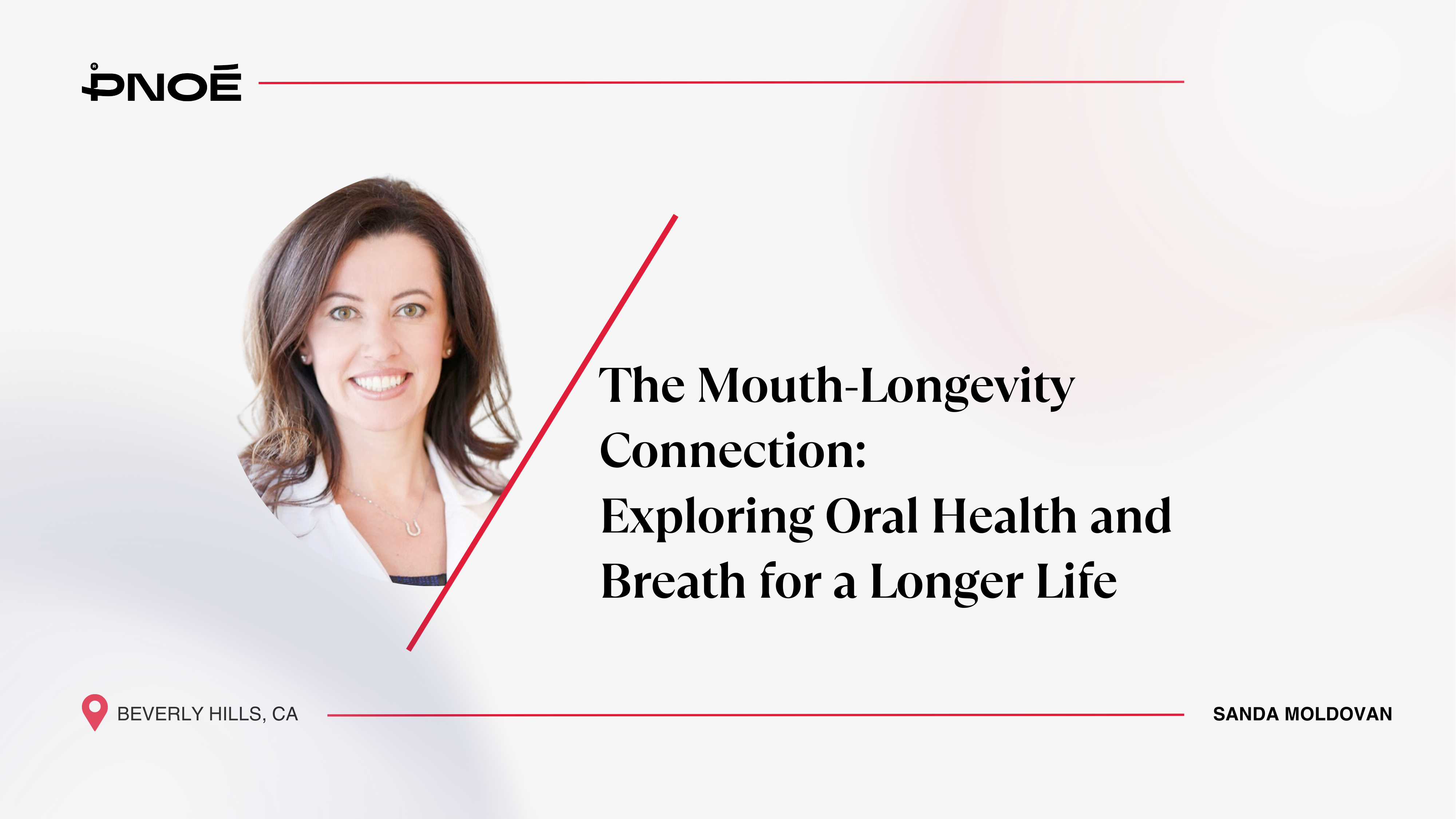
Welcome to this special edition of the PNOĒ Webinar Series, where leading clinicians and practitioners explore how objective health data and integrative care are shaping the future of prevention, performance, and longevity.
In this session, we examine an essential but often overlooked question: how does oral health influence whole-body health and long-term lifespan? What is the relationship between airway function, breathing mechanics, and the way the mouth and jaw develop over time? And how can dentists and health professionals use breath analysis and metabolic testing to better understand sleep-disordered breathing, including sleep apnea, and guide more comprehensive, personalized care?
If you’re looking for practical, evidence-led insights that can be applied in clinical practice and daily health routines, this webinar brings together key frameworks and actionable recommendations on airway-centered dentistry, myofunctional therapy, inflammation, and the oral-systemic link, supported by real-world experience using PNOĒ to evaluate breathing patterns and underlying physiology.
Unlock a deeper understanding of breathing and whole-body health with PNOĒ.
Learn how objective testing supports more precise decisions in integrative care and longevity-focused health strategies.
Follow PNOĒ on Instagram: @pnoe_analytics
Panos Papadiamantis:
Dr. Sanda, it is a pleasure to have you with us today. This webinar will focus on oral health and integrative dentistry. I’ll begin by providing a brief introduction and then invite you to expand on your work, including your experience using PNOĒ, and your broader clinical approach to integrative dental care.
Dr. Sanda Moldovan is a renowned integrative dentist who has been using PNOĒ for some time to assess breathing patterns, metabolic markers, and other indicators related to underlying health. She integrates these insights into a holistic care model that may include training, nutrition, breathwork, and evaluation of craniofacial development, specifically how craniofacial structure influences breathing, and how breathing patterns can, in turn, influence structural development.
This interaction is a central theme of today’s webinar. Dr. Moldovan, thank you again for joining us. The floor is yours. Please tell us about your background and clinical focus.
Dr. Sanda Moldovan:
Thank you, Panos. I appreciate the invitation and I’m glad to contribute. I became interested in PNOĒ primarily because of the number of sleep apnea patients in my practice. At Beverly Hills Dental Health and Wellness, we have three locations, and we see many patients with airway-related concerns.
One aspect I value about your equipment is that it is portable, which makes implementation more feasible in clinical settings. For patients with sleep apnea, I wanted better insight into airway function and breathing capacity. In our evaluations, we take a holistic approach looking at airway anatomy, lung capacity, tongue ties, palatal architecture, and structural factors that influence breathing.
We also use advanced laser technology to modify certain soft-tissue restrictions and help improve airway space. After treatment, I’m interested in retesting using PNOĒ to see how key breathing and physiology parameters change once the airway is improved.
Panos Papadiamantis:
This is an important application of breath analysis that many health professionals are not yet familiar with. From our side, given visibility across a very large number of tests conducted regularly, airway obstruction and respiratory-related challenges are among the most common issues we encounter.
In many cases, we identify a breathing abnormality and ask whether the individual has a known respiratory condition. A large portion respond that they do and sleep apnea is one of the most common conditions reported. Many are unaware that oral procedures and airway-focused dental interventions may meaningfully improve sleep-disordered breathing.
From your perspective, is this consistent with what you observe? Are patients generally aware of the interaction between oral development and breathing, or is this not well understood?
Dr. Sanda Moldovan:
Unfortunately, it is not well understood. I also believe sleep disorders are frequently undervalued in discussions of longevity and overall health. Sleep is increasingly discussed, but the clinical implications of sleep apnea are still not widely appreciated.
Many patients don’t understand that sleep apnea carries major risk. If someone has sleep apnea, the associated risk profile can be serious, including elevated cardiovascular and mortality risk. Many people view snoring as a minor issue and only seek help if it disrupts a partner.
The traditional pathway is often limited: a patient is referred to a sleep physician and placed on a CPAP machine if the apnea is moderate to severe. If symptoms improve, the root cause may remain unaddressed. In many cases, the condition is managed rather than resolved.
Breathing disorders affect a substantial portion of the population. Although it is more common in men, it is also common in women, and I see it in younger patients as well. I have treated patients in their 20s who snore, and I also see snoring in teenagers. In many cases, earlier intervention can be significantly more effective.
I’m fortunate to work closely with skilled myofunctional therapists who help improve jaw development, tongue posture, and muscle function throughout the oropharyngeal airway. This can materially improve breathing mechanics and respiratory capacity.
Panos Papadiamantis:
Something we frequently observe is a strong correlation between sleep apnea and nasal obstruction, such as chronic sinus issues or a deviated septum. Is that consistent with your clinical experience? Do you routinely evaluate nasal obstruction as part of your airway assessment?
Dr. Sanda Moldovan:
Yes, absolutely. If a patient is presenting for airway evaluation or sleep-related complaints, we must assess nasal breathing and obstruction, especially in individuals who report chronic mouth breathing.
Mouth breathing often begins due to nasal congestion, enlarged tonsils, or narrowing of the airway related to weight and tissue volume. We evaluate these contributors carefully because they affect both breathing mechanics and facial development.
Mouth breathers frequently develop a characteristic facial morphology. The jaw may be retruded and underdeveloped, and there is often what is referred to as “long-face syndrome.” You will also see postural changes, forward head posture, which is often the body’s attempt to compensate for restricted airflow.
These changes can affect the entire musculoskeletal chain, including the neck and spine. It is rarely isolated to the airway alone.
Panos Papadiamantis:
This aligns with the framework we attempt to reinforce in our reporting: breathing mechanics and posture are strongly interdependent. Poor breathing can drive poor posture, and poor posture can further impair breathing, creating a compounding cycle that contributes to airway restriction and, in some cases, progression toward sleep apnea.
From your perspective, what do you consider the most common upstream contributors to these airway issues? Some hypotheses include soft diets leading to underdevelopment of the jaw, increased allergic burden, nasal obstruction, and generalized deconditioning. What stands out most in your clinical experience?
Dr. Sanda Moldovan:
A common upstream factor is maxillary development, specifically the upper palate and the upper jaw. Research dating back many decades supports the observation that populations consuming more fibrous diets tend to have better developed jaws.
There is evidence that modern dietary patterns, with softer foods and reduced chewing demands, contribute to narrower arches and increased crowding. This can directly affect airway volume and nasal breathing.
It’s also important to emphasize that jaw development is not fixed. While early intervention is ideal, we can influence jaw shape and arch form throughout life, particularly through myofunctional therapy.
Myofunctional therapy is essentially oral physical therapy. It focuses on improving tongue posture, swallowing mechanics, and muscle function. Even simply restoring correct resting tongue position against the palate can support improved arch development.
Clinically, we see evidence of this change. For example, dental implants do not move, but teeth can. I have seen patients begin myofunctional therapy in their 50s, and over time spaces can open between teeth and implants. This reflects changes in arch form and jaw structure. Bone can remain responsive throughout life when appropriate forces and functional patterns are applied.
Chewing fibrous foods also creates mechanical stimulus. The bone receives the message that it must adapt to load, and this can support width and strength.
There is also an inflammation component. Diet influences mucosal inflammation, tonsillar hypertrophy, and nasal congestion. Many children become mouth breathers due to enlarged tonsils, which can be driven by allergens and inflammatory dietary exposures.
Panos Papadiamantis:
When patients undergo myofunctional therapy, what does that typically involve? How frequently is it performed, and in which cases do you recommend it?
Dr. Sanda Moldovan:
It is ideal to start early. Children as young as four can begin, particularly those who had difficulty breastfeeding, have swallowing challenges, mouth breathing, or other developmental concerns.
In adults, myofunctional therapy can be highly beneficial for clenching, migraines, and jaw tension. I have seen patients significantly reduce headaches and muscle tightness after therapy.
A critical component is identifying and addressing restrictive frenums, including tongue ties and lip ties. These tissue attachments can limit tongue mobility and affect resting posture, swallowing mechanics, and airway function.
As a periodontist, I frequently evaluate these restrictions. In some cases, releasing restrictive tissue can improve function and patients report easier breathing. Tongue ties, in particular, can contribute to airway restriction and are often part of a comprehensive sleep apnea protocol.
Panos Papadiamantis:
How can individuals identify these restrictions? Is there a way to self-screen at home?
Dr. Sanda Moldovan:
Yes. Individuals can do a basic self-check using a mirror and good lighting. Gently lift the upper lip and you will see tissue connecting the lip to the gums. If it feels like a tight band, that may indicate restriction. The same can be assessed for the lower lip.
For tongue ties, lift the tongue toward the roof of the mouth and observe whether there is a tight band restricting elevation or forward movement. If someone cannot place the tip of the tongue behind the upper teeth while opening the mouth, that can suggest significant restriction.
If someone observes these patterns, I recommend starting with a myofunctional therapist or consulting with an airway-trained provider who performs tongue tie evaluation and release when clinically indicated.
Panos Papadiamantis:
Is myofunctional therapy something that must be done in person, or can it be conducted remotely?
Dr. Sanda Moldovan:
Since COVID, many myofunctional therapists offer remote programs. Treatment often lasts four to six months, and in some cases up to a year depending on severity and whether surgical release is needed.
Patients typically meet with the therapist periodically, but the exercises are performed at home, usually daily. The therapist monitors progress and ensures correct movement patterns.
Panos Papadiamantis:
After intervention, whether myofunctional therapy, soft tissue treatment, or other airway-focused care, how soon do you typically see meaningful improvements in breathing?
Dr. Sanda Moldovan:
It varies by individual, but generally within three to six months. Muscle adaptation can occur relatively quickly.
Panos Papadiamantis:
That aligns well with retesting frequency. Many of our affiliates retest every three months, which is within that window.
Let’s return briefly to nutrition. Nutrition is frequently discussed as a driver of metabolic and cardiovascular health, but it is less commonly linked to airway anatomy and breathing. Beyond fibrous foods and chewing demand, are there other nutritional factors that influence breathing and oral inflammation?
Dr. Sanda Moldovan:
Yes. Diet-driven inflammation is a major factor. I appreciate that PNOĒ provides nutrition guidance aligned with the individual’s physiology and goals, because nutrition can influence airway inflammation, mucus production, and tonsillar hypertrophy.
In my clinical experience, dairy is a common trigger for many individuals, particularly due to intolerance patterns. It can contribute to increased mucus, nasal congestion, and enlarged tonsils. A2 dairy may be less problematic for some, but many remain sensitive.
In cases where I observe enlarged tonsils, I often review nutrition with the patient and commonly recommend reducing key inflammatory triggers, often dairy, gluten for some individuals, and excessive sugar. Sugar is particularly relevant because it influences inflammation and microbiome balance.
Personally, I dealt with chronic tonsillitis as a child and was repeatedly treated with antibiotics. Later, I had my tonsils removed. However, it was only after studying nutrition more deeply and changing my diet that I saw meaningful improvement in inflammatory response patterns.
Panos Papadiamantis:
Would you consider enlarged or inflamed tonsils a marker of systemic inflammation?
Dr. Sanda Moldovan:
In many cases, yes. As dentists, we have the advantage of frequent visibility into the oral cavity under strong lighting. It is common to see at least some degree of tonsillar inflammation. The tonsils are part of the immune system and react to microbial and inflammatory burden.
Patients with higher systemic inflammation often present with more inflamed tonsillar tissue. It is not the only indicator, but it can be a meaningful one.
Panos Papadiamantis:
You also mentioned white spots and tonsillar hygiene. Many people associate those only with acute infection. How should people interpret these signs?
Dr. Sanda Moldovan:
Tonsils have crypts, small channels where debris and bacteria can accumulate, similar to how plaque accumulates on teeth. This can form tonsil stones, which may calcify and contribute to chronic irritation and inflammation.
Regular gargling is an important component of oral hygiene that is often overlooked. It helps reduce tonsillar biofilm. I recommend gargling after brushing and flossing. Options include salt water, diluted hydrogen peroxide when appropriate, or ozonated water, ozone can be helpful for biofilm reduction.
It is also important to recognize that chronic oral infections, such as gum disease, infected root canals, or jawbone cavitations, can contribute to persistent tonsillar inflammation. If tonsillar redness persists despite improved hygiene, a comprehensive evaluation is warranted.
Panos Papadiamantis:
You referenced cone beam CT imaging. How is that different from a conventional scan?
Dr. Sanda Moldovan:
Cone beam CT is a dental-specific digital CT scan with significantly less radiation than many medical CT scans. It is designed to evaluate the teeth, jawbone, TMJ structures, and related anatomy. It provides critical insight into jawbone inflammation and dental pathology that may not be visible otherwise.
For longevity-focused care, I recommend that individuals with tooth extractions, root canals, or chronic oral symptoms consider a biological or integrative dental evaluation that includes cone beam imaging.
Panos Papadiamantis:
Let’s address gum disease and its broader implications. Gum disease is extremely common. How can it affect overall health, and what should people do about it?
Dr. Sanda Moldovan:
Gum disease is typically driven by biofilm, an overgrowth of microorganisms. This is influenced by stress, hormones, diet, and oral hygiene. The most common reason gum disease develops is inadequate cleaning between teeth.
Many people dislike string floss, but water flossing is an excellent alternative. There is strong evidence supporting its effectiveness, and for many patients it is more realistic and consistent. Gum disease often begins interdentally, where brushing alone cannot reach.
My core at-home recommendations are: brushing, water flossing, and a chewable oral probiotic. The oral microbiome is essential, and certain probiotics have evidence supporting reduced plaque and inflammation.
Panos Papadiamantis:
Beyond cardiovascular risk, what other major conditions are associated with gum disease and oral pathogens?
Dr. Sanda Moldovan:
There are multiple documented associations. These include increased cardiovascular risk, pregnancy complications including low birth weight, and links between specific pathogens and rheumatoid arthritis.
There are also associations with neuroinflammation, including Alzheimer’s disease, and emerging data on oral microbes crossing biological barriers. In older adults, oral bacteria can also contribute to lung infections, particularly when oral hygiene declines.
The broader point is that the mouth is not separate from the body. Oral microbes and inflammation can influence systemic health in meaningful ways.
Panos Papadiamantis:
This is an important reminder that small daily habits, brushing, flossing, hydration, and biofilm control, can have large downstream implications for health and longevity.
Before we close, is there anything else you would like to emphasize?
Dr. Sanda Moldovan:
I would encourage people to pay closer attention to oral health. When someone doesn’t feel well, they may seek medical evaluation and be told everything looks normal, yet they still feel poorly. The mouth can be a missing piece.
Start with practical, manageable habits: improved hydration, water flossing, and monitoring gum bleeding. The oral tissues regenerate quickly, and improvements can occur fast. Even small consistent changes can lead to meaningful outcomes.
Panos Papadiamantis:
Thank you, Dr. Moldovan. This has been an excellent and highly informative discussion. We’ll open the Q&A for any audience questions. For those watching the recording, this session will be available to share with colleagues and patients.
Thank you again for joining us today. We look forward to reconnecting soon.
Dr. Sanda Moldovan:
Thank you. It was my pleasure. For anyone interested in learning more, I host a podcast called The Holistic Dentistry Show, where we discuss oral health and its systemic connections. I look forward to future collaboration and to exploring more data on PNOĒ and oral health.
Panos Papadiamantis:
Excellent. We’ll be sure to share your podcast and additional resources with our audience. Thank you again.
Watch the full episode here.
Related Posts
Turning Breath Analysis into a Business Enabler for Chiropractic Clinics

PNOĒ & PEMF: A Powerful Combo for Physical Therapy Facilities